
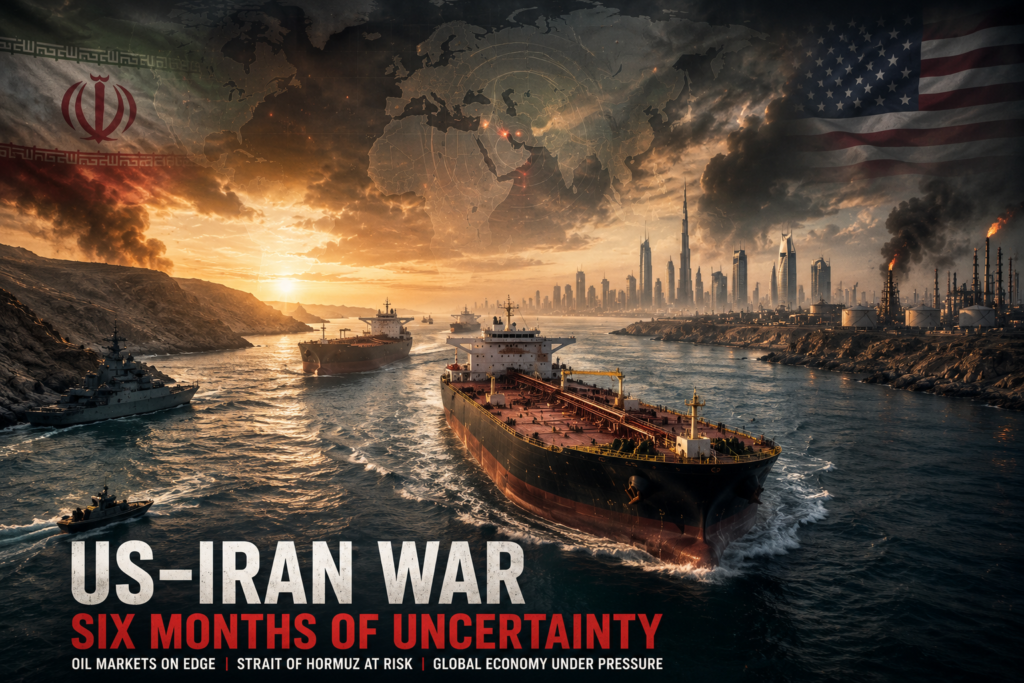
The Iran war has reached its six-month mark with no clear political settlement, transforming a conflict that was initially expected to last only weeks into a prolonged regional crisis. The war has disrupted shipping through the Strait of Hormuz, pushed global oil prices sharply higher and placed additional pressure on the economies of oil-importing countries, including Pakistan. It has also altered the strategic balance in the Middle East, tested US military commitments and created new uncertainty over Iran’s nuclear programme and the future of regional diplomacy.
How the USA-IranWar Began
The conflict began on February 28, 2026, when the United States and Israel launched a major military campaign against Iran, targeting its leadership, nuclear infrastructure and military capabilities. Iran responded with attacks on US assets and infrastructure across the Gulf, while the conflict expanded into Lebanon and other parts of the region.
The war quickly became more complicated than Washington initially anticipated. US President Donald Trump had predicted that the campaign would last roughly four to five weeks. Six months later, fighting, sanctions, blockades and diplomatic disputes continue, with no comprehensive peace agreement in place.
The scale of the conflict has been substantial. Data compiled by the Armed Conflict Location and Event Data project indicated that the United States and Israel had carried out more than 3,500 attacks on Iran, while Iran had conducted more than 2,000 attacks across the Gulf and wider Middle East during the first six months.
The human cost has also been severe. According to figures compiled from official sources, thousands of people have been killed across Iran, Lebanon, Israel and Gulf states, while the Pentagon has reported hundreds of wounded US personnel.
The Strait of Hormuz Became the World’s Biggest Energy Flashpoint
Perhaps the most important global consequence has been the disruption of the Strait of Hormuz, the narrow waterway linking the Persian Gulf with the Gulf of Oman.
Before the war, more than 100 ships passed through the strait each day, including large numbers of oil tankers. Traffic collapsed after Iran announced its closure of the waterway. Over the six-month period, an average of only about seven vessels a day passed through the strait, according to figures cited by Al Jazeera.
The disruption has had an immediate effect on energy markets.
Brent crude stood at about $72.48 per barrel when the conflict began but reached a peak of $120.88 on April 30, according to figures compiled for the six-month assessment. By August 28, Brent was around $88.58, still approximately 22% above its pre-war level.
The impact has extended beyond crude oil. Tanker operators have faced greater security risks, while shipping companies have had to consider insurance costs, alternative routes and the possibility of further attacks.
The International Maritime Organization had recorded 70 confirmed incidents involving ships in the Strait of Hormuz, resulting in 19 seafarer deaths, by August 26.
For the global economy, the lesson is clear: disruption at a single strategic waterway can quickly translate into higher energy costs, more expensive transportation and renewed inflationary pressure.
A New Strategic Reality for the Middle East
Six months of war have also exposed vulnerabilities in the existing security structure of the Middle East.
Gulf states have traditionally relied heavily on US military protection, but the conflict has forced regional governments to reassess how secure they are if tensions with Iran escalate. Saudi Arabia and other Gulf countries have increasingly looked at strengthening relationships beyond Washington, while Pakistan and Turkey have emerged as important regional security partners.
Iran, despite suffering major military and economic damage, has also demonstrated that it retains the ability to threaten regional infrastructure and influence energy markets.
The war has therefore not produced the decisive outcome that some of its architects initially expected. Instead, it has created a more complicated regional balance in which military power, economic pressure and control of strategic trade routes are closely connected.
Iran’s Nuclear Programme Remains a Major Question
Another major consequence concerns Iran’s nuclear programme.
US and Israeli strikes significantly damaged Iranian nuclear and military infrastructure, but determining the long-term effect has become more difficult because international inspectors do not have complete access to Iran’s facilities.
Reuters reported that the strikes have delayed Iran’s estimated ability to produce a nuclear weapon, with its potential breakout timeline assessed at around a year, but uncertainty remains because of limited inspection access.
This creates a major diplomatic problem. Military strikes can destroy facilities, but they cannot by themselves provide a permanent solution to concerns about Iran’s nuclear ambitions.
A durable agreement would require monitoring, verification and guarantees acceptable to both Tehran and Washington. As of late August, however, negotiations remain stalled and sanctions pressure continues.
The War Has Become an Economic Problem for the United States
The conflict has also become increasingly costly for Washington.
US Defense Secretary Pete Hegseth said in July that the war had cost approximately $37.5 billion, including military operations, maintenance, personnel and anticipated expenditure through the end of the US budget year. Other estimates cited by US media have placed the broader cost considerably higher when damage, replacement of weapons and equipment are included.
The war has also placed pressure on US military resources.
Long deployments, missile expenditure and the need to maintain forces across the Middle East have raised questions about how long Washington can sustain the current level of military activity without affecting its wider global commitments. Reuters noted concerns about military readiness as the conflict entered its sixth month.
Politically, the war has become increasingly difficult for the Trump administration. A Reuters/Ipsos poll conducted in August found that 33% of Americans approved of Trump’s performance, while 65% disapproved. The survey also found that 80% of Americans expected US involvement in Iran to continue for an extended period.
What the Iran War Means for Pakistan
Pakistan has a direct economic interest in how the conflict develops.
As a major importer of petroleum, Pakistan is vulnerable to higher international crude prices and shipping costs. A prolonged disruption around the Strait of Hormuz can increase the country’s import bill and place pressure on foreign-exchange reserves.
Higher global oil prices can also affect petrol and diesel prices, transport costs, electricity generation and the prices of goods transported across the country.
At the same time, Pakistan’s geographic position gives it an important diplomatic role. Islamabad was involved in mediation efforts that helped produce a June memorandum of understanding between the parties, although the broader diplomatic process has subsequently stalled.
For Pakistan, a lasting reduction in regional tensions would therefore have both economic and security benefits.
What Comes Next?
The next phase of the Iran war is likely to depend on whether diplomacy can replace military pressure.
The central issues remain Iran’s nuclear programme, sanctions, freedom of navigation through the Strait of Hormuz and the future of US military forces in the region.
A durable reopening of Hormuz could bring relief to oil markets and reduce the geopolitical premium built into crude prices. Failure of negotiations, renewed attacks or another major disruption to shipping could send prices higher again.
Six months after the first strikes, the conflict has demonstrated that modern wars do not remain confined to battlefields. They affect energy prices, shipping lanes, inflation, military budgets, domestic politics and international alliances.
The six-month Iran war has changed the strategic and economic landscape far beyond Iran and the United States. It has disrupted one of the world’s most important energy routes, pushed oil prices significantly above pre-war levels, strained US military resources and forced Middle Eastern countries to reconsider their security relationships.
For Pakistan, the most immediate concern is economic. Any prolonged disruption in the Strait of Hormuz could increase the cost of imported energy and place additional pressure on consumers and the country’s external finances.
The biggest uncertainty is whether the conflict remains a prolonged stalemate or moves towards a negotiated settlement. Six months of fighting have shown that military superiority alone has not produced a quick resolution. The next chapter may ultimately be decided not by another major airstrike, but by diplomacy, energy security and the ability of regional powers to find a sustainable way out of the crisis.