
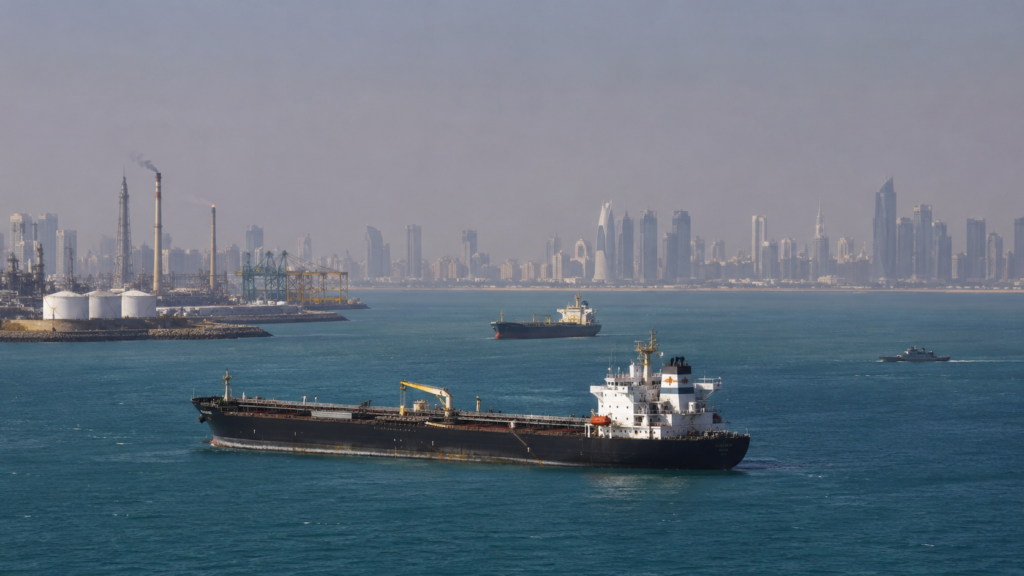
Iran is preparing conditions for reopening the Strait of Hormuz, a development that could influence global oil prices after months of disruption to one of the world’s most important energy routes. Iranian officials say ending the regional war, lifting restrictions on Iranian ports and easing economic pressure are among the issues linked to restoring maritime traffic. For Pakistan and other oil-importing economies, any sustained improvement in shipping could reduce pressure on crude prices, freight costs and domestic fuel markets.
What Is Iran Demanding to Reopen the Strait of Hormuz?
Iranian Supreme National Security Council secretary Mohsen Rezaei said Tehran was preparing a list of conditions for reopening the waterway after requests from mediators, according to Reuters. He said ending the regional war was one of Iran’s key requirements.
Iran has also been discussing a temporary shipping corridor with Oman. The proposed arrangement would establish a route through Iranian and Omani waters and include measures to clear sea mines, allowing commercial vessels to move more safely.
Reuters reported on August 28 that mediators were intensifying efforts to restore navigation. Qatar has also been involved in diplomatic efforts, with an emissary pressing Tehran to respect freedom of navigation. The talks indicate that reopening the strait is increasingly being treated as part of wider negotiations rather than simply a maritime-security issue.
Iran has previously linked reopening to broader concessions from the United States, including sanctions relief, compensation and the lifting of what Tehran describes as a blockade of its ports. Washington and Tehran remain far apart on several issues, so a complete and lasting reopening is not guaranteed.
The stakes are high. Before the conflict disrupted traffic, the Strait of Hormuz carried about one-fifth of global oil and liquefied natural gas flows. Even limited disruption can affect crude benchmarks, tanker rates, insurance costs and expectations about future energy supplies.
What Does It Mean for Global Oil Prices?
The immediate market reaction has shown how strongly oil traders are responding to developments around Hormuz. On August 28, Brent crude settled at $89.31 a barrel, while U.S. West Texas Intermediate closed at $83.40. Both benchmarks fell during the week, with Brent down more than 5% and WTI down more than 4%, as investors weighed expectations for increased shipping and other market factors.
The direction of oil prices will depend on whether the proposed arrangements produce reliable traffic. A credible reopening would remove part of the geopolitical risk premium that has kept traders concerned about supply disruptions. More tankers moving through the Gulf could also reduce bottlenecks and some transport costs.
However, a temporary corridor would not automatically restore the market to normal. Reuters reported that only seven commodity vessels transited the strait on Thursday, compared with 17 the previous day and a 10-day average of 15, based on preliminary Kpler data. The figures show traffic remains below normal levels and uncertainty continues.
For oil-importing countries, the difference between a temporary reopening and a durable settlement is crucial. If vessels can move consistently, refiners and traders can plan purchases with greater confidence. If traffic remains vulnerable to renewed fighting or political disputes, prices could rise again even if physical supply does not immediately collapse.
What Happens Next?
The key question is whether Iran’s conditions can become a practical agreement that guarantees safe and predictable navigation. Any announcement of a temporary corridor, mine-clearance arrangements or a broader ceasefire could put downward pressure on oil prices.
Conversely, stalled negotiations, renewed attacks or another sharp fall in tanker traffic could revive fears of supply shortages. Alternative export routes, emergency oil stocks and demand trends can cushion some impact but cannot fully replace a stable Strait of Hormuz.
A sustained reopening would be welcome news, but policymakers and consumers should not assume that lower global crude prices will immediately produce cheaper fuel at home. The most important development would be durable maritime traffic, reducing both physical supply risk and the uncertainty premium in energy markets.
Iran’s decision to prepare conditions for reopening the Strait of Hormuz marks an important diplomatic development, but it is not a guarantee that the waterway will return to normal operations. Global oil prices have already responded to signs of improving traffic and negotiations, with Brent remaining below $90 a barrel at the end of the week.
If Tehran, Oman, Qatar and the United States can reach arrangements that produce sustained freedom of navigation, global energy markets could see further relief. If talks fail, the strategic importance of Hormuz means oil prices could again face upward pressure. For Pakistan, the outcome matters directly because international crude prices feed into the country’s import bill and, ultimately, the cost of fuel and transportation.