
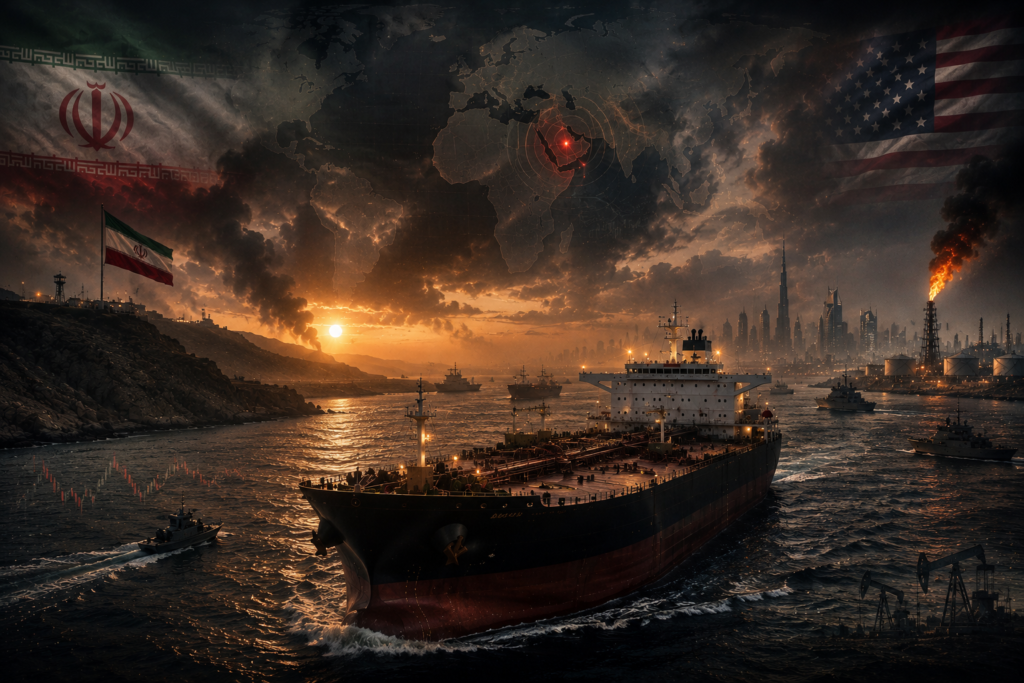
The six-month US-Iran war has left Gulf economies facing a difficult mix of higher energy prices, disrupted shipping and weaker investor confidence. The conflict has sharply reduced traffic through the Strait of Hormuz, the region’s main oil and gas export route, forcing Saudi Arabia, the UAE, Qatar, Kuwait, Bahrain and Oman to reassess economic plans built around stability and global investment. For Pakistan, the Gulf’s economic health matters because the region is a major source of remittances, investment, trade and energy supplies.
The conflict began on February 28, 2026, when the United States and Israel launched strikes on Iran. Six months later, the confrontation has evolved into a prolonged standoff in which control and access to the Strait of Hormuz have become central to the economic consequences.
Why Gulf Economies Are Under Pressure
The immediate problem is not simply the price of oil. It is the ability to export it.
The Strait of Hormuz carries roughly a fifth of global oil and liquefied natural gas supplies. Disruptions have sharply reduced commercial traffic and raised shipping, insurance and security costs. Reuters reported that Brent crude was around $90 a barrel in late August, roughly 25% above its pre-war level, although prices have been restrained by global inventories, increased production outside the Gulf and weaker Chinese imports.
For Gulf producers, higher oil prices provide some support to government revenues, but that benefit is being offset by lower export volumes and more expensive logistics. A July Reuters poll of economists found that most Gulf economies were expected to contract more sharply in 2026 than previously forecast.
Kuwait and Qatar faced the largest forecast downgrades. Both were expected to contract 8.1% in 2026, compared with earlier forecasts of contractions of 4.4% and 6.0%, respectively. Bahrain was forecast to shrink 5.1%, while the UAE was expected to contract 0.5%.
Saudi Arabia and Oman were exceptions. Saudi Arabia can move some oil through its East-West pipeline to the Red Sea, while Oman’s export terminal is outside the Strait of Hormuz. The Reuters poll projected Saudi Arabia to grow 1.4% this year and Oman 3.1%.
These differences show why infrastructure has become an increasingly important part of Gulf economic policy. Countries with alternative export routes have greater room to absorb a prolonged disruption.
Oil Wealth Is No Longer Enough
The war is testing a major economic strategy pursued by Gulf governments for years: reducing dependence on oil.
Saudi Arabia, the UAE and Qatar have invested heavily in tourism, logistics, aviation, finance, technology and real estate. These sectors were designed to provide new sources of growth and make Gulf economies less vulnerable to oil-price cycles.
But the conflict has demonstrated that non-oil industries are not insulated from regional instability.
Tourism can suffer when visitors perceive the region as unsafe. Aviation is vulnerable to airspace restrictions. Logistics businesses depend on reliable shipping routes, while investors may delay projects when geopolitical risks rise.
The July Reuters survey found that economists were concerned about a higher long-term geopolitical risk premium. That means investors could demand greater returns before committing capital to Gulf projects, potentially increasing financing costs and slowing investment even after the immediate crisis ends.
Inflation has so far remained relatively contained compared with the scale of the disruption. Reuters’ median forecasts put 2026 inflation at 2.1% in Saudi Arabia, 2.9% in the UAE, 2.7% in Kuwait, 3.2% in Qatar, 2.5% in Oman and 1.9% in Bahrain. Dollar pegs, subsidies, price controls and fiscal buffers have helped absorb some of the higher freight and insurance costs.
But prolonged disruption could make those protections more expensive to maintain.
Shipping and LNG Add to the Risk
The Strait of Hormuz crisis extends beyond crude oil.
Qatar is particularly exposed because it is a major liquefied natural gas exporter. Disruptions to shipping can affect LNG deliveries, contracts and European and Asian energy markets. Gulf economies also depend on imports of food, machinery, construction materials and other goods, meaning shipping disruption can increase costs across the wider economy.
The International Maritime Organization said on August 28 that up to 400 ships carrying around 6,000 seafarers had been unable to depart safely from the region since the conflict began. It warned that disruption to supplies of fuels, fertilisers and other commodities was affecting economies and communities worldwide.
For Gulf states, the security of maritime routes has therefore become an economic priority, not only a military concern.
What Happens Next?
The Gulf economies are likely to remain sensitive to developments around the Strait of Hormuz for as long as the conflict continues.
Reuters economists expected a strong rebound in 2027 if tensions ease and shipping gradually returns to normal. Forecasts put 2027 growth at 10.1% for Kuwait, 7.8% for Qatar, 6.0% for Saudi Arabia, 5.8% for the UAE, 4.5% for Bahrain and 2.8% for Oman.
Those forecasts highlight the central assumption behind the Gulf economic outlook: that the disruption will eventually ease.
If maritime traffic normalises, Gulf oil and gas exports could recover and investment confidence could improve. If the conflict remains unresolved, governments may have to spend more on security, infrastructure and alternative export routes while accepting slower growth.
Six months of the US-Iran war have shown that Gulf economies remain vulnerable even after years of diversification and investment. Higher oil prices have offered some protection, but they cannot fully compensate for lost export volumes, disrupted shipping, higher insurance costs and increased geopolitical risk.
Saudi Arabia and Oman have benefited from alternative export routes, while Kuwait, Qatar, Bahrain and the UAE face greater exposure to the disruption. The longer the conflict continues, the more important resilient ports, pipelines, diversified trade routes and stable investment conditions will become.
For Pakistan, the stakes are also significant. A prolonged Gulf crisis could affect oil costs, remittances, employment and investment. A durable diplomatic settlement and restoration of safe navigation through the Strait of Hormuz would therefore bring benefits far beyond the Gulf, offering relief to energy-importing economies and reducing uncertainty across global markets.