
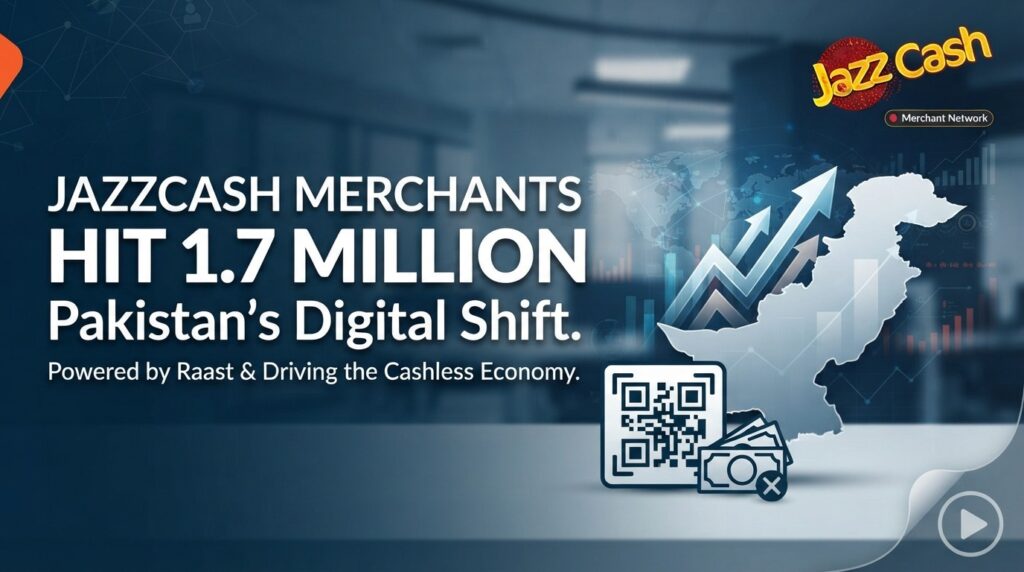
Pakistan’s digital payments landscape is gaining momentum as JazzCash expands its merchant network to 1.7 million Raast-enabled QR merchants, strengthening the role of digital payments in everyday commerce. The milestone comes as the government pushes to increase merchant adoption, document economic activity and reduce reliance on cash. Jazz Cash says its network grew from about 900,000 merchants in January to 1.7 million by July, while QR payments through the network now approach Rs150 billion a month on average.
JazzCash Merchant Network Reaches 1.7 Million
JazzCash has onboarded 1.7 million merchants onto the State Bank of Pakistan’s interoperable Raast QR network, according to a September 5 report by Business Recorder. The company is targeting 2 million digital merchants by the end of 2026.
Aamir Aftab, Chief Product Officer at JazzCash, said the network increased from around 900,000 merchants in January to 1.7 million by July, nearly doubling in six months. The company’s QR network now moves close to Rs150 billion in payments each month on average.
The expansion places JazzCash at the centre of Pakistan’s drive to widen digital payment acceptance among shops, retailers, micro-entrepreneurs and other small businesses. QR-based payments give merchants an alternative to handling physical cash while creating digital records of transactions.
What Is JazzCash Raast QR?
Raast is Pakistan’s national instant payment system, launched by the State Bank of Pakistan in 2021. Its interoperable structure allows customers to make digital payments through participating bank apps and wallets, while merchants can accept payments through Raast-enabled services.
JazzCash says its Raast QR service allows businesses to accept payments from customers using participating bank apps or wallets. Funds are credited to the merchant’s JazzCash Business account in real time, and QR acceptance does not require additional payment hardware.
The State Bank has encouraged financial institutions and payment providers to expand Raast merchant acceptance as part of Pakistan’s cashless economy push. In September 2025, the central bank announced a Rs3.5 billion government-supported subsidy framework for Raast person-to-merchant QR transactions covering the period from September 2025 to June 2026.
Digital Payments in Pakistan Are Expanding
The growth in JazzCash merchants comes against a wider increase in digital transactions in Pakistan. The State Bank’s Retail Payments Review for the second quarter of fiscal year 2026 reported 3.4 billion retail payment transactions during October-December 2025, up 8% from the previous quarter.
Digital channels accounted for 92% of those transactions, while over-the-counter channels represented 8%. The central bank also reported 1.9 million QR-enabled stores and 2.1 million merchants registered on Raast’s person-to-merchant platform during the quarter, while noting that the latter figure may not represent fully operational merchants.
The figures show that QR payments Pakistan is becoming a more established part of the country’s payment infrastructure. For consumers, QR payments can reduce the need to carry cash and allow transactions through mobile banking apps or digital wallets.
How JazzCash Business Accounts Support Merchants
The growth of JazzCash merchant accounts is linked to the company’s broader business-payment services. JazzCash offers a Business account for merchants and businesses, with payment acceptance through QR/Raast, an online payment gateway and Tap on Phone services.
Its Raast QR service allows merchants to receive payments from participating bank apps or wallets. JazzCash says the service provides real-time settlement and can reduce the risks and inconvenience associated with cash handling.
The company has also taken digital payments into local marketplaces. In April 2026, JazzCash and Mobilink Bank launched a cashless bazaar initiative in Rawalpindi’s Chaklala Scheme-III, covering 900 shops and carts. Raast-enabled QR codes were introduced across the bazaar, while participating retailers could access Business Plus accounts and other financial services.
What Comes Next for JazzCash Merchants?
JazzCash’s target of reaching 2 million digital merchants by the end of 2026 indicates that the company expects merchant adoption to continue expanding. The sharp increase from January to July shows strong momentum, but maintaining active usage will be as important as increasing registrations.
For Pakistan, the broader significance is the shift from cash-only transactions towards interoperable digital payments. Raast provides national infrastructure, while banks, fintech companies and payment providers bring that infrastructure into everyday commerce.
- JazzCash’s Raast-enabled merchant network reached 1.7 million by July 2026.
- The network grew from around 900,000 merchants in January to 1.7 million by July.
- JazzCash is targeting 2 million digital merchants by the end of 2026.
- QR payments through the network approach Rs150 billion per month on average.
- Pakistan recorded 3.4 billion retail payment transactions in October-December 2025.
- Digital channels accounted for 92% of retail payment transactions in the State Bank’s Q2 FY26 review.
The government allocated Rs3.5 billion for Raast P2M QR subsidies covering September 2025 to June 2026
The expansion of JazzCash merchants to 1.7 million marks a notable development in Pakistan’s digital payments journey. As Raast QR adoption grows and more businesses begin accepting electronic payments, the country is building infrastructure for a broader digital economy. The challenge now is to turn merchant onboarding into sustained usage and make digital payments accessible and practical across Pakistan’s diverse retail sector