
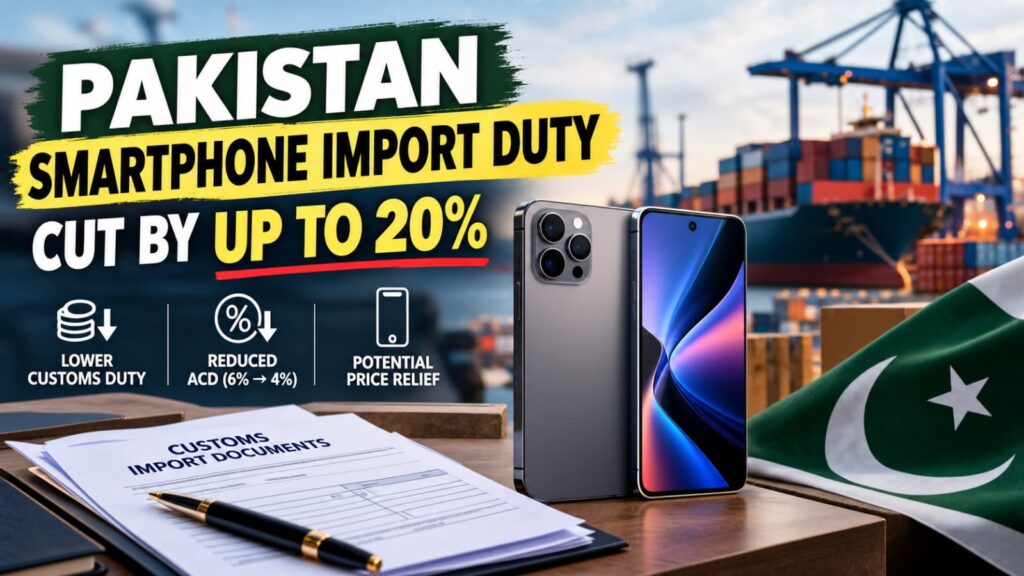
Pakistan has reduced regulatory duty and additional customs duty on imported mobile phones under the revised FY2026-27 tariff structure. The biggest reduction applies to premium smartphones priced above $500, where regulatory duty has fallen from Rs22,000 to Rs17,600 per handset. The move could ease costs for importers and create room for lower smartphone prices, although the final retail impact will depend on other taxes, exchange rates and market conditions.
- Regulatory duty on CBU smartphones above $500 has been reduced by Rs4,400 per handset, or 20%.
- Additional Customs Duty (ACD) on listed smartphone and cellular-phone categories has fallen from 6% to 4%.
- New CBU regulatory duty slabs range from Rs240 for phones priced up to $30 to Rs17,600 for devices above $500.
- For smartphones and cellular phones imported in CKD/SKD condition, regulatory duty has been reduced from 5% to 4%.
- The changes form part of wider tariff rationalisation under the National Tariff Policy 2025-30.
Pakistan Smartphone Import Duty Reduction
According to a Ministry of Commerce brief reported by Business Recorder, the revised tariff structure applies for FY2026-27 and reduces regulatory and additional customs duties on relevant mobile-phone categories.
For completely built-up (CBU) smartphones, regulatory duty is now linked to the device’s customs-value category. Phones priced up to $30 face an RD of Rs240, down from Rs300. The $30-$100 category has fallen from Rs3,000 to Rs2,400, while the $100-$200 category has dropped from Rs7,500 to Rs6,000.
For phones valued between $200 and $350, RD has been reduced from Rs11,000 to Rs8,800. Devices in the $350-$500 range now carry Rs12,000, compared with Rs15,000 previously. For smartphones above $500, the charge has dropped from Rs22,000 to Rs17,600.
The Rs4,400 reduction in the highest category represents a 20% cut in regulatory duty. However, this does not mean the retail price of an imported smartphone will automatically fall by 20%, because regulatory duty is only one component of the total tax and cost structure.
Additional Customs Duty Also Reduced
The government has also reduced Additional Customs Duty on the listed smartphone and cellular-phone categories from 6% to 4%.
For smartphones and cellular phones imported in completely knocked down (CKD) or semi-knocked down (SKD) condition, regulatory duty has been reduced from 5% to 4%, while ACD has fallen from 6% to 4%.
The change is significant for Pakistan’s mobile phone industry, which includes domestic assembly operations as well as imports of finished devices. Tariff changes can affect the relative cost of imported handsets, components and locally assembled phones.
What Does the Duty Cut Mean for Smartphone Prices in Pakistan?
For a premium imported smartphone above $500, the regulatory-duty saving alone is Rs4,400 per handset. A distributor or retailer may pass some or all of that saving to consumers, but the final price also depends on other customs duties, sales tax, income or withholding taxes where applicable, customs valuation, freight, exchange rates and retail margins.
The impact could differ between brands and models. But there is no basis to say that every imported smartphone will become 20% cheaper.
Pakistan Smartphone Market Sees Higher Import Value
The tariff changes come after a rise in the value of Pakistan’s mobile-phone imports. Business Recorder, citing the Commerce Ministry, reported that imports of smartphones and cellular phones increased from $1.497 billion in FY2024-25 to $1.888 billion in FY2025-26. CBU smartphone imports reportedly more than doubled to $357.7 million.
Pakistan Customs, however, has separately clarified that the higher import value should not be treated as a simple surge in finished-phone imports. In an official July 2026 clarification, Pakistan Customs said around 32 million mobile phones were imported in FY2025-26, compared with about 33 million units in FY2024-25. It said total import value across mobile-phone categories reached about Rs520 billion, compared with Rs427 billion a year earlier, with much of the trade reflecting inputs used by Pakistan’s domestic assembly industry.
Why the Government Changed Smartphone Tariffs
The tariff cuts are part of a broader effort to rationalise Pakistan’s customs structure under the National Tariff Policy 2025-30. FBR’s FY2026-27 budget documents say regulatory duties between 2.5% and 20% were subject to a 20% reduction across 1,347 tariff lines, while other RD rates were also revised.
The Mobile Device Manufacturing Policy 2020-25 has expired, according to the Commerce Ministry brief cited by Business Recorder. However, incentives available to manufacturers and assemblers remain protected under the Fifth Schedule to the Customs Act, 1969, until further policy decisions.
What Pakistani Consumers Should Expect
The new Pakistan mobile phone import taxes do not guarantee an immediate nationwide fall in retail prices. Buyers should compare prices and check whether sellers have actually passed on any reduction.
For premium phones, the Rs4,400 reduction in regulatory duty is more significant in absolute terms. For cheaper devices, the rupee saving is smaller, although their revised RD slabs also represent a 20% reduction.
Pakistan’s latest smartphone tariff changes provide a targeted reduction in the duty burden on imported mobile phones, with premium devices receiving the largest fixed saving of Rs4,400 per handset. The measures may support competition and provide some room for lower prices, but consumers should not expect every phone to become 20% cheaper. The actual benefit will depend on the wider tax structure, exchange rates, import costs and how much of the saving businesses pass on.