
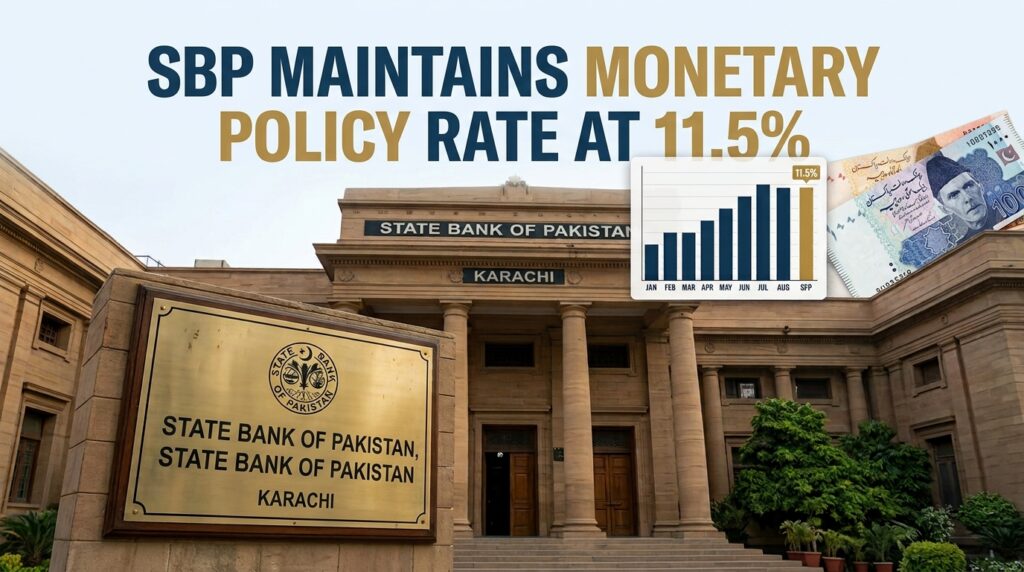
The Monetary Policy Committee (MPC) of the State Bank of Pakistan (SBP) has decided to keep the policy rate unchanged at 11.5 percent. The central bank cited ongoing fluctuations in international commodity prices alongside gradual moderation in domestic headline inflation. SBP officials emphasized that the current monetary stance remains aligned with achieving medium-term price stability while protecting external financial buffers
Monetary Policy Highlights
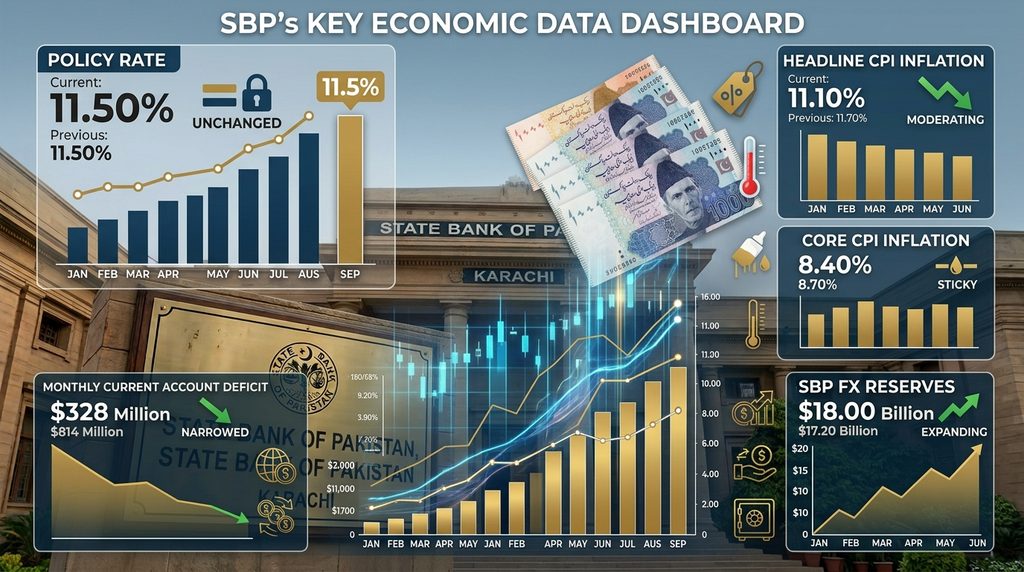
- Key Policy Rate: Maintained at 11.5 percent by the Monetary Policy Committee.
- Inflation Trajectory: Headline consumer price index (CPI) inflation eased to 11.1 percent year-on-year, while core inflation remained near 8.4 percent.
- Current Account Deficit: Registered at $328 million (Rs 32.80 crore) in July 2026, down from $814 million recorded in June.
- Foreign Exchange Reserves: Gross official reserves held by the SBP reached $18 billion, supported by multilateral disbursements and bilateral inflows.
- Private Sector Credit: Credit growth registered a 14.9 percent expansion year-on-year, driven by working capital demands and industrial financing.
Central Bank Prioritizes Economic Stabilization Over Immediate Rate Cuts
The decision to maintain the policy rate at 11.5 percent follows consecutive pauses by the MPC as policymakers evaluate volatile energy markets and regional geopolitical friction. While business associations have continued to advocate for monetary easing to lower borrowing costs, central bank officials noted that premature rate cuts could trigger foreign exchange pressure and undermine anti-inflation gains.
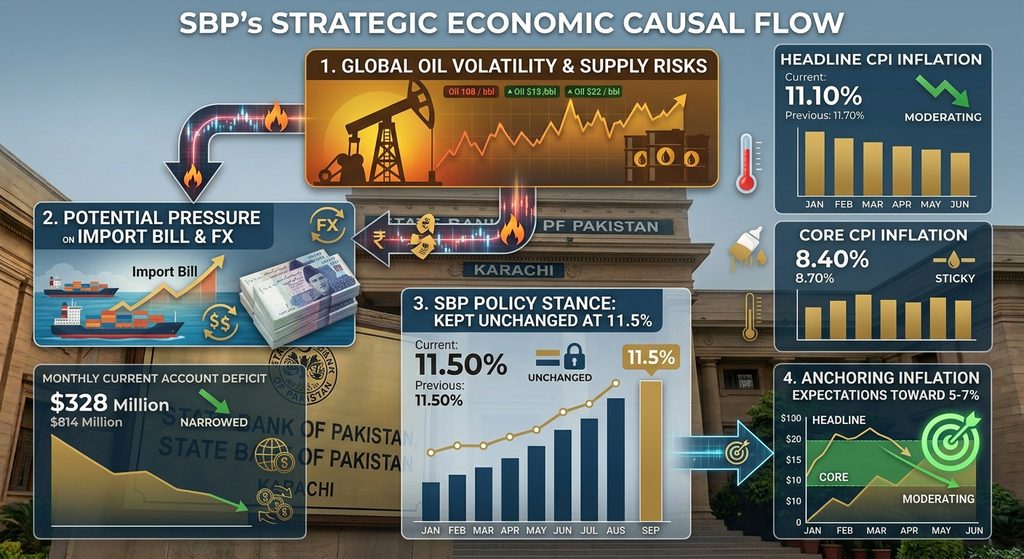
The MPC noted that while domestic demand remains moderate, geopolitical events in the Middle East have driven crude oil futures back above $100 per barrel. Because energy imports constitute a major share of Pakistan’s import bill, maintaining higher domestic yields acts as a safeguard against imported inflationary pressures
Balance of Payments and Fiscal Discipline Keep Stance Tight
Pakistan’s external position showed signs of stabilization entering the new fiscal year. The current account deficit narrowed sharply to $328 million in July 2026, supported by steady worker remittances and controlled non-essential imports
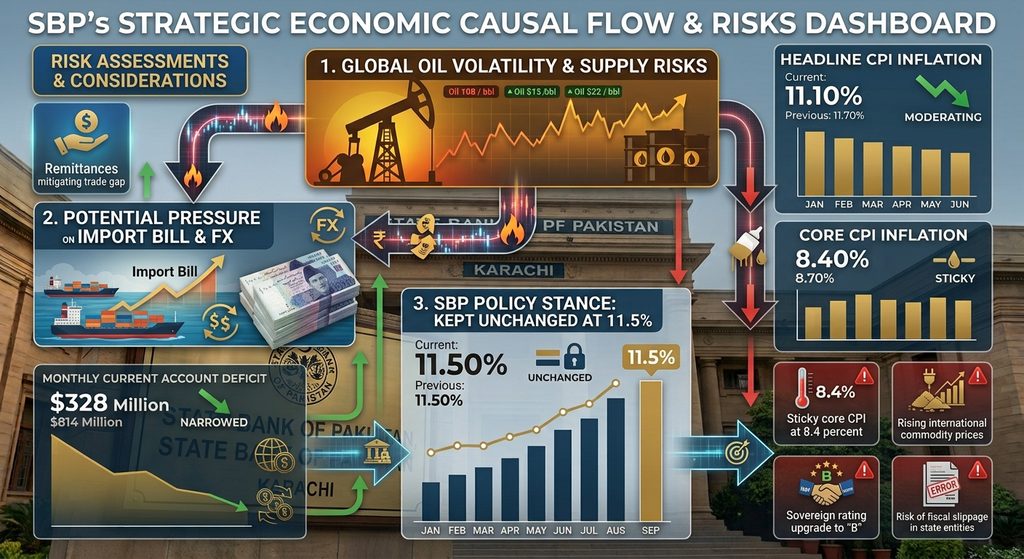
- Remittance Flows: Strong inflows from overseas Pakistanis continue to offset trade imbalances, helping support the foreign exchange reserves cushion.
- Fiscal Consolidation: Total tax revenue collection by the Federal Board of Revenue (FBR) met adjusted benchmarks, reinforcing the government’s target of achieving a primary balance surplus.
- Private Sector Financing: Commercial bank lending to the private sector grew 14.9 percent year-on-year, indicating that industrial liquidity is gradually recovering under current monetary settings.
Outlook: Path Toward Medium-Term Inflation Targets
The SBP’s policy statement maintained its long-term objective of guiding headline inflation toward the target range of 5.0 to 7.0 percent over the medium term. However, board members acknowledged several short-term headwinds, including potential adjustments in utility tariffs, supply-chain interruptions, and agricultural crop yields.
Financial market participants anticipate that the central bank will keep monetary settings tight until global crude oil prices stabilize and official foreign exchange reserves rise toward $20 billion. Any future policy shift will depend on upcoming inflation data, trade deficit figures, and international financial market developments.
By keeping the policy rate at 11.5 percent, the State Bank of Pakistan has reaffirmed its commitment to price stability and economic consolidation. While local industries continue to push for lower borrowing rates, central bank leadership remains focused on managing international commodity shocks and protecting national balance-of-payments reserves.