
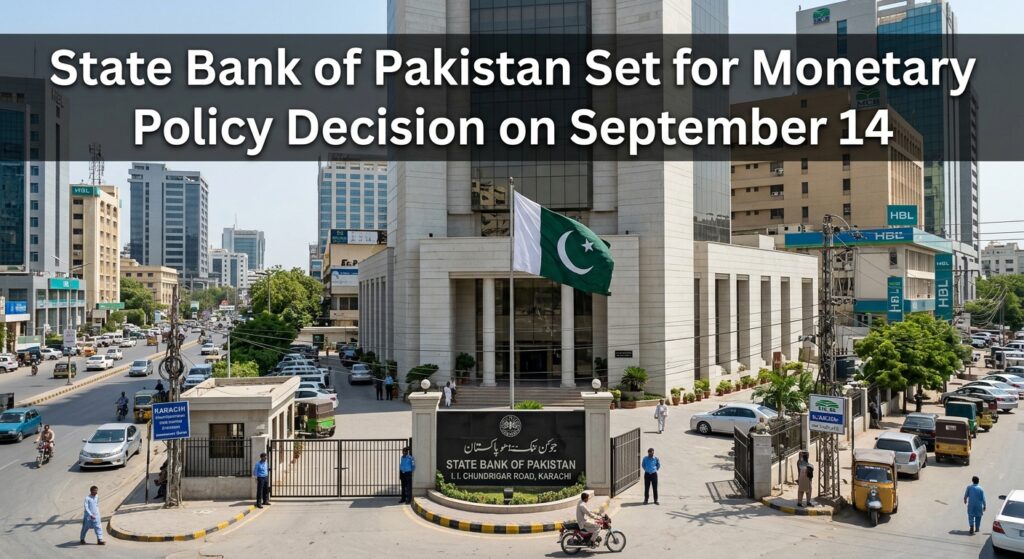
The Monetary Policy Committee (MPC) of the State Bank of Pakistan (SBP) is scheduled to convene on Monday, September 14, 2026, to determine the country’s benchmark policy rate. Financial markets and economic analysts broadly anticipate that the central bank will maintain its hawkish stance and hold the key interest rate unchanged at 11.50%. The upcoming monetary policy decision comes at a critical juncture as policymakers evaluate persistent inflationary pressures alongside ongoing economic stabilization measures under Pakistan’s broader macroeconomic framework.
- Announcement Date: Monday, September 14, 2026.
- Current Policy Rate: 11.50% per annum (held steady since June 2024).
- Market Consensus: Policy rate expected to remain UNCHANGED at 11.50%.
- Latest CPI Inflation: August 2026 headline inflation rose to 11.10% year-on-year.
- SBP Medium-Term Target: Inflation target range of 5.0% to 7.0%.
- Interest Rate Corridor: Standing Reverse Repo (Ceiling) at 12.50%; Standing Repo (Floor) at 10.50%.
- Impacted Sectors: Banking (HBL, UBL, MEBL), Autos, Cement, Real Estate, Oil & Gas (PPL, OGDC, PSO), Fertilizer (DGKC, HUBC).
Market Consensus Points to Policy Rate Pause at 11.50%
The State Bank of Pakistan last adjusted its benchmark rate during its summer reviews, establishing a baseline policy rate of 11.50% per annum. As the MPC prepares for its September 14 meeting, a overwhelming majority of institutional investors, brokerage houses, and treasury managers project that the central bank will opt for status quo.
The primary catalyst supporting an interest rate pause is the trajectory of consumer price inflation. According to data published by the Pakistan Bureau of Statistics (PBS), national Consumer Price Index (CPI) headline inflation accelerated to 11.10% year-on-year in August 2026, rebounding from 9.20% in July. With annual inflation lingering near the baseline interest rate level, real interest rates remain marginally positive, providing the central bank with structural justification to maintain current borrowing costs.
| Indicator / Parameter | Current Level / Status | Target / Horizon |
| SBP Policy Rate | 11.50% p.a. | Subject to MPC Review |
| August 2026 CPI Inflation | 11.10% YoY | SBP Target: 5.0% – 7.0% |
| SBP Reverse Repo (Ceiling) | 12.50% p.a. | Corridor (+100 bps) |
| SBP Repo Rate (Floor) | 10.50% p.a. | Corridor (-100 bps) |
| Food Inflation (Aug 2026) | 13.89% YoY | Medium-term normalization |
| Transport Inflation (Aug 2026) | 20.17% YoY | Vulnerable to global oil prices |
Maintaining positive real interest rates is widely regarded as a core priority for the SBP to anchor inflation expectations and support foreign exchange reserve stability.
Inflationary Dynamics and Forward Guidance in Focus
While the immediate consensus favors an interest rate hold, investors and corporate leaders will closely scrutinize the State Bank’s post-meeting Monetary Policy Statement for forward-looking guidance. The August uptick in inflation was largely driven by rising energy costs, seasonal food price adjustments, and elevated transportation expenses, which surged 20.17% year-on-year.
The central bank’s medium-term mandate targets an inflation range of 5.0% to 7.0%. However, persistent structural headwinds—including international commodity price volatility, prospective energy tariff revisions, and fiscal revenue adjustments—continue to pose upside risks to the domestic price outlook.
Treasury analysts note that the MPC’s language regarding foreign exchange reserves, external debt repayments, and broad money supply growth will dictate sentiment across money markets. If the central bank signals that headline inflation has peaked, money markets could begin pricing in potential rate cuts during the final quarter of 2026. Conversely, a cautious tone emphasizing upside risks could push expectations of monetary easing into early 2027.
Sectoral Implications Across the Pakistan Stock Exchange (PSX)
Monetary policy decisions exert a direct influence on equity valuations and sectoral liquidity across the Pakistan Stock Exchange (PSX). A decision to hold the policy rate at 11.50% carries distinct implications for key listed sectors:
- Banking Sector (HBL, UBL, MEBL): Commercial banks continue to benefit from elevated net interest margins (NIMs) supported by high sovereign yields on Treasury Bills (T-Bills) and Pakistan Investment Bonds (PIBs).
- Interest-Rate Sensitive Sectors (Autos, Cement, Real Estate): High borrowing costs remain a headwind for capital-intensive industries. Automobile assemblers and construction-linked companies face subdued private sector credit demand due to elevated leasing and mortgage rates.
- Energy & Utility Exploration (OGDC, PPL, PSO): Strong cash flows and high dividend yields in blue-chip oil and gas exploration assets provide defensive positioning for institutional portfolios amidst prevailinginterest rate environments.
- Fertilizer & Heavy Industrial Firms (DGKC, HUBC): Corporate leverage balance sheets remain sensitive to financial charges, making these stocks highly reactive to any subtle shifts in the SBP’s long-term policy stance.
Short-term volatility across the KSE-100 index is anticipated surrounding the official announcement on September 14 as institutional funds realign portfolios based on the SBP’s revised economic projections.
As the State Bank of Pakistan prepares for its Monetary Policy Committee meeting on September 14, 2026, market participants broadly anticipate a continuation of the 11.50% policy rate baseline. Driven by the recent resurgence in CPI inflation to 11.10% in August, central bankers face the task of balancing price stability against economic recovery. The outcome of Monday’s meeting and the SBP’s accompanying economic guidance will serve as a definitive benchmark for commercial lending rates, fixed-income yields, and broader equity market trajectory across Pakistan