
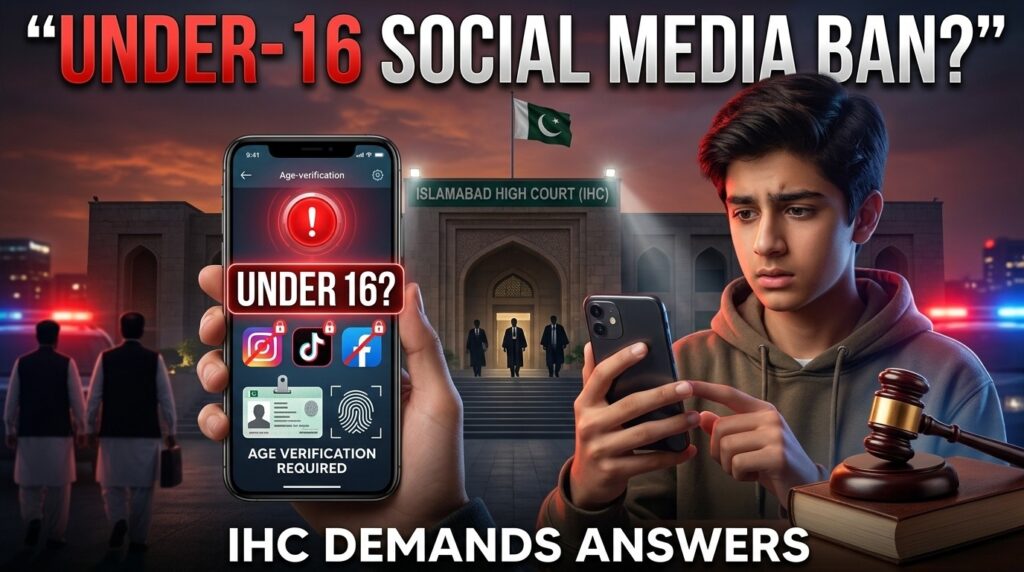
The Islamabad High Court (IHC) has formally issued notices to federal ministries and telecommunications regulators regarding a petition seeking a nationwide legal ban and age-verification framework for social media users under 16 years old. Presided over by IHC Chief Justice Sardar Muhammad Sarfaraz Dogar, the court directed relevant state authorities to submit their responses within 15 days. The legal initiative aims to address mounting concerns over cyberbullying, online harassment, and digital addiction among Pakistani children
- Judicial Action: IHC Chief Justice Sardar Muhammad Sarfaraz Dogar issued notices to six key federal departments and regulators, setting a 15-day deadline for official responses.
- Respondents Named: Ministry of Information Technology and Telecommunication (MoITT), Ministry of Information and Broadcasting, Ministry of Interior, Ministry of Law and Justice, Pakistan Telecommunication Authority (PTA), and Pakistan Electronic Media Regulatory Authority (PEMRA).
- Legal Representation: The petition was filed by citizen Waqas Nasir through legal counsel Advocates Muhammad Jalal Haider and Yahya Farid Khawaja.
- Core Demands: Enactment of child online safety legislation, establishing strict digital age-verification systems, and enforcing platform compliance for youth protection.
- International Precedent: The plea explicitly cites global legislative frameworks, including Australia’s 2024 minimum age threshold for social media platforms.
IHC Demands Answers from Ministries and Regulators
During the preliminary hearing, the petitioner’s counsel argued that the state bears a constitutional and legal obligation to safeguard children under the principle of parens patriae. Advocates Muhammad Jalal Haider and Yahya Farid Khawaja submitted that unsupervised internet exposure subjects minors to severe risks, including cyberbullying, sexual exploitation, privacy violations, and cognitive impairment.
Chief Justice Sarfaraz Dogar inquired whether existing regulatory bodies, such as PEMRA, operate under any specific legislative mandate governing youth online access. In response, the counsel clarified that while PEMRA can process individual public complaints, Pakistan currently lacks dedicated legislation regulating children’s access to digital platforms or enforcing age limits. Consequently, the court ordered the law officer to ensure immediate compliance and delivery of notices to the designated ministries.
Growing Concerns Over Children Online Safety in Pakistan
The legal movement comes at a time when digital adoption across Pakistan is accelerating rapidly. According to data metrics from digital intelligence firm DataReportal, Pakistan hosts approximately 117 million internet users and nearly 80 million active social media user accounts. Legal representatives highlighted that youth constitute a significant portion of this demographic; for instance, an estimated half of TikTok’s regional active user base consists of minors.
Digital safety advocates and mental health experts have continuously raised alarms regarding the unregulated exposure of minors to algorithmic feeds. The petition details how children under 16 often lack the legal capacity or structural support to independently approach enforcement mechanisms, such as the Federal Investigation Agency (FIA) Cybercrime Wing, when encountering online harms.
Age Verification and Regulatory Challenges for PTA and NADRA
A central component of the petition is the practical implementation of robust technological barriers rather than relying solely on parental oversight. Counsel for the petitioner proposed that the Pakistan Telecommunication Authority (PTA) collaborate with the National Database and Registration Authority (NADRA) to architect a mandatory, centralized age-verification system.
| Regulatory Aspect | Current Status in Pakistan | Proposed Framework |
| Minimum Age Law | Absent (Platform self-regulation at 13+) | Statutory ban for under-16 users |
| Verification Method | Basic self-declared birth dates | NADRA-linked biometrics / identity checks |
| Enforcement Body | Ad-hoc PTA complaints / FIA Cybercrime | Dedicated Child Digital Protection Body |
| Platform Liability | Limited localized compliance | Statutory financial & operational penalties |
The proposed framework calls for legally binding digital safety obligations on global technology firms operating within Pakistan, paired with potential legal penalties for guardians who knowingly bypass access controls.
Global Precedents Driving Pakistan’s Social Media Ban Debate
The petition filed before the IHC reflects a expanding global shift toward restricting youth access to digital platforms. The legal plea draws heavily on international legislation, most notably Australia’s Online Safety Amendment (Social Media Minimum Age) Act 2024, which established a statutory prohibition on social media accounts for minors under 16.
The arguments presented to the court also cite legislative frameworks across other jurisdictions:
- United Kingdom: The Online Safety Act 2023, imposing legal duties on tech platforms to shield children from illegal or age-inappropriate content.
- France: Statutory requirements mandating explicit parental consent for digital account creation by children under 15.
- United Nations Framework: Article alignment with the UN Convention on the Rights of the Child and General Comment No. 25 regarding children’s rights in the digital environment.
Political and Provincial Momentum Across Pakistan
The proceedings in the Islamabad High Court coincide with broader political legislative movements across the country. In the Punjab Assembly, Member of the Provincial Assembly (MPA) Sarah Ahmad recently moved a resolution urging the federal government to enact comprehensive legislation prohibiting social media accounts for individuals under 16 without verified parental consent.
This parallel movement demonstrates growing cross-institutional momentum among provincial lawmakers, legal experts, and civil society organizations calling for structural reform to establish digital boundaries for minors in Pakistan.
Digital Safeguards for Minors: What Lies Ahead
As the 15-day deadline set by Chief Justice Sarfaraz Dogar approaches, the upcoming responses from the Ministry of IT, PTA, and PEMRA will dictate the direction of digital policy in Pakistan. While civil rights organizations emphasize the need to balance online protection with youth freedom of expression and digital literacy, the judicial mandate underscores an inescapable reality: state regulations must evolve alongside digital consumption.
Whether the IHC proceedings result in binding policy directives or catalyze legislative draft bills in Parliament, the hearing marks a major turning point in Pakistan’s approach to child online safety and platform accountability.
The Islamabad High Court’s intervention marks a pivotal moment in Pakistan’s digital governance trajectory. As the 15-day notice period lapses, responses from key regulators like the PTA, PEMRA, and the IT Ministry will set the foundation for how the state addresses youth digital safety. Balancing online protection with educational growth presents complex technical and policy challenges, yet this judicial petition has successfully elevated the conversation around child digital rights to national priority. Whether through immediate court orders or formal parliamentary legislation, Pakistan appears poised to implement structural boundaries on social media platforms to safeguard its younger generation