
KARACHI — Indus Motor Company Limited (PSX: INDU), the assembler and marketer of Toyota vehicles in Pakistan, announced its annual financial results for the fiscal year ended June 30, 2026, delivering a robust operational and financial performance despite broader economic pressures. The company’s Board of Directors, meeting in Karachi on August 29, 2026, recommended a final cash dividend of Rs 47 per ordinary share (470%), bringing total cash dividends for FY26 to an aggregate of Rs 195 per share. Driven by a 33% expansion in unit sales and favorable exchange rate dynamics, net profit after tax rose to Rs 25.51 billion, translating into basic and diluted earnings per share (EPS) of Rs 324.50.
- Final Cash Dividend: Rs 47 per ordinary share (470%), supplementing interim payouts of Rs 148 per share for a full-year payout of Rs 195 per share.
- Profit After Tax (PAT): Rs 25.51 billion in FY26 compared to Rs 23.01 billion in FY25 (up 10.85%).
- Earnings Per Share (EPS): Basic and diluted EPS reached Rs 324.50, up from Rs 292.74 in the preceding fiscal period.
- Net Sales Revenue: Rose 20.27% year on year to Rs 258.75 billion from Rs 215.14 billion.
- Combined Vehicle Sales Volume: 45,035 CKD and CBU units sold, reflecting a 33.41% increase over 33,757 units in FY25.
- AGM & Entitlement Closure: 37th Annual General Meeting set for September 28, 2026; Share Transfer Books closed from September 22 to September 28, 2026.
Payout Strategy Highlighted by Rs 47 Final Dividend Recommendation
The headline payout decision forms a central pillar of Indus Motor’s capital return framework for the fiscal year ended June 30, 2026. The Board of Directors proposed a final cash dividend of Rs 47 per share (470%). This payout builds upon three interim cash distributions previously authorized during the fiscal year: a first interim dividend of Rs 51 per share, a second interim dividend of Rs 46 per share, and a third interim dividend of Rs 51 per share.
Combined, total cash distributions for FY26 reach Rs 195 per ordinary share (1,950%), representing a substantial payout ratio relative to the period’s EPS of Rs 324.50. Shareholders listed in the Register of Members as of September 21, 2026, will be eligible to receive the recommended final dividend following formal approval at the 37th Annual General Meeting scheduled for September 28, 2026, at Avari Towers, Karachi.
Payout Strategy Highlighted by Rs 47 Final Dividend Recommendation
The headline payout decision forms a central pillar of Indus Motor’s capital return framework for the fiscal year ended June 30, 2026. The Board of Directors proposed a final cash dividend of Rs 47 per share (470%). This payout builds upon three interim cash distributions previously authorized during the fiscal year: a first interim dividend of Rs 51 per share, a second interim dividend of Rs 46 per share, and a third interim dividend of Rs 51 per share.
Combined, total cash distributions for FY26 reach Rs 195 per ordinary share (1,950%), representing a substantial payout ratio relative to the period’s EPS of Rs 324.50. Shareholders listed in the Register of Members as of September 21, 2026, will be eligible to receive the recommended final dividend following formal approval at the 37th Annual General Meeting scheduled for September 28, 2026, at Avari Towers, Karachi.
| Dividend Tranche (FY26) | Dividend Per Share (Rs.) | Dividend Percentage (%) |
| First Interim Cash Dividend | Rs. 51.00 | 510% |
| Second Interim Cash Dividend | Rs. 46.00 | 460% |
| Third Interim Cash Dividend | Rs. 51.00 | 510% |
| Proposed Final Cash Dividend | Rs. 47.00 | 470% |
| Total Full-Year Distribution | Rs. 195.00 | 1,950% |
Year on Year Comparisons in Earnings Show Resilient Top-Line Growth
A rigorous analysis of year on year comparisons in earnings reveals a fundamental recovery in auto demand alongside improved operational realization. Total vehicle sales volumes—comprising Completely Knocked Down (CKD) and Completely Built Up (CBU) units—grew by 33.41% to reach 45,035 units compared to 33,757 units in FY25. Consequently, total vehicle production surged by 37.13% to 45,597 units against 33,251 units manufactured in the prior year, allowing the company to retain a 14.7% domestic market share.
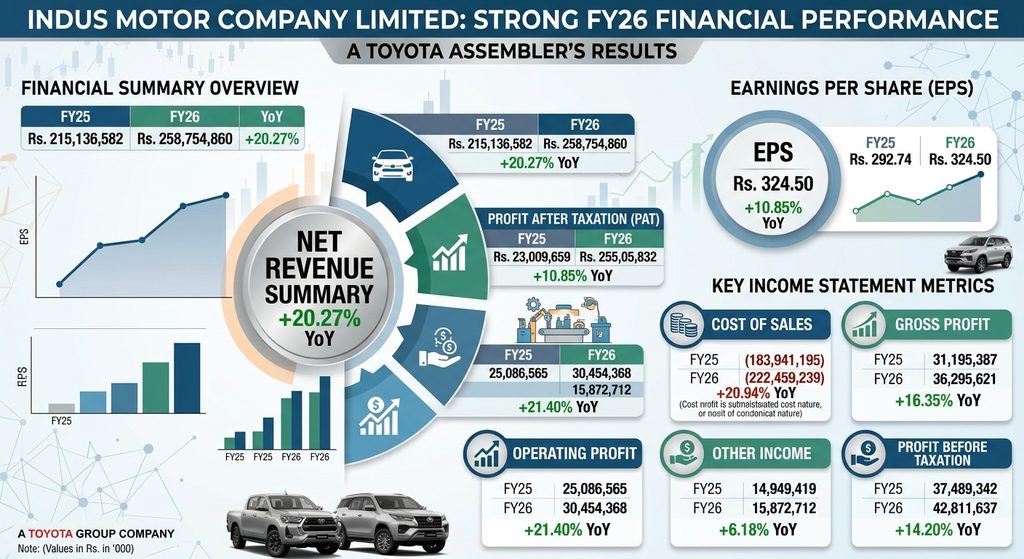
Gross profit for the year expanded by 16.35% to Rs 36.30 billion, up from Rs 31.20 billion in FY25. Management attributed margin stability to sustained consumer demand for flagship sedans—specifically the Toyota Corolla and Toyota Yaris variants—enhanced localization of component manufacturing, and steady exchange rate parity that tempered imported raw material costs. Other income also provided a reliable earnings cushion, climbing to Rs 15.87 billion from Rs 14.95 billion, supported by yields on bank placements and an unrealized gain on the re-measurement of long-term Sindh Infrastructure Development Cess (SIDC) liabilities.
Structural Shifts in Cash Flows and Liquidity Management
While profitability metrics remained solid, the Statement of Cash Flows indicates notable shifts in operating cash generation and treasury allocations. Net cash generated from operating activities underwent a contraction, shifting from a positive cash inflow of Rs 41.24 billion in FY25 to a net cash utilization of Rs 2.37 billion in FY26.
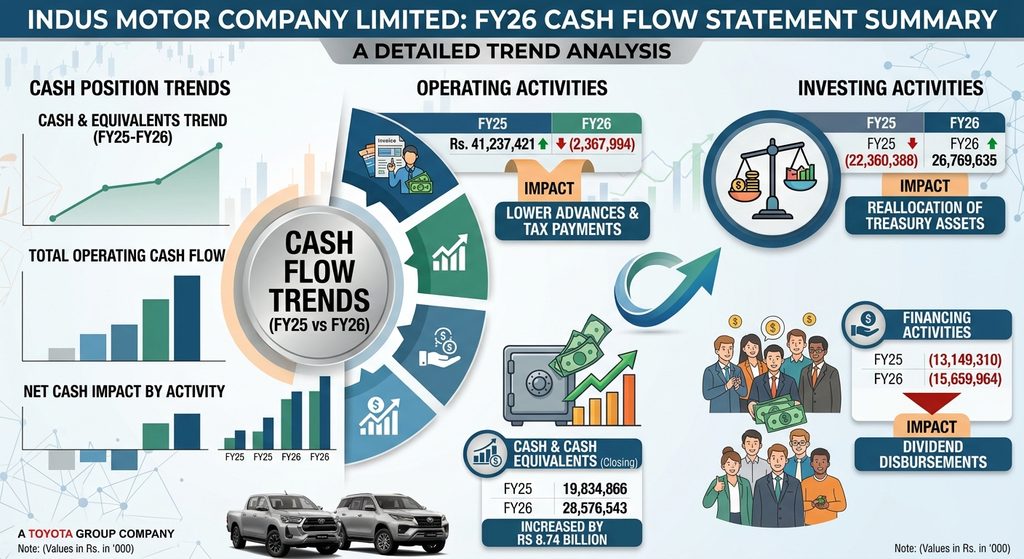
This working capital variance was primarily driven by cash outflows related to income tax and levy payments totaling Rs 20.71 billion in FY26 (versus Rs 13.68 billion in FY25) alongside a settlement of Rs 1.39 billion towards SIDC liabilities.
In contrast, cash flow from investing activities turned sharply positive, generating Rs 26.77 billion compared to a net outflow of Rs 22.36 billion in the previous year. This shift reflected the strategic redemption and net proceeds from listed mutual fund units amounting to Rs 24.94 billion and Treasury bill maturities of Rs 12.31 billion, which replenished liquid reserves. Overall cash and cash equivalents at the close of the financial year expanded to Rs 28.58 billion, up from Rs 19.83 billion at the end of FY25.
National Exchequer Contributions and CSR Initiatives
Beyond baseline corporate earnings, Indus Motor maintained a sizeable macroeconomic footprint within Pakistan’s domestic economy. During FY26, the company remitted Rs 140 billion in taxes, duties, and levies to the national exchequer, accounting for roughly 1% of total tax collections recorded by the Government of Pakistan for the fiscal year. Cumulative contributions since the company’s inception in 1989 now exceed Rs 1,030 billion.
INDUS MOTOR IMC – FY26 HIGHLIGHTS
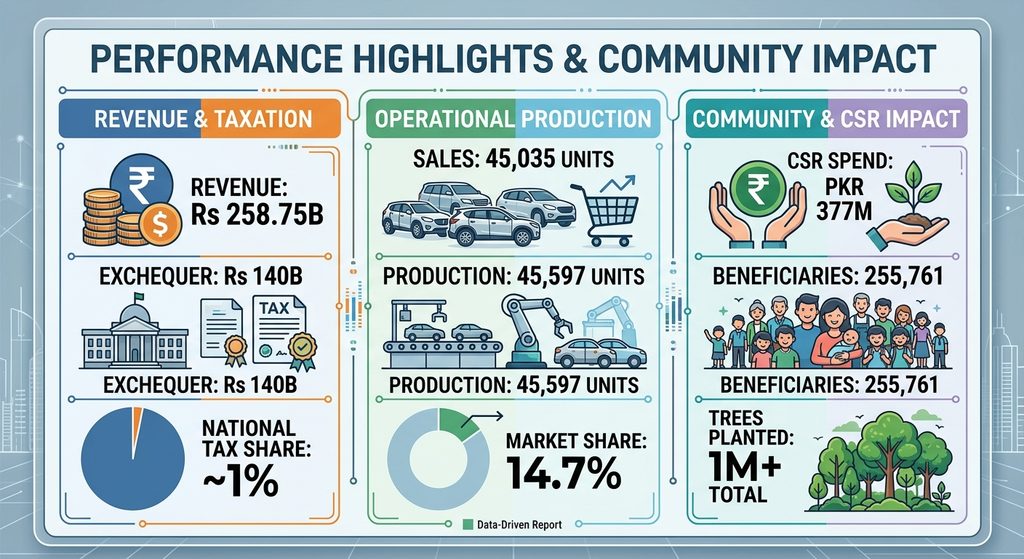
Concurrently, the manufacturer allocated PKR 377 million towards corporate social responsibility under its “Concern Beyond Cars” banner, delivering social assistance, healthcare services, and environmental conservation projects. Corporate sustainability efforts included the ongoing “Million Tree Plantation Program,” which has surpassed one million saplings planted since its 2018 rollout, as well as inaugural sustainability reporting compliant with IFRS S1 and IFRS S2 standards.
Macroeconomic Risk Factors and Industry Outlook
Despite positive full-year profitability, company management highlighted several structural risk factors that could influence financial performance heading into FY27:
Foreign Exchange Volatility: Cost structures remain sensitive to Japanese Yen and US Dollar exchange rates due to imported raw materials and CKD kits.
Taxation & Duty Structures: Fluctuations in luxury taxes, federal excise duties (FED), and import tariffs directly alter final vehicle pricing and consumer purchasing power.
Supply Chain Dynamics: Potential supply chain bottlenecks or freight cost inflation present ongoing operational hazards to assembly timelines.
Technology Transition: The gradual shift toward hybrid electric vehicles (HEVs) and electric vehicles (EVs) mandates continuous capital investment in localized engineering and assembly line modernization.
Indus Motor Company Limited’s FY26 financial performance demonstrates operational stability and strong earnings realization within Pakistan’s automotive sector. With total sales rising 33% to 45,035 units and annual profits reaching Rs 25.51 billion, the board’s decision to issue a Rs 47 final dividend reflects confidence in the company’s liquidity position. While cash flows from operations reflected heavy tax and working capital adjustments, active treasury management ensured that cash reserves expanded to Rs 28.58 billion by year-end. Looking forward, sustained localized production and stable macroeconomic policy will remain key determinants of the company’s growth trajectory.