

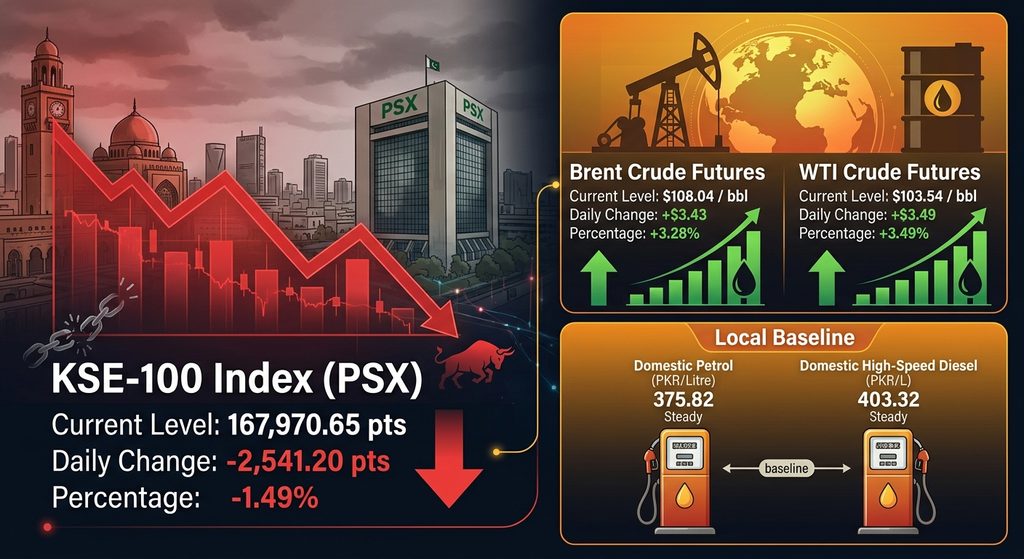
Bearish sentiment dominated the Pakistan Stock Exchange on Monday as the benchmark KSE-100 Index dropped 2,541.20 points (1.49%) to close at 167,970.65. The market decline followed a global oil price surge driven by geopolitical instability in the Middle East. Investors moved to reduce equity exposure over concerns that higher energy import costs would worsen local inflation and delay interest rate cuts.
Market Breakdown
- KSE-100 Benchmark Index: Closed at 167,970.65 points, dropping 2,541.20 points (-1.49%) from the previous close of 170,511.85 points.
- Intraday Market Range: Fluctuated within a high of 170,437.72 points and a low of 167,441.63 points.
- Trading Volumes: Main Board trading volume reached 230.17 million shares within the KSE-100 Index, while total regular market volume totaled 564.70 million shares.
- International Crude Benchmarks: Brent Crude climbed 3.3% to $108.04 per barrel, while West Texas Intermediate (WTI) rose 3.5% to $103.54 per barrel.
- Leading Sector Drag: Commercial banking, cement, automotive, and fertilizer stocks faced selling pressure.
Global Crude Rally Sparks Domestic Economic Volatility
The selling pressure on the KSE-100 Index was driven primarily by events in international energy markets. Global crude oil prices rose past key thresholds, with Brent crude reaching $108 per barrel and WTI crude trading at $103 per barrel
The crude price increases followed reports of drone strikes damaging key energy transport infrastructure in Saudi Arabia, which led to a temporary shutdown of the East-West pipeline. With roughly 4% of global oil shipments redirected or delayed, global energy markets adjusted upward.
Because Pakistan relies heavily on imported energy, higher crude prices affect the country’s trade deficit and foreign exchange reserves. Analysts noted that sustained oil prices above $100 per barrel could lead to higher domestic retail fuel prices, which currently stand at Rs 375.82 per litre for petrol and Rs 403.32 per litre for diesel.
Corporate Earnings Realities vs. Macroeconomic Risk
Despite positive corporate earnings from major E&P companies like Pakistan Petroleum Limited (PPL)—which reported a FY26 net profit of Rs 98.53 billion—macroeconomic concerns dominated market activity.
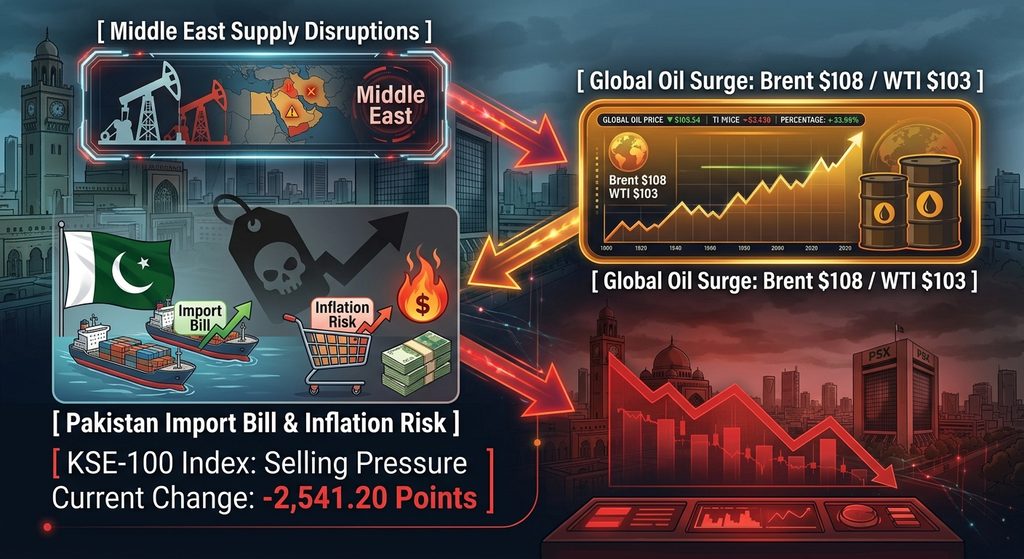
- Banking & Financials: Heavily weighted financial stocks saw institutional profit-taking, driven by concerns that persistent inflation could delay further monetary easing by the State Bank of Pakistan.
- Industrial & Cement Sectors: Energy-intensive sectors, including cement manufacturers and automotive assemblers, experienced lower valuations as higher fuel and freight costs were projected to squeeze operating margins.
- Refineries & E&P Companies: Oil and gas exploration companies saw mixed performance; while higher oil prices improve top-line revenues, broader market volatility limited upside gains across the board.
Technical Outlook: Will the Down Trend Continue?
Chart analysis shows the benchmark KSE-100 Index testing key support levels after pulling back from its recent 52-week high of 191,032.73 points. Monday’s session saw the index breach the 168,000 intraday mark before settling at 167,970.65 points.
Market analysts expect volatility to persist while international oil prices remain elevated. If Brent crude continues to trade above $105 per barrel, institutional investors may maintain a cautious approach, focusing on defensive sectors or capital protection. Conversely, any stabilization in global energy supply chains could help support a near-term floor for the
The 2,541-point decline at the Pakistan Stock Exchange highlights how closely domestic equities are tied to international energy markets. With Brent crude reaching $108 and WTI at $103 per barrel, market participants are weighing potential inflation pressures against domestic economic stability. Equity performance in the coming sessions will largely depend on global oil price trends and foreign exchange movements.