
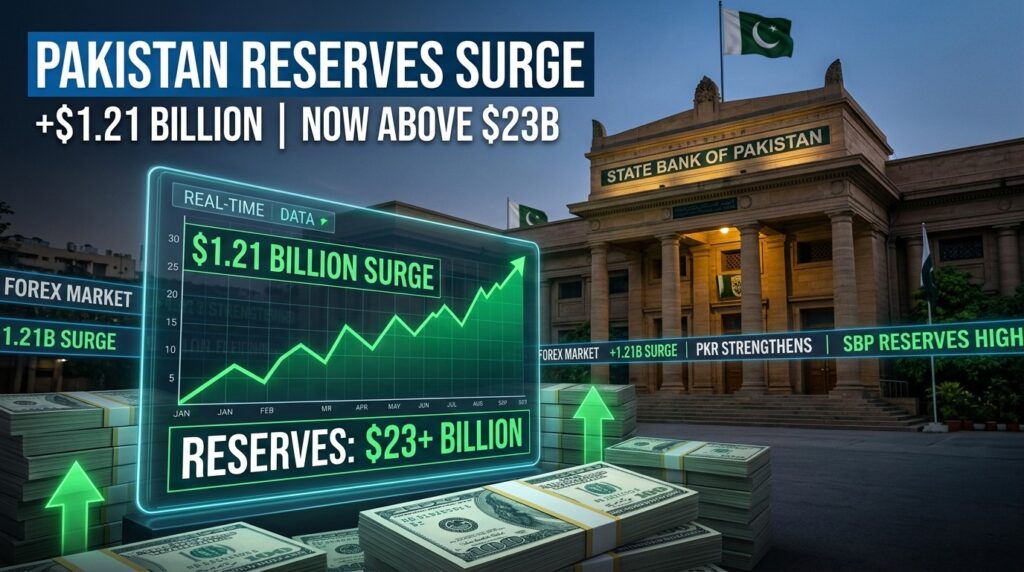
KARACHI — Pakistan’s total liquid foreign exchange reserves crossed the $23 billion threshold after a substantial weekly influx of funds into the central bank. The central bank said total reserves stood at $23.7bn on September 4, with $18.3bn at SBP and $5.4bn in commercial banks. SBP holdings rose $1.21bn, though no lender or loan terms were disclosed.
This week-on-week surge of 5.27 percent in overall reserves provides critical external account cushioning for the South Asian economy. The fiscal injection comes at a pivotal junction as Islamabad navigates ongoing structural adjustment commitments under multilateral agreements while balancing short-term debt servicing obligations.
Central Bank Holdings Drive Capital Inflow
According to official weekly data released by the State Bank of Pakistan (SBP) on Thursday, SBP-held foreign exchange reserves climbed by $1.21 billion—a 7.07 percent single-week surge—to hit $18.33 billion ($18,328.2 million) for the week ended September 4, 2026. A week earlier, on August 28, central bank reserves stood at $17.12 billion.
FOREIGN EXCHANGE RESERVES BREAKDOWN (As of Sept 4, 2026)
———————————————————————-
Entity Amount ($) Weekly Change
———————————————————————-
State Bank of Pakistan (SBP) $18.33 Billion + $1.21 Billion
Net Commercial Bank Reserves $5.39 Billion – $22.5 Million
———————————————————————-
Total Liquid Foreign Reserves $23.72 Billion + $1.19 Billion
(Source: State Bank of Pakistan official data)
The central bank attributed the entire accumulation to the “receipt of Government of Pakistan commercial loan proceeds.” However, central bank officials and the Ministry of Finance remained silent on the identities of the foreign commercial lenders, the tenure of the facility, and the negotiated interest rate terms.
Meanwhile, foreign exchange holdings retained by commercial banks registered a marginal decline of $22.5 million (-0.42 percent), closing at $5.39 billion ($5,387.6 million) compared to $5.41 billion in the preceding week. Despite the slight dip in private bank liquidity, total liquid reserves across the national banking architecture expanded by $1.19 billion.
Macroeconomic Impact and Currency Stability
The sizable addition to SBP’s coffers offers immediate breathing room for Pakistan’s import cover capacity, extending domestic stability across interbank FX markets. Following the release of the reserve statement, the Pakistani Rupee (PKR) demonstrated measured stability against the US Dollar, closing at 277.35 in the interbank market.
Financial analysts highlight that rebuilding foreign exchange buffers is essential for Pakistan to maintain sovereign credit standing and secure favorable terms during debt refinancing negotiations. The current calendar year has witnessed a net increase of $2.27 billion (+14.04 percent) in overall reserves, reflecting consistent policy intervention and commercial debt management by economic planners.
“Crossing the $23 billion threshold reinforces short-term market confidence and strengthens the central bank’s capacity to meet external obligation commitments without putting pressure on domestic currency liquidity,” noted a senior financial analyst based in Karachi.
The central bank previously met its target for Fiscal Year 2026 by maintaining SBP-held reserves above $18 billion. Economic policy roadmaps set by the central bank target an SBP reserve cushion of $20.20 billion by December 2026, making this recent commercial loan intake an indispensable bridge toward achieving those macroeconomic benchmarks.
External Debt Obligations and the Road Ahead
While the influx of foreign currency strengthens immediate balance-of-payments defense, policy observers point out that commercial borrowing carries higher debt-servicing burdens relative to long-term concessional financing. With key IMF review talks scheduled for late September, maintaining robust external buffers remains critical to meeting international stability criteria.
Economic managers face a continuous dual challenge: ensuring adequate import cover for vital goods like petroleum and industrial machinery, while simultaneously managing a strict schedule of external debt repayments due over the remainder of the fiscal year. Financial institutions will be watching whether Pakistan can convert these short-term capital boosts into durable structural reserves driven by non-debt-creating flows, such as export receipts and overseas worker remittances.
- Total Reserves: $23.72 billion as of September 4, 2026.
- SBP Holdings: Surged to $18.33 billion following a $1.21 billion weekly gain.
- Commercial Bank Holdings: Stood at $5.39 billion after a slight drop of $22.5 million.
- Primary Driver: Commercial loan proceeds received by the Government of Pakistan.
- Year-to-Date Growth: Calendar year-to-date reserves are up 14.04% ($2.27 billion).
- Currency Reaction: Pakistani Rupee steady at 277.35 against the US Dollar
The crossing of the $23 billion mark in liquid foreign reserves provides a critical buffer for Pakistan’s foreign exchange market. While the $1.21 billion commercial borrowing boosts central bank liquidity and helps meet short-term economic milestones, medium-term stability will depend on securing non-debt-creating capital, sustaining export growth, and retaining steady remittance inflows as structural economic reforms progress