
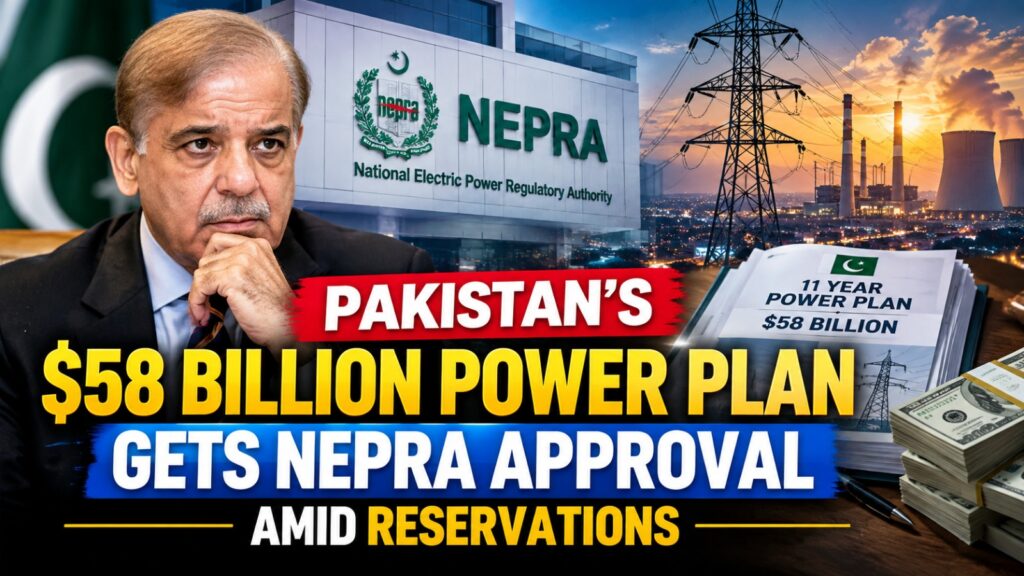
The National Electric Power Regulatory Authority (NEPRA) has conditionally approved Pakistan’s 11-year Integrated System Plan (ISP 2025-35), paving the way for an estimated $58 billion investment in power generation and transmission. In a 45-page decision, the power sector regulator greenlit the framework to tackle the ongoing electricity shortage in Pakistan and stabilize grid operations. However, the approval comes with severe internal friction, as all three regulator members authored over 12 pages of dissenting and advisory notes challenging key assumptions.
- Total Investment: $58 billion projected over an 11-year planning horizon (2025–2035).
- Generation Expansion: $47.08 billion allocated for new power generation capacity.
- Transmission Overhaul: Cumulative transmission expansion budget set at $10.65 billion.
- Excluded Items: $900 million Battery Energy Storage System (BESS) and a 2028 K-Electric transmission line were rejected.
- Capacity Targets: Total installed power generation capacity expected to reach 62,657 MW by 2035.
Regulatory Green Light with Heavy Dissent
Can an ambitious $58 billion roadmap resolve the persistent electricity shortage in Pakistan? NEPRA thinks it can, but with massive caveats.
The regulatory body approved the revised base case of the Integrated Generation Capacity Expansion Plan (IGCEP-2025) along with the Transmission System Expansion Plan (TSEP-2025). Yet, the unanimity ended there. NEPRA members, including the chairman, raised blunt questions about project selections, flawed demand forecasts, and procedural shortcuts.
The regulators expressed deep displeasure over changes made to long-term plans at the behest of a power division technical committee. They noted that national electricity policy cannot be altered by administrative units without constitutional oversight. The decision highlighted how federal authorities bypassed the Council of Common Interests (CCI) during plan updates.
What Does the $58 Billion Plan Cover?
Pakistan’s power grid faces a dual challenge: rising demand and aging infrastructure. The ISP 2025-35 tries to fix both.
Under the approved reference scenario, total installed generation capacity will expand to 62,657 MW by 2035. That figure includes 26,045 MW of new additions alongside the planned retirement of 2,577 MW of inefficient, older thermal plants. It also factor in 8,120 MW contributed by net-metering consumers.
Generation projects take the lion’s share, taking $47.08 billion. Transmission upgrades require $10.65 billion to evacuate power safely across provinces.
Major Exclusions: BESS and K-Electric Line Axed
NEPRA did not approve the plan blindly. It swung the ax on several high-profile line items.
The regulator refused to authorize a $900 million allocation proposed for Battery Energy Storage Systems (BESS). Officials stated that grid managers failed to provide a convincing technical or economic feasibility study justifying the expense. NEPRA directed the Independent System and Market Operator (ISMO) to prove the optimal capacity, location, and cost-effectiveness of battery storage before seeking approval.
Similarly, NEPRA struck out a K-Electric transmission line planned for 2028. However, to address isolated grid demands, the regulator approved a 40 MW localized generation plant for the Gwadar and Makran regions. Connecting that remote coastal belt directly to the main national grid remains technically and economically unviable for now.
Consumer Tariffs: Rising Costs Ahead?
Will this multi-billion dollar expansion lower consumer bills?
Data presented during the hearings suggests otherwise. Conflicting reports from energy bodies created confusion over tariff projections during the regulatory review. The Power Planning and Monitoring Company (PPMC) estimates that average base electricity tariffs will climb. Rates could move from 34 Pakistani rupees per unit in 2024-25 up to 37.28 rupees per unit by 2035.
NEPRA ordered ISMO to clearly quantify the exact impact of generation expansion on final consumer rates. Mismanaging capital outlays runs the risk of generating excess capacity that line-payers cannot afford.
The Broader Impact on Pakistan Economy
Energy planners face a delicate balancing act. Unreliable grid stability halts industrial factories, damages commercial productivity, and drags down the wider Pakistan Economy.
Yet, building unneeded power capacity triggers crippling capacity payments that drain public finances. Over-forecasting electricity demand previously left the country burdened with high fixed costs for idle power plants.
By forcing tighter reviews, independent audits, and strict project timelines, NEPRA aims to prevent past planning mistakes. Whether this $58 billion investment stabilizes electricity demand without triggering another circular debt crisis depends entirely on disciplined execution.
NEPRA’s conditional approval of the $58 billion Integrated System Plan marks a decisive step for Pakistan’s power generation sector. By trimming $900 million in unverified battery projects and demanding strict alignment with actual demand, the regulator showed needed independence. For everyday consumers and industrial units, the true test lies in whether grid authorities can deliver stable electricity without pushing end-user tariffs beyond reach