
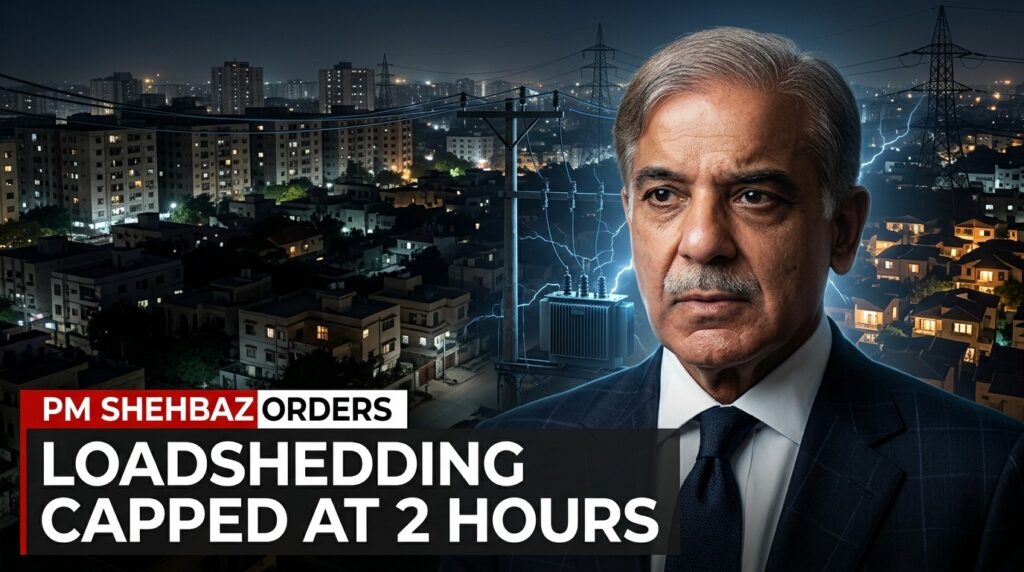
Prime Minister Shehbaz Sharif has strictly directed power sector authorities to limit daily electricity loadshedding to a maximum of two hours in any area across Pakistan. Chairing a high-level review meeting in Islamabad on Friday, the premier addressed growing public frustration over surging power outages driven by imported fuel constraints. To enforce compliance, the government ordered the immediate setup of public grievance committees at every distribution company within seven days
- Mandate: Nationwide power cuts capped at a maximum of 2 hours daily.
- Primary Cause: Global supply disruptions in Re-gasified Liquefied Natural Gas (RLNG) combined with regional maritime tensions in the Strait of Hormuz.
- Redressal Mechanism: Consumer Grievance Redressal Committees to be operational at the DISCO level within one week, featuring direct public representation.
- Help System: Consumers instructed to lodge operational transmission complaints via the central 118 helpline.
PM Shehbaz Intervenes as Outages Escalate
Power outages recently spiked across urban and rural centers in Pakistan. Citizens faced unannounced shutdowns during intense heat waves, sparking protests. Prime Minister Shehbaz Sharif expressed deep dissatisfaction with the management of the electricity supply during a emergency review session in Islamabad.
He instructed the Ministry of Energy and power distribution companies (DISCOs) to optimize operational output immediately. The premier emphasized that the public must not bear the brunt of administrative or logistical failures.
“Effective utilization of all available energy resources is mandatory,” Shehbaz Sharif told officials. He ordered authorities to utilize alternative generation methods to fill immediate gaps, ensuring no town or city exceeds the two-hour outage cap.
Global Fuel Disruptions Trigger Domestic Power Deficit
Why did Pakistan’s energy supply drop so suddenly?
Briefings presented to the Prime Minister pointed directly to international fuel supply bottlenecks. Pakistan relies heavily on imported thermal fuels to fire its primary generation fleet. Recent geopolitical escalation around the Strait of Hormuz disrupted shipments of Re-gasified Liquefied Natural Gas (RLNG).
With LNG cargoes delayed, domestic gas-fired generation plants faced severe fuel shortages. The sudden generation shortfall forced grid controllers to enforce load management to prevent a systemic collapse of the national grid. Additional transmission bottlenecks exacerbated supply deficits in dense population centers.
The domestic electricity crisis in Pakistan worsened as generation costs for gas-dependent plants surged dramatically. The government now faces the double burden of managing high generation costs while struggling to maintain baseline fuel inventory levels.
Institutional Accountability: DISCOs Given One-Week Deadline
Exasperated by recurring public complaints, PM Shehbaz ordered a rapid structural overhaul of consumer complaint mechanisms. He directed power distribution companies (DISCOs) to form Consumer Grievance Redressal Committees within seven days.
These committees must include elected local representatives alongside technical officers. Their primary mandate will be resolving localized feeder tripping, arbitrary power cuts, and billing discrepancies.
Consumers can log complaints directly via the national 118 helpline service. Upon registration, users receive an automated tracking token alongside an estimated time for restoration. Power ministry officials reported that except for minor disruptions affecting isolated locations like Rajanpur district, recent monsoon rains have not compromised the national transmission line infrastructure.
Economic Strain and Energy Diversification Needs
The ongoing power crisis underscores Pakistan’s structural vulnerability to volatile international spot markets. Relying on imported RLNG leaves the national budget exposed whenever regional conflict flares.
Commercial sectors have repeatedly warned that unstable electricity supplies threaten industrial output and national exports. Business leaders continue to call for an accelerated transition toward solar, wind, and domestic hydel resources to insulate the country from international fuel shocks.
The government maintains that current load management efforts remain temporary until delayed gas shipments dock at port facilities in Karachi.
Prime Minister Shehbaz Sharif’s directive sets an explicit benchmark for energy management during a volatile global market phase. Restricting daily nationwide loadshedding to two hours demands disciplined fuel allocation, swift logistics, and tight oversight across all electric distribution companies. Whether grid operators can maintain this limit depends on how quickly international gas shipments resume and how efficiently domestic generation resources are deployed