
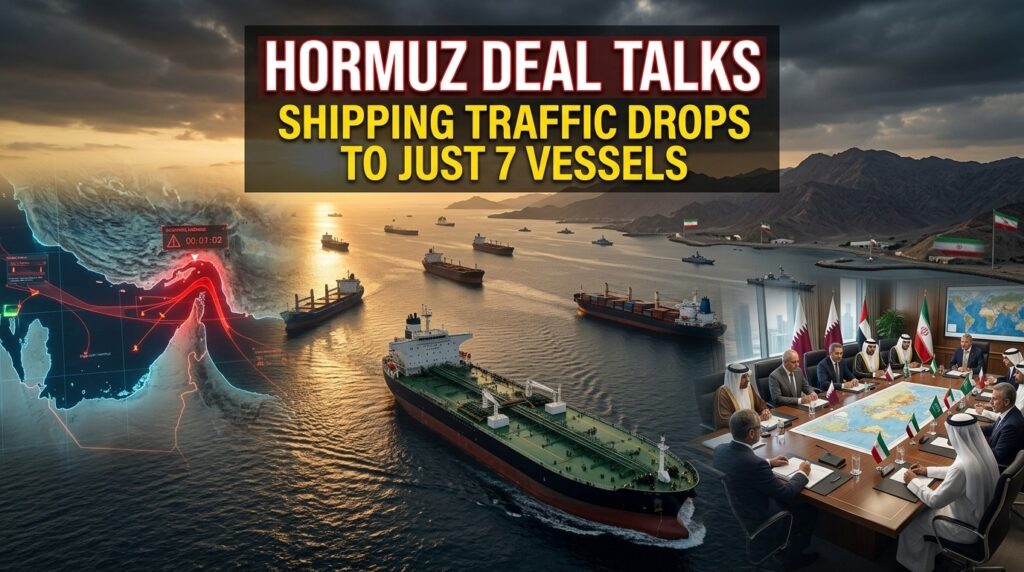
Foreign ministers from Iran and Gulf Arab nations are set to meet on Monday in Salalah, Oman, in an effort to broker a temporary agreement governing passage through the Strait of Hormuz. The high-stakes diplomatic initiative comes as commercial maritime movement through the world’s most critical oil choke point has ground to a virtual halt, with daily traffic dropping to just seven vessels. Regional diplomats hope the Omani-led mediation can prevent further economic contagion and restore safe transit through a waterway responsible for nearly a fifth of global petroleum supply.
The sudden reduction in transit activity highlights the extreme friction engulfing the Persian Gulf, where commercial shipping companies and international insurers have halted operations due to heightened security risks and military warnings. For energy-importing South Asian nations like Pakistan, the meeting in Oman represents a crucial attempt to stabilize supply routes and avert severe macroeconomic fallout.
High-Stakes Diplomacy in Oman Seeks Maritime Framework
The diplomatic gathering scheduled for Monday in the coastal city of Salalah will bring together Iranian Foreign Minister Abbas Araghchi and senior diplomats from Gulf Cooperation Council (GCC) member states. Brokered under the auspices of Omani mediation, the discussions aim to formulate a temporary operational mechanism to safeguard commercial vessels navigating the 34-kilometer-wide narrow passage.
STRAIT OF HORMUZ MARITIME TRANSIT METRICS
———————————————————————-
Indicator Historical Standard Current Status
———————————————————————-
Daily Commodity Vessel Transits ~15 to 20 Vessels 7 Vessels
Global Seaborne Oil Share ~25 Percent Severely Disrupted
Global Seaborne LNG Share ~20 Percent Severely Disrupted
Immediate Diplomatic Venue — Salalah, Oman
———————————————————————-
(Sources: Maritime tracking data / Kpler / Regional diplomatic reports)
Oman, long known for its neutral diplomacy in the Middle East, has stepped in as a essential bridge builder. Tehran has indicated a willingness to consider designated transit corridors for non-belligerent commercial vessels, provided regional states offer reciprocal security assurances and resist external military escalation. However, diplomatic sources note that reaching a consensus will require balancing delicate security guarantees between Iran and its neighboring Gulf monarchies.
Maritime Choke Point Stalled as Traffic Collapses
Ship-tracking data from Kpler and maritime intelligence services show that transit through the Strait of Hormuz has plummeted far below normal operating baselines. A total of only seven commercial cargo and commodity vessels were recorded passing through the waterway on a single day this week, compared to historical daily averages of 15 to 20 major vessels.
The drastic slowdown follows escalated military activity, missile strikes, and maritime warnings issued across the Persian Gulf, which forced international shipping lines to re-route tankers or keep vessels anchored outside the Gulf of Oman. War risk insurance premiums for vessels operating in the region have soared to unsustainable levels, effectively pricing out merchant fleets without state-backed indemnities.
“The drop to seven vessels per day demonstrates that maritime transport through Hormuz has reached a functional standstill,” said a Singapore-based energy analyst. “Without a binding regional framework negotiated in Oman, global energy distribution faces its most severe structural bottleneck in decades.”
Implications for Pakistan and Regional Energy Security
For Pakistan, the breakdown of regular shipping through the Strait of Hormuz carries immediate economic consequences. Islamabad relies heavily on the Persian Gulf for its energy imports, receiving the majority of its crude oil and liquefied natural gas (LNG) shipments from Gulf suppliers via the Arabian Sea routes. Extended disruptions risk driving up national import bills, increasing domestic fuel prices, and exerting renewed downward pressure on the Pakistani Rupee.
Economic planners in Islamabad are watching the Salalah summit closely. A successful deal that reopens commercial transit channels would alleviate supply chain bottlenecks and contain global crude oil prices, which have seen heightened volatility since the onset of the regional maritime crisis. Pakistani energy officials have emphasized the importance of unimpeded freedom of navigation, aligning with broader international calls for immediate de-escalation in key trade lanes.
- Diplomatic Summit: Foreign ministers from Iran and Gulf countries will meet on Monday in Salalah, Oman.
- Core Objective: To negotiate a temporary agreement securing safe passage for commercial shipping through the Strait of Hormuz.
- Traffic Collapse: Daily vessel transits through the strait dropped to just seven ships.
- Energy Impact: The Strait of Hormuz historically handles nearly 25% of global seaborne oil and 20% of global LNG trade.
- Pakistan Risk: High vulnerability to domestic inflation, elevated import bills, and LNG supply disruptions if shipping lanes remain stalled.
Monday’s ministerial conference in Oman marks a vital diplomatic effort to de-escalate one of the world’s most hazardous maritime crises. With traffic through the Strait of Hormuz down to a trickle of seven vessels, the regional talks must establish tangible operational guarantees to restore maritime security, protect international commerce, and stabilize global energy markets before economic damage becomes permanent.