
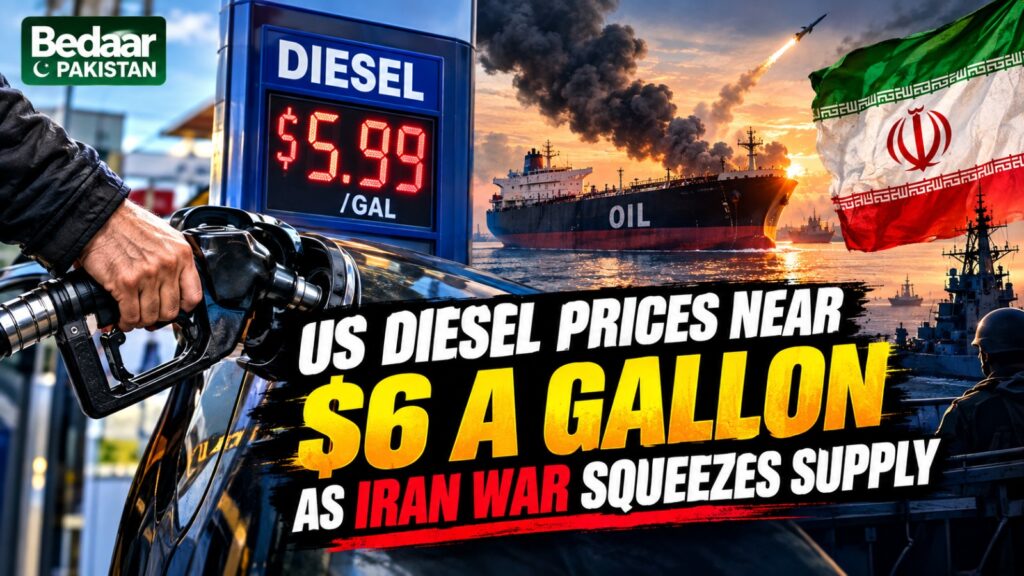
Retail diesel prices in the United States have breached historic milestones, climbing past $5.85 to touch $6.00 per gallon as global fuel supply chains buckle under the strain of the ongoing conflict with Iran. The price surge represents a dramatic 61 percent increase from year-ago levels, driven by severe maritime bottlenecks near the Strait of Hormuz and depleted commercial distillate inventories. For global commodity markets and emerging economies like Pakistan, the record-setting fuel shock threatens a fresh wave of imported inflation and elevated freight costs.
$6 a Gallon
The rapid increase in industrial fuel costs arrives at an unprecedented operational juncture for the global transport sector. Commercial shipping lines, agricultural equipment operators, and heavy logistics fleets are bearing the brunt of refined product scarcity, forcing energy markets into uncharted territory.
Historical Increase Drives Refined Product Shortages
According to energy tracking data from GasBuddy and the American Automobile Association (AAA), national average retail diesel prices surged to an all-time record of $5.85 per gallon before crossing the $6.00 benchmark in multiple regional markets. This milestone surpasses the previous historical record of $5.78 per gallon set in June 2022 during the early phase of the Russia-Ukraine conflict.
U.S. DIESEL BENCHMARKS & ENERGY SPREADS (SEPTEMBER 2026)
———————————————————————-
Metric Baseline Value Current Value
———————————————————————-
U.S. Average Retail Diesel ~$3.71 / gallon $5.85 – $6.00 / gallon
U.S. Gulf Coast Crack Spread ~$20.00 / barrel >$100.00 / barrel
U.S. Refinery Utilization Rate ~94.6 Percent 98.0 Percent
Brent Crude Oil Benchmark ~$70.00 / barrel $100.00 – $107.00 / barrel
———————————————————————-
(Sources: U.S. Energy Information Administration / GasBuddy / Market Data) The primary metric illustrating the localized refined product shortage is the Gulf Coast diesel “crack spread”—the profit margin between crude oil purchase costs and output diesel prices. The crack spread spiked from its pre-conflict average of $20 per barrel to over $100 per barrel, signaling acute structural supply deficits in refined distillates. Even as American domestic refineries operated at an extraordinary 98 percent capacity utilization rate, facilities could not expand output fast enough to offset global market shortfalls.
Supply Bottlenecks and Depleted Distillate Inventories
The supply crunch is heavily compounded by systemic disruptions along Middle Eastern transit corridors. The de facto restriction of commercial tanker traffic through the Strait of Hormuz—a narrow passage that typically handles roughly one-fifth of global petroleum shipments—has severed major refined product exports leaving Persian Gulf ports.
“We are entering a critical seasonal window for commercial freight and agricultural harvest with the lowest distillate inventories on record for early autumn,” noted a senior market strategist tracking global energy flows.
In the United States, distillate fuel stocks fell to their lowest late-summer inventory levels since 1982. On the U.S. East Coast, regional distillate reserves dropped to 19.3 million barrels—the lowest total recorded since data collection began in 1990. The tight supply environment coincides with peak seasonal demand, as agricultural harvesting machinery and winter heating fuel distributors compete for dwindling fuel allocations.
Macroeconomic Impact and Consequences for Global Fuel
The compounding surge in diesel prices exerts immediate pressure on global freight logistics and supply chains. Analysts estimate that the $1.61 per gallon average pump price increase since the outbreak of hostilities has added nearly $35 billion in direct fuel expenses for the commercial freight sector, an expense that cascades directly to end consumers through higher transport surcharges.
For soaring global fuel benchmarks exacerbate an already fragile balance-of-payments situation. Because Pakistan relies heavily on imported refined fuels and crude oil to run its domestic transportation, agriculture, and power generation sectors, sustained high global diesel prices threaten to:
- Elevate the National Import Bill: Pushing up trade deficits and straining central bank foreign exchange reserves.
- Fuel Domestic Inflation: Raising freight charges for essential agricultural products, food supplies, and manufactured goods across major domestic supply routes.
- Increase Production Costs: Elevating operational overheads for industrial manufacturers and agricultural producers reliant on diesel-powered machinery and backup generators.
- Historic High: U.S. retail diesel prices crossed the $6.00 per gallon threshold, setting a new historical record.
- Annual Surge: Prices have climbed 61% compared to the same period last year.
- Crack Spread Expansion: The Gulf Coast diesel crack spread breached $100 per barrel, up fivefold from normal levels.
- Inventory Depletion: U.S. distillate inventories reached their lowest late-summer levels since 1982.
- Primary Cause: Middle Eastern war disruptions, Strait of Hormuz shipping bottlenecks, and tight global refining capacity.
The surge in U.S. diesel prices past the historic $6 milestone highlights the deep vulnerabilities in global energy supply chains during regional conflicts. With global crude benchmarks hovering around $100 a barrel and refining capacity maxed out, industrial transportation costs will remain elevated. For energy-importing nations like Pakistan, navigating these international energy price spikes requires vigilant economic management to shield domestic consumers from severe inflationary shocks.