
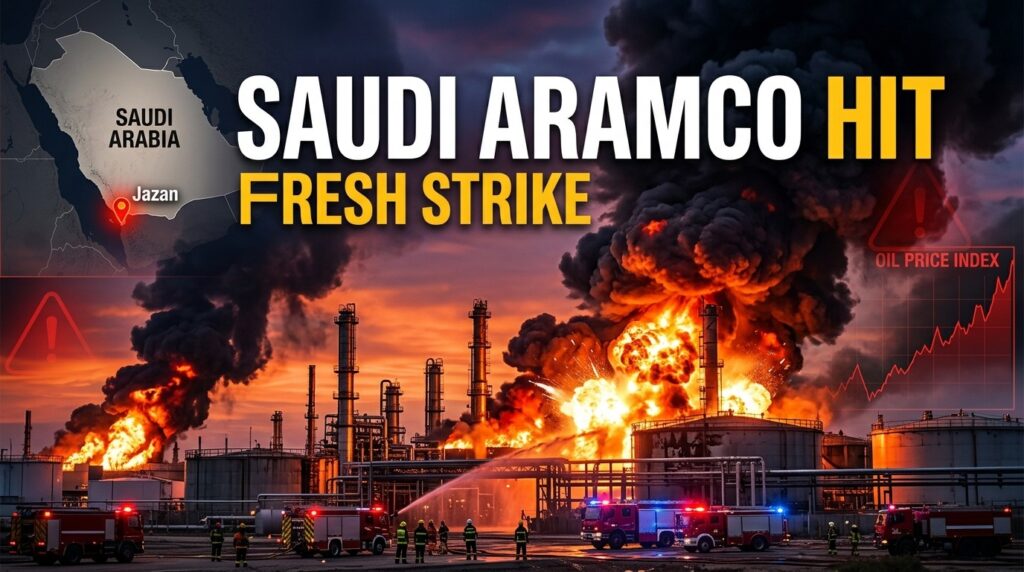
State energy giant Saudi Aramco’s key oil facilities in Jazan came under a fresh attack on Monday, marking a major escalation in regional energy vulnerability. Sources familiar with the matter revealed that technical teams are currently assessing the extent of physical damage following the strike, which mirrors a similar attack on the southwestern processing hub just weeks prior. The incident has immediately rattled international energy markets, pushing crude oil benchmarks higher and threatening to disrupt critical Red Sea fuel export routes.
The renewed targeting of Saudi energy infrastructure highlights the precarious balance of global oil distribution amid escalating regional conflict. As commercial shipping lines face growing insecurity, Asian import-dependent economies—including Pakistan—are watching energy market fluctuations with acute concern.
- Target Location: Saudi Aramco’s industrial energy complex in Jazan, located near the kingdom’s southwestern Red Sea coast.
- Facility Capacity: The Jazan processing complex houses a 400,000-barrel-per-day (bpd) refinery vital for producing gasoline and ultra-low-sulfur diesel.
- Market Response: Global oil benchmarks ticked upward immediately following reports, with Brent crude rising over 1.2% toward $97.40 per barrel.
- Regional Context: Escalating hostilities along the Bab el-Mandeb corridor have restricted alternative maritime pathways for Middle Eastern refined products.
Fresh Attack Triggers Damage Assessment in Jazan
The fresh strike on Saudi Aramco’s Jazan complex targeted one of the kingdom’s most crucial refining and export centers on the Red Sea. The facility handles processing for up to 400,000 barrels of crude oil daily, supplying domestic markets and international trade routes. Emergency crews and structural engineers rushed to the site to inspect primary refining units and storage assets.
While Saudi Aramco has not officially issued a public tally of operational downtime, industry insiders confirmed that the scale of this latest event closely resembles previous strikes in late July. The strategic placement of the Jazan refinery was intended to bypass Persian Gulf transit bottlenecks, making direct hits on the facility particularly disruptive for Saudi Arabia’s Red Sea export flexibility.
Strategic Pressure on Red Sea Energy Corridors
The incident comes amidst broader military clashes and maritime blockades expanding across the Red Sea and the Bab el-Mandeb Strait. As conflict severely throttled traditional shipping channels through the Strait of Hormuz, Saudi Arabia increasingly relied on Red Sea hubs like Jazan and Yanbu to route refined petroleum exports.
Ship-tracking data compiled by industry analysts showed that waterborne loadings from Jazan dropped precipitously following repeated security incidents. The combination of direct infrastructure hits and elevated war-risk insurance premiums for commercial tankers has constricted the flow of refined fuels exiting the Arabian Peninsula.
Global Oil Market Volatility and Price Spikes
International crude markets reacted swiftly to the vulnerability of major OPEC infrastructure. Energy analysts warn that sustained downtime at key refineries could tighten global supplies of diesel and gasoline, compounding inflation across import-reliant regions.
With global oil inventories already operating under tight margins, energy traders are pricing in persistent operational risks. The risk premium on Middle Eastern crude remains elevated as market participants evaluate whether defensive systems can adequately safeguard regional energy installations against low-cost drone and missile technologies.
Direct Economic Fallout for Pakistan
The strike on Saudi Aramco’s facilities carries severe economic consequences for South Asian economies, particularly Pakistan:
- Import Inflation: Rising international benchmark prices directly inflate Pakistan’s oil import bill, worsening the country’s trade deficit.
- Domestic Fuel Prices: Higher global crude costs force price hikes at domestic petrol pumps, adding cost-of-living pressures for consumers and transport sectors.
- Supply Chain Stability: Pakistan relies heavily on Middle Eastern refined products; supply bottlenecks in the Red Sea and Gulf threaten import timelines for essential fuels
Energy Security at a Crossroads
The fresh strike on Saudi Aramco’s Jazan complex highlights the ongoing fragility of global energy supply chains. As strategic refineries face repeated disruptions, international markets remain exposed to sudden price shocks and supply shortages. For developing nations like Pakistan, navigating this environment of elevated oil prices will require careful fiscal management and strategic energy planning