

ISLAMABAD — The Pakistan Stock Exchange (PSX) has experienced a severe downturn, with the benchmark KSE-100 index plummeting by over 12,000 points over the past 30 days. This sharp contraction reflects heightened risk aversion among retail and institutional investors as global crude benchmarks near $100 per barrel and domestic fuel prices reach historic highs. Driven by persistent foreign fund outflows and shrinking daily trading volumes, the stock market’s prolonged slide highlights growing fears that reignited inflationary pressures could derail Pakistan’s macroeconomic recovery
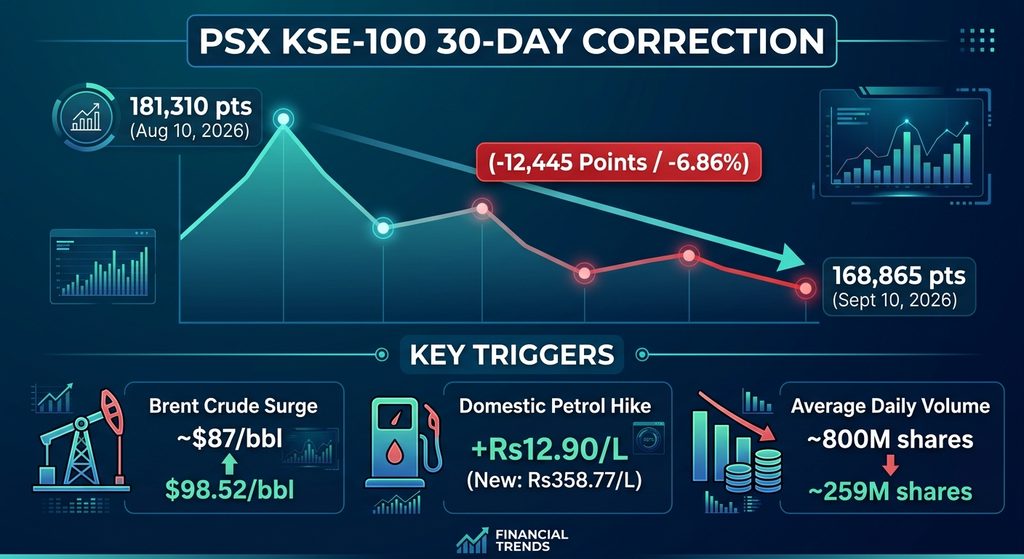
- Monthly Benchmark Index Plunge: The PSX KSE-100 index fell from an all-time high of over 181,310 points on August 10, 2026, to 168,865 points by September 10, 2026—a net decline exceeding 12,400 points (-6.86%).
- Shrinking Market Liquidity: Daily trading volumes dropped significantly, hovering around 259 million shares compared to previous monthly averages exceeding 600–800 million shares.
- Energy Price Shock: Global Brent crude breached $98.50 per barrel, triggering domestic fuel price increases in Pakistan of Rs12.90 per liter for petrol (to Rs358.77/L) and Rs3.72 per liter for High-Speed Diesel (to Rs381.77/L).
- Broad-Based Sector Devaluation: Major market cap weights including Oil & Gas Development Company (OGDC), Pakistan Petroleum Limited (PPL), Habib Bank Limited (HBL), and Lucky Cement recorded sharp declines.
- Inflationary Pressures: Analysts project headline CPI inflation to rise over the next two to three weeks due to higher freight transport tariffs and import parity adjustments.
Escalating Energy Costs and Global Crude Surges Rattle Investor Sentiment
The primary driver behind the month-long rout at the Pakistan Stock Exchange is the relentless surge in global energy markets. International benchmark Brent crude surged toward $98.52 per barrel following escalating regional conflicts in the Middle East, shipping disruptions along critical Gulf transit corridors, and military exchanges affecting key energy infrastructure. West Texas Intermediate (WTI) crude similarly crossed $93.80 per barrel, representing a single-month surge of over 12% in global energy costs.
As a net energy-importing country, Pakistan’s macroeconomic stability is highly sensitive to swings in international crude pricing. To prevent severe revenue shortfalls and limit circular debt within the energy sector, the federal government passed the burden onto consumers on September 8, raising domestic petrol prices to Rs358.77 per liter and diesel to Rs381.77 per liter. Equity investors view these developments as a double-edged sword: while state-owned oil exploration companies like OGDC and PPL briefly experience revenue gains, the overall cost of doing business across the broader economy rises sharply.
Low Trading Volume and Foreign Outflows Signal Deepening Caution
Beyond international energy shocks, structural liquidity issues within the local equity market have accelerated the downward momentum. Trading activity on the main board of the PSX has contracted sharply, reflecting widespread participant hesitancy and a noticeable absence of fresh institutional capital.
| Market Indicator | Baseline Level (August 2026) | Current Level (September 10, 2026) | Net Change (%) |
| KSE-100 Index Level | 181,310.28 pts | 168,865.04 pts | -6.86% |
| Daily Trading Volume (Shares) | ~874.3 Million | ~259.0 Million | -70.37% |
| Brent Crude Oil (USD/bbl) | ~$87.50 | $98.52 | +12.59% |
| Petrol Price (PKR/Liter) | Rs345.87 | Rs358.77 | +3.73% |
| High-Speed Diesel (PKR/Liter) | Rs378.05 | Rs381.77 | +0.98% |
Investment analysts point out that low volume during a market decline indicates that buyers are waiting on the sidelines rather than aggressively buying the dip. Foreign portfolio investors have maintained a net selling posture, offloading holdings in commercial banking and manufacturing equities to reallocate capital into safer global fixed-income assets. Without strong institutional buying, small retail sell orders have caused disproportionately large index drops.
Inflationary Ripple Effects Threaten Corporate Earnings and Consumer Spending
The decline in the PSX also reflects broader market expectations regarding reignited inflation. High-Speed Diesel (HSD) serves as the primary fuel source for Pakistan’s industrial logistics, heavy freight trucks, public transit, and agricultural machinery. Consequently, raising diesel rates to Rs381.77 per liter immediately elevates transportation costs across supply chains.
Economic research teams warn that secondary-round inflation will manifest within two to three weeks:
- Perishable Food & Essential Goods: Increased freight tariffs directly inflate retail prices for food staples transported from agricultural hubs in Punjab and Sindh to urban centers like Karachi, Lahore, and Islamabad.
- Manufacturing & Industrial Margins: Cement, steel, automobile assemblers, and textile producers face rising power generation and transportation overheads, reducing expected quarterly operating margins.
- Consumer Discretionary Demand: Shrinking household disposable income reduces sales projections for retail, technology, and consumer goods companies listed on the exchange.
The 12,000-point drop at the Pakistan Stock Exchange highlights the economy’s sensitivity to international energy volatility and domestic inflation. As global crude benchmarks hover near $100 per barrel and domestic petrol and diesel prices hit record highs, equity markets are pricing in higher operating costs and tighter consumer budgets. Until international energy prices ease and domestic market liquidity returns, the PSX is likely to remain under pressure, requiring investors to navigate a challenging economic landscape