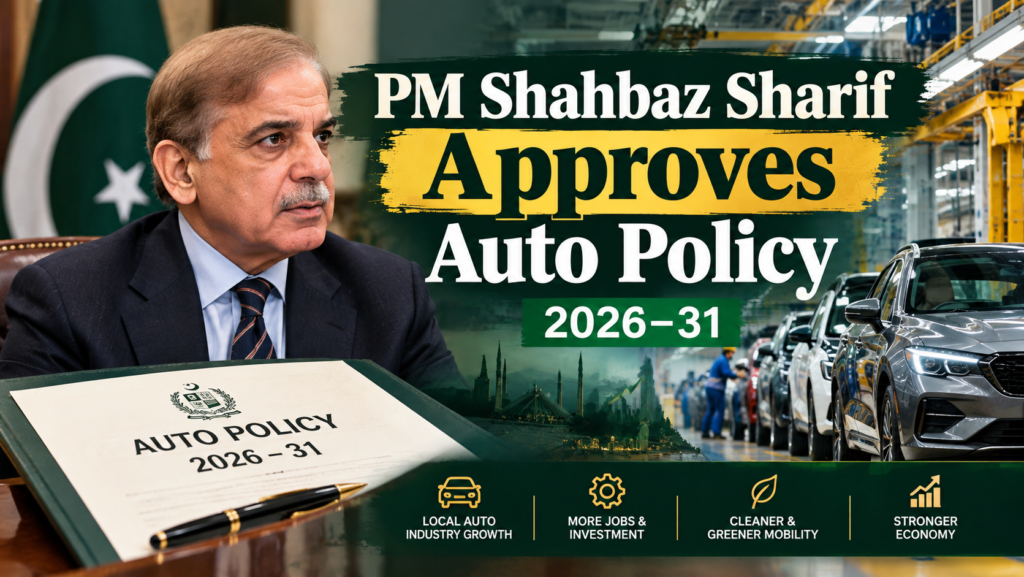
Prime Minister Muhammad Shehbaz Sharif has granted in-principle approval to the landmark Automotive Industry Development Policy (AIDP) 2026–31, establishing a structural framework to revamp Pakistan’s domestic car manufacturing and accelerate vehicle electrification. Developed by an inter-ministerial steering committee, the new five-year policy succeeds the previous auto framework that expired on June 30, 2026, and will operate alongside the New Energy Vehicles (NEV) Policy 2025–30. The policy directly targets foreign-exchange conservation, job protection, export competitiveness, and targeted tax relief across multiple vehicle segments.
Policy Highlights
- Tariff Rationalization: Weighted-average import tariffs on auto components will drop from 15.7% to 5.99% by 2030 through a simplified four-tier customs structure (0%, 5%, 10%, 15%).
- Macroeconomic Projection: Forecasts $17.7 billion in cumulative foreign-exchange savings via localized CKD assembly and $4.586 billion in total automotive exports over five years.
- Fiscal and Labor Impact: Designed to protect 2.5 million existing industrial jobs while generating a net fiscal surplus of Rs 21.11 billion for the national exchequer.
- EV and Clean Tech Support: Direct consumer subsidies under the Rs 100.36 billion Pakistan Accelerated Vehicle Electrification (PAVE) programme to drive a target of 30% electric vehicle adoption by 2030.
- Export Requirements: Original Equipment Manufacturers (OEMs) must export up to 12% of production value ($596.1 million) by FY31 or face quantitative customs penalties.
Major Import Duty Cuts and Tax Relief Structure
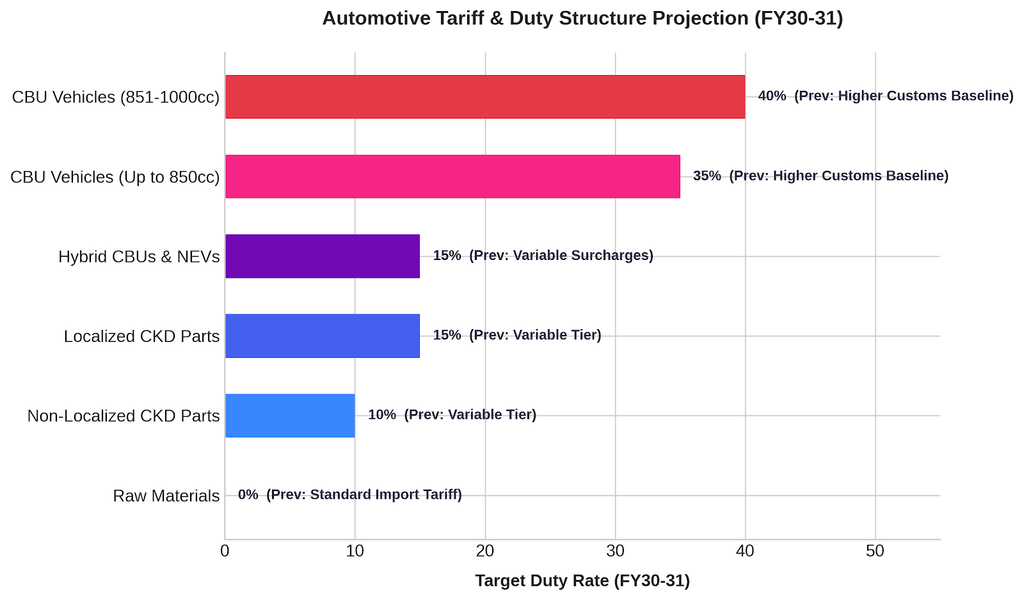
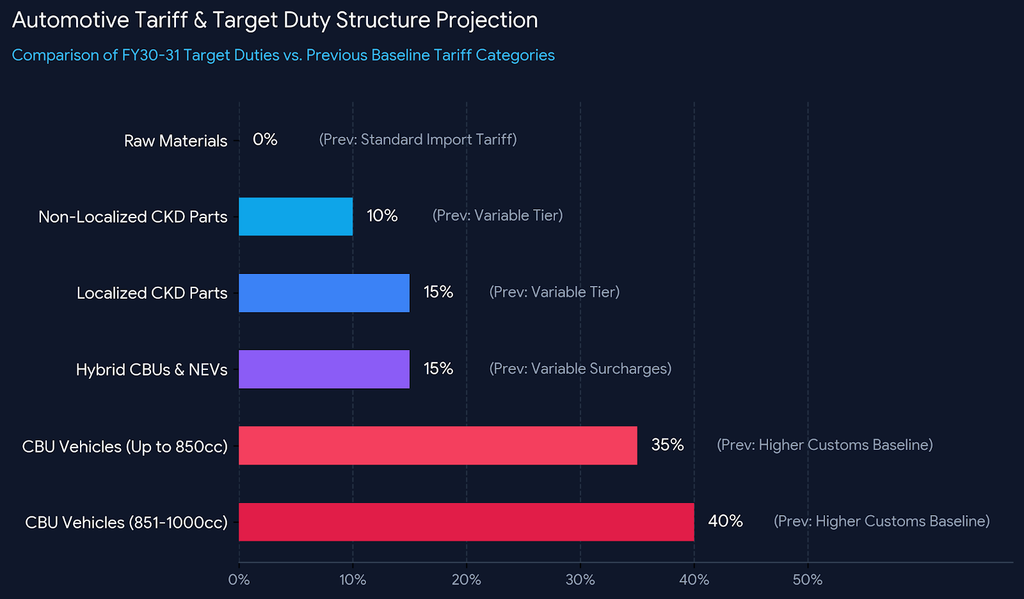
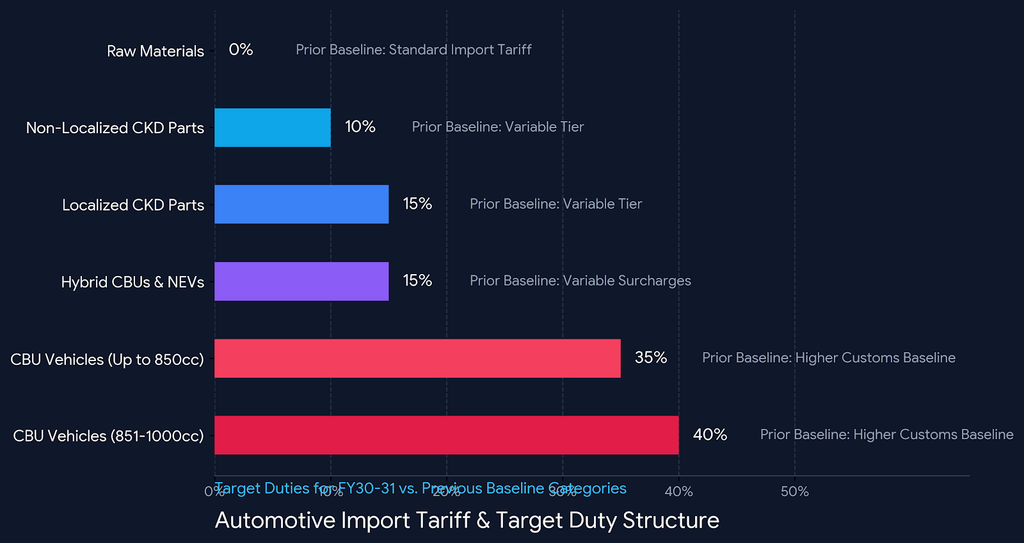
The centerpiece of the Auto Policy 2026–31 is a comprehensive restructuring of import duties aimed at reducing manufacturing costs for local assemblers while lowering entry barriers for imported vehicles over the next five fiscal years. Under the approved framework, customs duties on non-localized completely knocked-down (CKD) kits will fall to 10%, while duties on localized components will drop to 15%. Raw materials used in automotive manufacturing will enjoy a complete duty exemption (0%).
For completely built-up (CBU) imported vehicles, customs duties will undergo a gradual step-down reduction reaching their target levels by FY 2030–31. Small-engine vehicles up to 850cc will see tariffs decline to 35%, while 851cc–1,000cc vehicles will fall to 40%. Medium-capacity cars (1,001cc–1,500cc) will be taxed at 45%, mid-size sedans (1,501cc–1,800cc) at 77%, and luxury vehicles above 1,800cc will be set at 115%. Hybrid CBUs will attract a reduced 15% customs duty, matching the flat 15% rate assigned to New Energy Vehicles (NEVs). Additionally, regulatory duties and additional customs duties on vehicle imports will be phased out entirely by FY31.
While an 18% General Sales Tax (GST) will remain standard across vehicle segments, targeted tax relief is embedded directly into local production. Localized NEVs will benefit from a minimal 1% kit duty until June 2027 and complete exemption from Federal Excise Duty (FED).
PAVE Programme and Green Financing Initiatives
To accelerate green mobility, the government is coupling the Auto Policy 2026–31 with the newly established Pakistan Accelerated Vehicle Electrification (PAVE) programme, backed by an allocation of Rs 100.36 billion. Funded through a modest 1% to 3% levy imposed on internal combustion engine (ICE) vehicles, PAVE shifts green-vehicle incentives away from tax waivers into direct consumer subsidies. The government aims for New Energy Vehicles to comprise 30% of total automotive sales in Pakistan by 2030.
Under PAVE, cash subsidies of Rs 65,000 will be provided for e-bikes, up to Rs 400,000 for electric three-wheelers, and Rs 15,000 per kWh for commercial fleet operations. To resolve infrastructure bottlenecks, the policy mandates the setup of 3,000 public charging stations along primary highways and urban centers nationwide.
Complementing these direct subsidies, the State Bank of Pakistan (SBP) will expand its green auto-financing framework. The maximum loan ceiling for electric and hybrid vehicle purchases will increase to Rs 10 million, accompanied by extended repayment tenures of up to seven years.
Strict Export Mandates and Localization Rules
Unlike prior policies that offered unconditional incentives, AIDP 2026–31 directly ties fiscal concessions to domestic value addition and export metrics. The Engineering Development Board (EDB) will strictly enforce a quantitative Minimum Domestic Value Addition (MDVA) regime to curb low-value assembly practices.By FY 2030–31, OEMs must achieve progressive MDVA thresholds across all major vehicle categories:
- Passenger Cars: 40% local value addition
- Light Commercial Vehicles (LCVs): 45% local value addition
- Tractors: 80% local value addition
- Two-Wheelers and Three-Wheelers: 90% local value addition
- New Energy Vehicles (NEVs): 15% initial local value addition
Access to concessionary CKD duties will be strictly contingent on export performance. Passengercar manufacturers must progressively increase exports until export revenues equal 12% of total production value by FY31, representing a collective export target of $596.1 million. Assemblers failing to meet these annual quotas will face financial customs penalties proportional to their shortfall.
Conversely, meeting or exceeding export benchmarks makes manufacturers eligible for up to 15% tax rebates under the Duty Drawback of Local Taxes and Levies (DLTL) scheme. To regulate market quality and curb speculative trading, commercial imports of used cars up to five years old will now be limited exclusively to active corporate tax filers maintaining authorised 3S (sales, service, and spare parts) dealer networks. An initial 40% regulatory tariff will apply to used imports, which will be gradually phased out by 2030. The framework requires compliance with 62 UNECE international safety standards and sets up an Auto Parts Export Council to support vendors expanding into global supply chains. Following the Prime Minister’s approval, the policy moves to the Economic Coordination Committee (ECC) and the Federal Cabinet for final ratification in consultation with ongoing IMF economic reviews.
The Prime Minister’s approval of the Auto Policy 2026–31 represents a decisive transition from simple assembly to export-oriented manufacturing and sustainable mobility in Pakistan. By balancing significant tax relief and duty reductions with strict localization quotas and mandatory export targets, the framework protects domestic industrial jobs while safeguarding foreign exchange reserves. If implemented consistently across its five-year timeline, AIDP 2026–31 positions Pakistan to become a key regional hub for auto parts manufacturing and clean-energy transportation.