
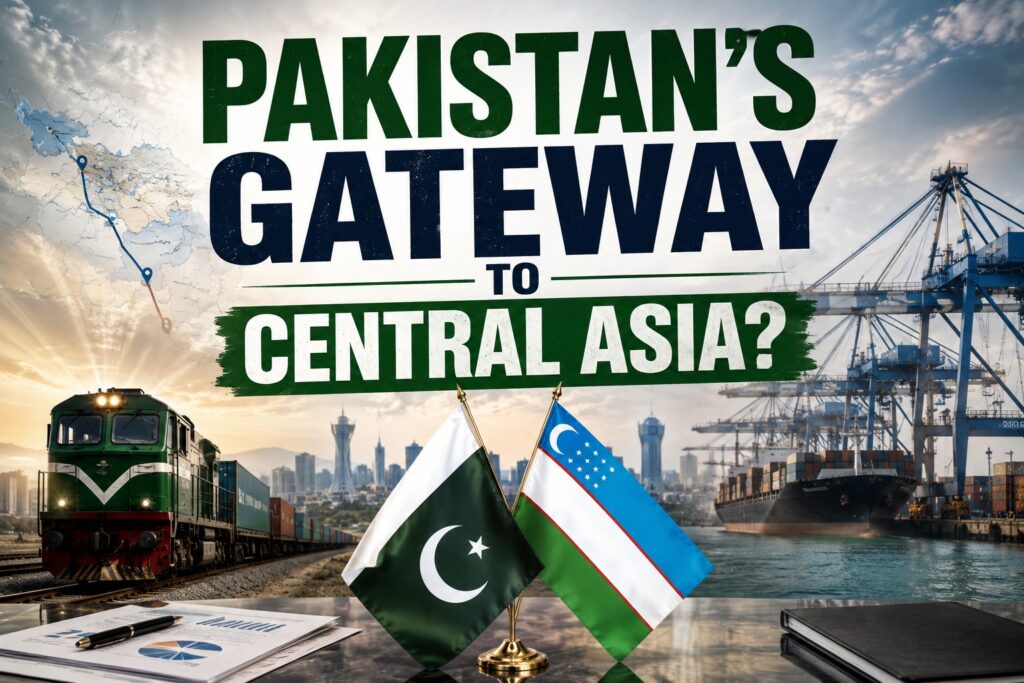
Pakistan and Uzbekistan are seeking to turn close political ties into a larger economic partnership, with both governments targeting bilateral trade of $2 billion by 2029. Target was reaffirmed in August 2026; both sides seek stronger links. The challenge is to improve trade, logistics, banking and market access.
- Trade target: $2 billion by 2029.
- February 2026 visit: Pakistan says 27 agreements and MoUs were concluded; B2B MoUs were valued at $3.4 billion.
- Trade framework: The countries have a Preferential Trade Agreement and a Transit Trade Agreement.
- Connectivity: The Uzbekistan-Afghanistan-Pakistan railway is intended to connect Central Asia with Pakistan’s transport network and seaports.
- Latest push: Prime Minister Shehbaz Sharif reaffirmed the target on August 31, 2026.
Pakistan Uzbekistan trade: the road to $2 billion
The $2 billion target was reinforced during President Shavkat Mirziyoyev’s February 2026 state visit to Pakistan. Prime Minister Shehbaz Sharif and President Mirziyoyev signed a bilateral trade protocol aimed at increasing trade to $2 billion within five years.
Official figures show why the target is ambitious. Pakistan’s Foreign Ministry lists bilateral trade at $111 million, including Pakistani exports of $91.47 million and imports of $20.15 million. Uzbekistan’s ambassador said in August that trade turnover exceeded $404.5 million in 2024 and reached $350 million in the first seven months of 2026.
Pakistan Uzbekistan trade agreement and market access
The Preferential Trade Agreement is a key part of the relationship. Pakistan’s Ministry of Commerce lists the Pakistan-Uzbekistan PTA and the Uzbekistan-Pakistan Transit Trade Agreement among its bilateral trade arrangements.
During the February visit, the countries signed a protocol expanding the list of goods covered by the PTA. A later National Assembly document said 29 additional items were added, but noted that the expanded protocol had not yet been implemented at the time of the document.
Preferential tariffs can make exports more competitive, but businesses also need efficient customs procedures and reliable payment channels. In August, the countries agreed to extend digital customs information exchange to transit trade.
Pakistan Uzbekistan economic relations and business opportunities
The 2026 agreements show that Pakistan Uzbekistan economic cooperation extends beyond traditional trade. Areas include agriculture, textiles, pharmaceuticals, mining, industry, digital technology and transport.
For Pakistani companies, Uzbekistan can provide access to Central Asian markets, while Pakistan offers Uzbek companies access to the Arabian Sea through Karachi, Gwadar and Port Qasim.
Connectivity could change the equation
Transport is central to the Pakistan Uzbekistan business relationship. Uzbekistan is landlocked, while Pakistan has seaports and road infrastructure.
The Uzbekistan-Afghanistan-Pakistan railway is a major part of that vision. The two sides endorsed the Termiz-Kharlachi route and agreed to jointly finance a feasibility study.
Pakistan has reaffirmed readiness to provide Uzbek transit cargo access to its seaports and road network. The route depends on security, financing and coordination.
Investment and B2B cooperation
At the February 2026 business forum, private-sector companies signed B2B MoUs worth $3.4 billion. Pakistan highlighted opportunities in textiles, pharmaceuticals, mining, agriculture and tourism.
The countries also agreed to establish an Uzbek-Pakistani Business Council and an Interregional Forum. The MoUs are not completed investments; their value will depend on financing and implementation.
In March, Pakistan’s Ministry of Industries and Production said eight working groups had been established under a proposed 2026–2030 roadmap covering energy, transport, agriculture and industry.
What happens next?
The next test is implementation. In August 2026, officials reviewed progress on agreements signed during the February visit, including trade, investment, logistics, livestock exports and correspondent banking.
Better banking and approvals can help turn discussions into transactions.
On August 31, Prime Minister Shehbaz Sharif again called for timely implementation of decisions on trade, investment and connectivity. He backed the expanded PTA, stronger B2B engagement and mutually beneficial joint ventures. The two sides also discussed industry, agriculture, pharmaceuticals, textiles, mining and possible direct Tashkent-Karachi air connectivity.
Pakistan Uzbekistan trade relations have entered a more implementation-focused phase. The $2 billion target, expanded trade preferences, B2B agreements and proposed rail links provide a framework for stronger economic relations. But reaching the target will require more than diplomatic agreements. Competitive logistics, reliable banking, efficient customs and commercially viable projects will determine whether the partnership delivers sustained trade and investment. For Pakistan, deeper engagement with Uzbekistan could strengthen access to Central Asian markets. For Uzbekistan, Pakistan offers a potential gateway to the Arabian Sea. The key question is whether the 2026 agreements can become measurable business activity