
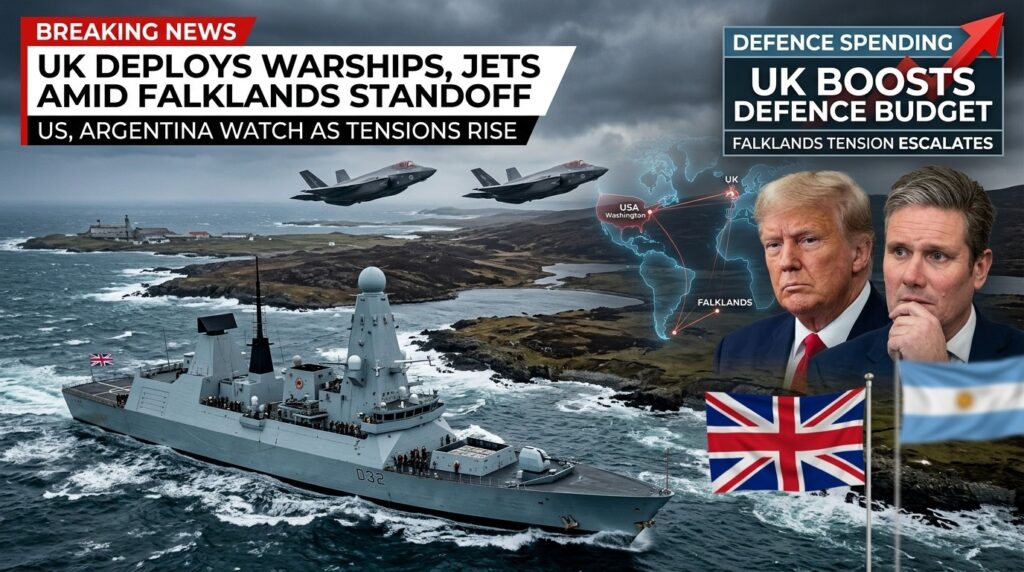
The United Kingdom has announced plans to outline an accelerated path toward higher military expenditure following explicit pressure from the United States. US President Donald Trump confirmed that Washington is reviewing its diplomatic stance on the Falkland Islands, signaling potential leverage over London’s NATO contributions. The move marks a sharp escalation in trans-Atlantic relations, forcing British policymakers to recalibrate defence budgets while defending territorial sovereignty in the South Atlantic.
- US Pressure: Washington is pressuring NATO allies to aim for a total defense and security spending target of 5% of GDP, treating the UK’s existing target of 3.5% by 2035 as insufficient.
- Falklands Leverage: Pentagon reports indicate Washington could revise or end its implicit support for British administration over the Falkland Islands (Las Malvinas) to enforce burden-sharing.
- UK Response: British Chancellor John Healey confirmed plans to set out a clear schedule toward hitting 3% of GDP on core defense, with an additional target date leading to 3.5% by 2035 ahead of the upcoming October budget
Washington Weaponises Falklands Sovereignty in NATO Row
The geopolitical diplomatic friction between Washington and London has intensified dramatically following statements from the White House. Speaking to reporters at the Oval Office, President Donald Trump stated that he is reviewing the US position regarding the Falkland Islands. “I always review every position – that’s just one of many,” Trump remarked when questioned on whether Washington might alter its historical stance on the South Atlantic territory.
The US officially maintains a policy of neutrality, recognizing British de facto administration of the territory while taking no side on formal sovereignty claims made by Argentina. However, reports from the Pentagon confirm that officials are exploring diplomatic leverage to compel European allies to drastically increase defense budgets. Senior Pentagon sources noted that Britain would receive “special attention” because of its economic potential and historic military capacity.
UK Fiscal Dilemma: The Cost of Reaching Military Targets
In direct response to Washington’s diplomatic maneuvering, British Chancellor John Healey confirmed at the G20 summit in North Carolina that London will establish a firm trajectory for military funding. Speaking on the upcoming UK spending review scheduled for October 28, Healey declared that the government will set an explicit schedule to reach 3% of GDP for core military spending before targeting 3.5% by 2035.
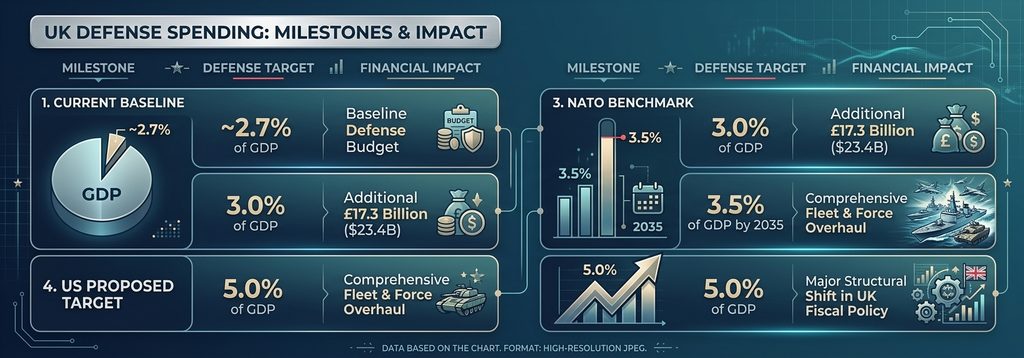
Meeting a 3% target by 2030 is estimated to cost an additional £17.3 billion ($23.4 billion) annually. For a British treasury constrained by strict borrowing rules, diverting funds to military assets poses severe fiscal challenges across domestic sectors.
Historical Context: The 1982 War and Modern South Atlantic Tensions
The Falkland Islands—known in Latin America as Las Malvinas—have remained a flashpoint since the 1982 war between Argentina and the United Kingdom. The 74-day conflict resulted in the deaths of 649 Argentine military personnel, 255 British troops, and three islanders.
While London considers the legal status of the islands settled based on self-determination—pointing to a 2013 referendum where 99.8% of islanders voted to remain a British Overseas Territory—Buenos Aires has continually asserted its claim. For Global South nations, including readers in South Asia, the dispute illustrates the persisting complexities of post-colonial territorial borders and major-power diplomacy. A shift in US neutrality would undermine four decades of trans-Atlantic policy, potentially reopening territorial debates in international forums like the United Nations.
Implications for Global Security and Strategic Alliances
Washington’s tactical use of territorial claims to enforce NATO spending goals sets a precedent in international relations. The policy highlights a transactional approach to traditional defense pacts, signaling that security guarantees and diplomatic backing from the US are explicitly linked to fiscal output.
For Asian and Middle Eastern observers, including defense analysts in Pakistan, this friction underscores a shifting global order:
- Multipolarity in Alliances: Western security architectures are undergoing internal strain as the US demands European nations manage their regional defense burdens independently.
- Precedent for Disputed Territories: Using territorial sovereignty claims as economic leverage demonstrates how localized border conflicts can be utilized in broader superpower bargaining.
- Reallocation of Military Assets: As Britain attempts to scale up its military budget to satisfy NATO standards, force deployment in the Indo-Pacific and South Atlantic may be restructured to cut operational costs.
The convergence of NATO spending demands and South Atlantic territorial disputes marks a significant juncture in trans-Atlantic security dynamics. As Britain prepares its upcoming spending review, London faces the challenge of balancing fiscal constraints with strategic alliances. Washington’s willingness to review long-standing diplomatic positions highlights an evolving era of international diplomacy where traditional security commitments are linked to defense contributions.