
KARACHI — in a landmark development for Pakistan’s power distribution sector, Kohat Cement Company Limited has officially disclosed its entry into a high-powered corporate alliance targeting state-owned power distribution infrastructure. According to a formal material information filing sent to the Pakistan Stock Exchange (PSX), Kohat Cement has joined hands with Hub Power Holdings Limited, Lucky Cement Limited, and Metro Ventures (Private) Limited to form a bidding consortium. The alliance has submitted an Expression of Interest (EOI) and Statement of Qualification (SOQ) for the proposed acquisition of a 51 percent to 100 percent equity stake, alongside operational management control, in Faisalabad Electric Supply Company Limited (FESCO).
- Target Entity: Faisalabad Electric Supply Company Limited (FESCO).
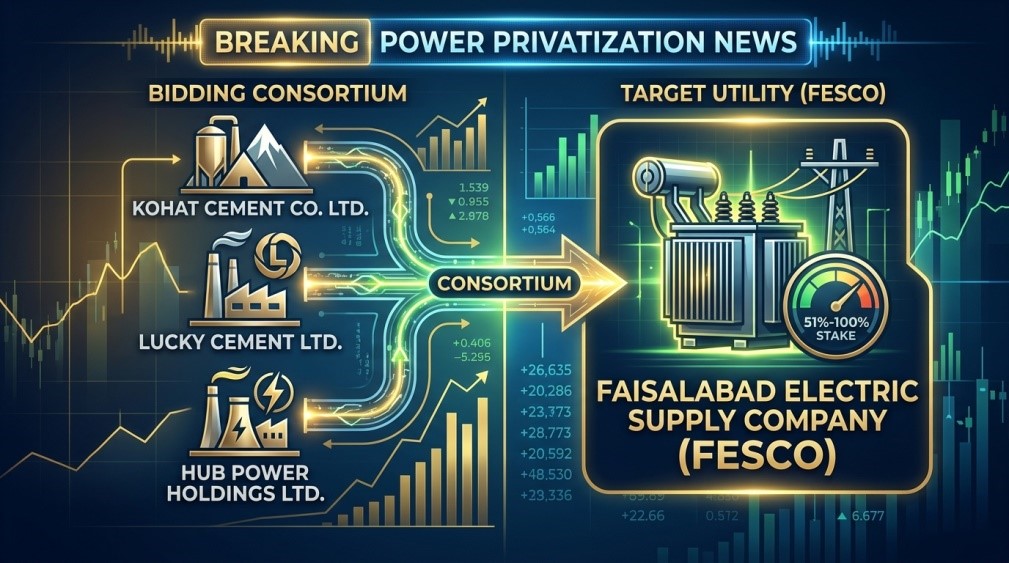
- Consortium Partners: Kohat Cement Company Limited, Lucky Cement Limited, Hub Power Holdings Limited, and Metro Ventures (Private) Limited.
- Transaction Scope: Proposed acquisition of a 51% to 100% equity stake along with full management control via competitive bidding.
- Current Status: Pre-qualified by the Privatization Commission of Pakistan; cleared to commence detailed financial, legal, and technical due diligence.
- Regulatory Compliance: Disclosed under Sections 96 and 131 of the Securities Act, 2015, and Regulation 5.6.1 of the PSX Rule Book.
Pre-Qualification Milestone in Pakistan’s Distribution Sector Privatization
The official disclosure issued by Kohat Cement Company Secretary Iqra Khalid confirms that the consortium has successfully scaled the initial regulatory hurdle administered by the Privatization Commission of Pakistan. Following a board meeting chaired by the Privatization Commission leadership, the consortium was formally pre-qualified among the shortlisted prospective bidders cleared to conduct comprehensive due diligence on FESCO.
This corporate maneuver represents a significant step forward in the federal government’s broader strategy to divest state-owned power distribution companies (DISCOs). FESCO, which services millions of industrial, commercial, and residential consumers across the industrial heartland of Punjab—including Faisalabad, Jhang, Sargodha, and surrounding districts—is widely considered one of the most commercially viable DISCOs in the national grid due to its relatively high recovery rates and dense industrial consumer base.
The involvement of heavyweights like Lucky Cement, Hub Power Holdings, and Kohat Cement underscores strong domestic corporate appetite for infrastructure assets, despite macroeconomic headwinds. Market analysts suggest that vertically integrated industrial groups are moving to secure power distribution networks to hedge energy supply logistics and capital deployment.
Non-Binding Commitment and Next Steps in Bidding Procedure
Despite achieving pre-qualification status, Kohat Cement explicitly emphasized in its PSX filing that the process remains at an exploratory, non-binding stage. The document clarifies that neither Kohat Cement nor its partner entities have entered into any legally binding financial or operational commitments regarding the actual acquisition of FESCO shares.
Any eventual binding agreement or financial bid will depend entirely on several critical prerequisites:
- Satisfactory Completion of Due Diligence: Detailed technical audit of distribution infrastructure, legal review of existing power purchase commitments, and financial evaluation of line losses and recoveries.
- Regulatory Approvals: Clearances from the Competition Commission of Pakistan (CCP), the National Electric Power Regulatory Authority (NEPRA), and corporate approvals from the respective boards of directors.
- Commercial Viability Determination: Independent evaluation of the transaction’s risk-reward profile, return on equity (ROE), and debt-restructuring conditions mandated by privatization terms.
The ultimate equity disposition—whether a controlling 51 percent stake or a full 100 percent transfer—will be determined through a transparent competitive bidding process governed by federal privatization laws.
3. Market Sentiment and Strategic Synergies for Listed Entities
The stock market reacted to the filing with measured optimism, as investors weighed the capital requirement against potential long-term earnings diversification. By aligning with Hub Power Holdings—the country’s largest independent power producer (IPP)—and Lucky Cement—Pakistan’s premier cement manufacturer—Kohat Cement gains access to deep balance sheet capacity and operational expertise required to turn around power distribution infrastructure. For energy-intensive manufacturers like cement producers, acquiring a stake in a major distribution network provide strategic insights into grid management, power load dynamics, and regional industrial demand patterns. Analysts note that if the consortium successfully wins the competitive bidding round, the capital expenditure needed for FESCO’s modernization will likely be structured through project finance mechanisms, minimizing direct cash drag on individual parent balance sheets in the immediate term.
The joint bid by Kohat Cement, Lucky Cement, Hub Power Holdings, and Metro Ventures represents a pivotal strategic alignment in Pakistan’s corporate landscape. As the Privatization Commission opens FESCO’s books for detailed financial and technical due diligence, the consortium positions itself as a frontrunner to acquire control of one of the country’s prime utility assets. While immediate operational impact remains contingent on competitive bidding outcomes and regulatory approvals, the move signals strong domestic corporate willingness to lead the privatization of critical state infrastructure.