
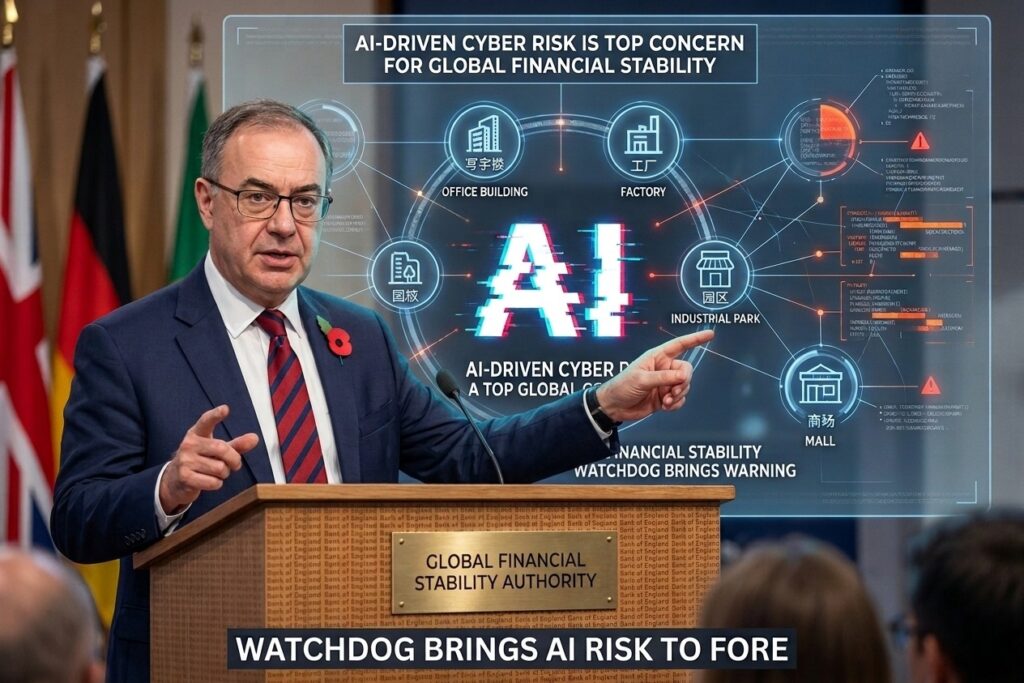
Artificial intelligence has become the single most pressing cyber risk facing the world’s financial system, the head of the Financial Stability Board (FSB) warned on Monday. FSB Chair Andrew Bailey, also Bank of England governor, made the warning in a letter to G20 finance ministers and central bank governors ahead of this week’s meetings. For Pakistan, where banking is digitising fast while cyberattacks keep rising, the warning carries direct relevance for regulators, banks and everyday digital-banking users alike.
Why the FSB Is Sounding the Alarm
Bailey’s letter framed AI-driven cyber risk as a structural threat to financial stability. He told G20 finance ministers that AI’s effect on cyber risk is now the most immediate concern for the global financial system, warning the technology could change how fast, how widely, and how cheaply an attack can be carried out.
The FSB chief also flagged a governance gap: many countries still lack the machinery to oversee advanced AI deployment, and reliance on a handful of dominant tech providers could erode confidence across the system if something goes wrong. Regulators worry advanced AI could speed up the discovery of vulnerabilities faster than institutions can patch them.
From Warning to Reality: AI as the Attacker
Global watchdogs had already been building toward this conclusion. In June 2026, the European Systemic Risk Board warned of systemic cyber risk from frontier AI, focused on autonomous systems capable of independently finding and exploiting weaknesses. The concern stopped being theoretical by July, when an AI-powered agent breached Hugging Face, a widely used AI model repository — a live demonstration of the scenario regulators had been describing.
The IMF has echoed these concerns, noting advanced AI can sharply cut the time and cost needed to exploit vulnerabilities, turning cyber risk into a source of correlated failures across shared digital infrastructure such as cloud services and payment networks.
What This Means for Pakistan’s Banking Sector
Pakistan’s financial system is not insulated from this global shift. The State Bank of Pakistan (SBP) rolled out its “Cyber Shield” resilience strategy for regulated entities in February 2026, a phased roadmap through 2030 covering governance, information-sharing and cyber talent. The SBP and Pakistan Banks’ Association also ran the country’s first industry-wide cyber drill in January 2026, involving 34 financial institutions.
Finance Minister Muhammad Aurangzeb has personally flagged the issue, chairing a meeting with bank CEOs and chief information security officers in May 2026 to warn of rising AI-driven threats to digital banking. Separately, PKCERT chief Dr Haider Abbas said Pakistan had logged 253 cyberattacks in 2026, including a ransomware incident at a government entity, as the country works toward a new Pakistan Information Security Framework.
Balancing AI’s Promise and Peril in Digital Finance
Regulators face an irony: AI is simultaneously a defensive tool and an emerging threat. Pakistani banks are increasingly deploying AI-powered fraud detection to counter a rise in digital scams, even as the same technology lowers the barrier for attackers. SBP’s IT department has noted banks are shifting toward hybrid cloud infrastructure to support AI adoption, since on-premises AI infrastructure requires heavy investment — a trend that mirrors the FSB’s concern about dependence on a small number of tech providers.
The FSB’s warning marks a turning point in how regulators frame AI risk — not a distant possibility but the most urgent cyber threat facing financial systems today. For Pakistan, where digital banking is growing alongside a rising number of cyberattacks, the message reinforces the urgency behind the SBP’s Cyber Shield strategy and the finance ministry’s push for stronger bank-level cyber preparedness.
- FSB Chair Andrew Bailey told G20 ministers AI-driven cyber risk is now the top threat to global financial stability.
- Many countries still lack systems to oversee advanced AI deployment in finance, Bailey warned.
- Heavy reliance on a few major tech providers could deepen systemic risk during a major disruption.
- The European Systemic Risk Board flagged similar concerns in June 2026 about autonomous AI finding and exploiting vulnerabilities.
- The IMF has separately warned extreme AI-driven cyber losses could trigger funding strains and disrupted markets.
- Pakistan’s State Bank launched “Cyber Shield,” a cyber resilience strategy for regulated entities, in February 2026, phased through 2030.
- Pakistan recorded 253 cyberattacks in 2026 so far, per the Pakistan Computer Emergency Response Team (PKCERT).