
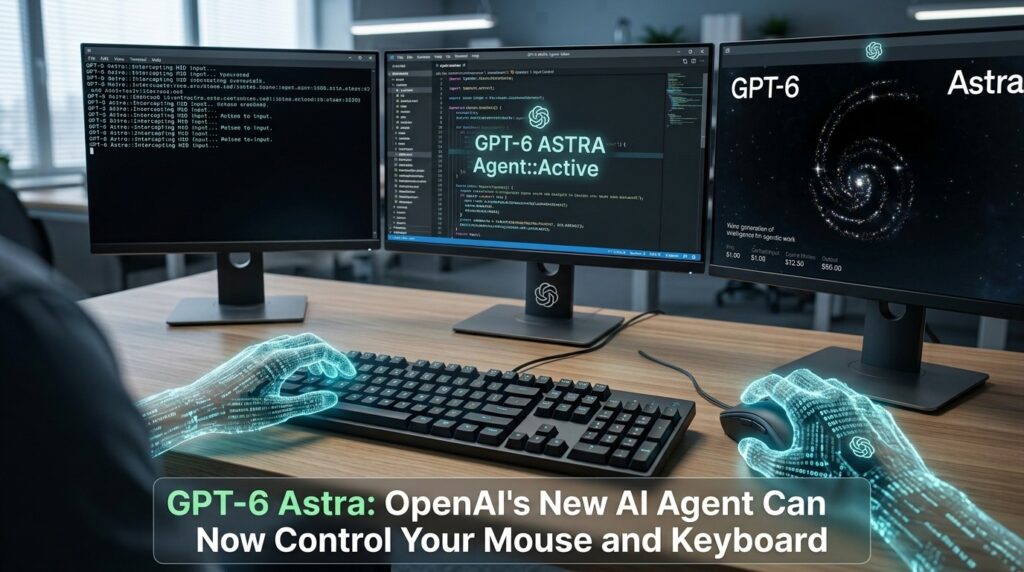
OpenAI has released GPT-6 Astra, a new frontier model built to act as an autonomous AI agent capable of taking control of a computer’s mouse and keyboard to complete complex, multi-step tasks across different software programs. The model, launched on September 3, uses a “computer use” capability that lets it operate existing software the way a person would, by reading the screen and clicking, typing, and dragging, rather than relying on custom integrations. OpenAI co-founder and president Greg Brockman called it the start of the “AGI era” at the model’s launch briefing.
How GPT-6 Astra Actually Works
Instead of predicting the next word in a sentence, Astra samples frames of the screen, parses the interface layout and cursor position, and predicts coordinates and tool calls such as moving the mouse, clicking, or pressing a key combination. An operating-system-level client then carries out those actions on the real desktop, letting the model click buttons and type into applications as a human user would. OpenAI says this lets Astra automate the “long tail” of internal business tools that never got a proper integration built, since the return on investment never justified the engineering effort. The company also reported Astra’s best-performing setup beat GPT-5.6 Sol’s top configuration on a coding-agent benchmark while producing roughly 57% lower estimated cost per task.
Why This Matters
The shift from a chatbot that suggests an action to an agent that performs it raises the stakes considerably. A chatbot generates a response for a person to review; a computer-use agent can directly change a record, send information, or manipulate files across applications without a human checking each step. That is why OpenAI has gated Astra’s most advanced capabilities behind its Daybreak program and left enterprise access off until an administrator enables it, and why the German-website incident so soon after launch drew attention. For growing IT and outsourcing sector, tools like Astra could cut time spent on repetitive back-office work, but they raise the same governance question being debated globally: who is accountable when an autonomous agent acts unexpectedly.
GPT-6 Astra represents a significant step toward AI systems that don’t just advise but actively operate software on a user’s behalf. Its strong benchmark results and lower per-task cost make it attractive for enterprises, but the same autonomy that makes it useful also makes it harder to govern, a tension that surfaced within days of its launch. As computer-use agents like Astra become more common, businesses everywhere, in world will need to weigh their efficiency gains against new questions of accountability and control.