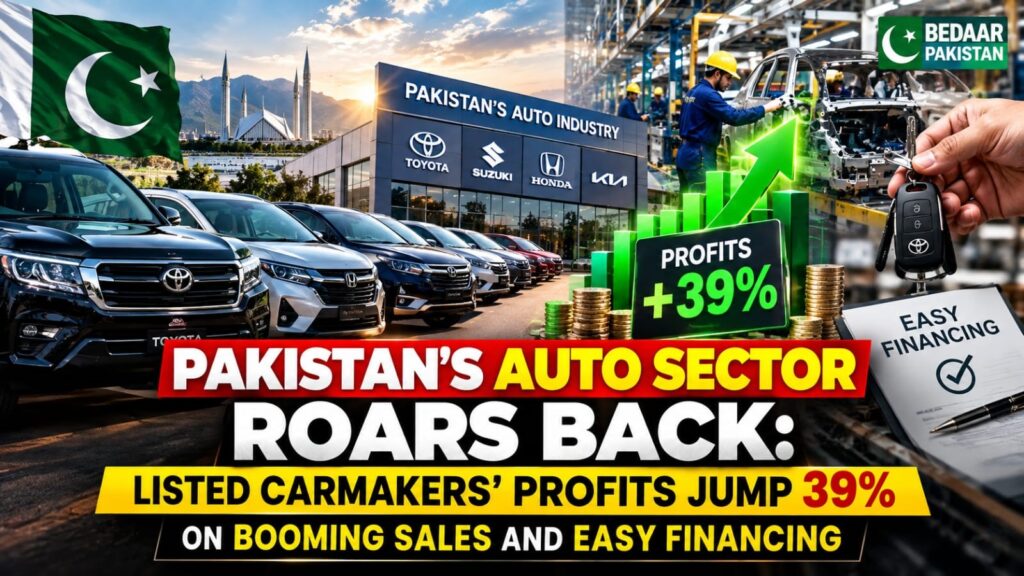
Pakistan’s listed automobile manufacturers have posted a sharp rebound in earnings, with combined profits climbing 39.2% year-on-year during the April-June 2026 quarter. The surge, detailed in a fresh Arif Habib Limited (AHL) research report, was driven by a wave of new vehicle sales, fresh model launches and a significant expansion in auto financing. The numbers offer the clearest signal yet that Pakistan’s auto industry, long squeezed by high interest rates and weak demand, is finding its footing again
Sazgar Leads the Pack as Financing Fuels Demand
The report, compiled by Arif Habib Limited, credited the profit surge to a combination of strong vehicle sales, new model launches and a substantial rise in auto financing across the sector. Among individual companies, Sazgar Engineering Works emerged as the standout performer, posting a 150.6% jump in quarterly profit to Rs8.7 billion, backed by revenue growth of 180.7% as its four-wheeler sales more than doubled to 6,549 units, alongside deliveries of its Tank 500 model.
Atlas Honda’s earnings rose 25.2% to Rs6 billion, while Honda Atlas Cars posted a threefold increase in profit to Rs2.5 billion. Millat Tractors saw earnings grow 36.3% to Rs1.8 billion as sales volumes expanded 42.4%. Not every listed player shared in the boom: Indus Motor’s profit fell 5.4% to Rs6.1 billion amid lower revenue and rising competition, Ghandhara Automobiles’ consolidated profit dropped 14.6% to Rs1.6 billion, and Ghandhara Industries’ earnings stayed broadly flat at Rs1.7 billion.
The improvement in access to financing played a central role in reviving demand, with outstanding auto loans expanding by more than a third over the year. Beyond passenger vehicles, industry-wide tractor sales grew 42.6% to 8,499 units, truck sales rose 37.2% to 2,561 units, and two-wheeler sales advanced 27.4% to 530,481 units during the quarter.
Government Pushes Localisation and Electric Mobility
The earnings report coincided with the Pakistan International Auto Show 2026 at the Lahore International Expo Centre, where Coordinator to the Prime Minister for Commerce and Industries, Rana Ihsan Afzal Khan, addressed industry leaders at the Paapam Symposium on its second day. Organised by the Pakistan Association of Automotive Parts and Accessories Manufacturers (Paapam) under the theme “Competitiveness – Localisation and Electric Mobility,” the symposium brought together automotive executives, government officials and academia.
Rana Ihsan Afzal underscored the need for competitive localisation, technological advancement and a faster transition toward electric mobility to secure the industry’s future. He said localisation must go beyond domestic production and be strategically aligned with global competitiveness, affordability, quality and reliability, adding that consumers must be given greater choice and confidence through a technologically advanced automotive ecosystem.
Highlighting the sector’s economic weight, he noted that every vehicle produced in Pakistan supports an extensive value chain of manufacturers, vendors, engineers, technicians and workers, with the automotive sector contributing nearly 4% to national GDP and employing millions of Pakistanis. He reaffirmed the government’s commitment to working with industry stakeholders on policies that are inclusive, future-oriented, consistent and fair, and said the sector must now prepare decisively for emerging technologies, particularly electric vehicles.
What This Means for Pakistani Consumers and Investors
For car buyers, the combination of new model launches and expanding financing options signals more choice and easier access to credit than in recent years, when high borrowing costs kept many households out of the market. For investors tracking the KSE-100, the sector’s improved margins and Sazgar’s standout performance highlight where growth is concentrated, even as established players like Indus Motor face margin pressure from intensifying competition. The government’s parallel push on localisation and electric vehicle policy suggests the next phase of growth may hinge less on financing cycles and more on how quickly manufacturers adapt their product lines to new-energy vehicles.
Future Of Pakistan Auto Sector
Pakistan’s auto sector has delivered one of its strongest quarterly performances in recent memory, with a 39.2% jump in combined profitability reflecting a genuine recovery in consumer demand, supported by cheaper financing and a wave of new models.
Yet the divergent fortunes within the sector Sazgar’s triple-digit growth against declines at Indus Motor and Ghandhara Automobiles show that the recovery is uneven. With the government now urging localisation and a faster shift to electric mobility, the industry’s next challenge will be sustaining this momentum while adapting to a rapidly changing global auto landscape