
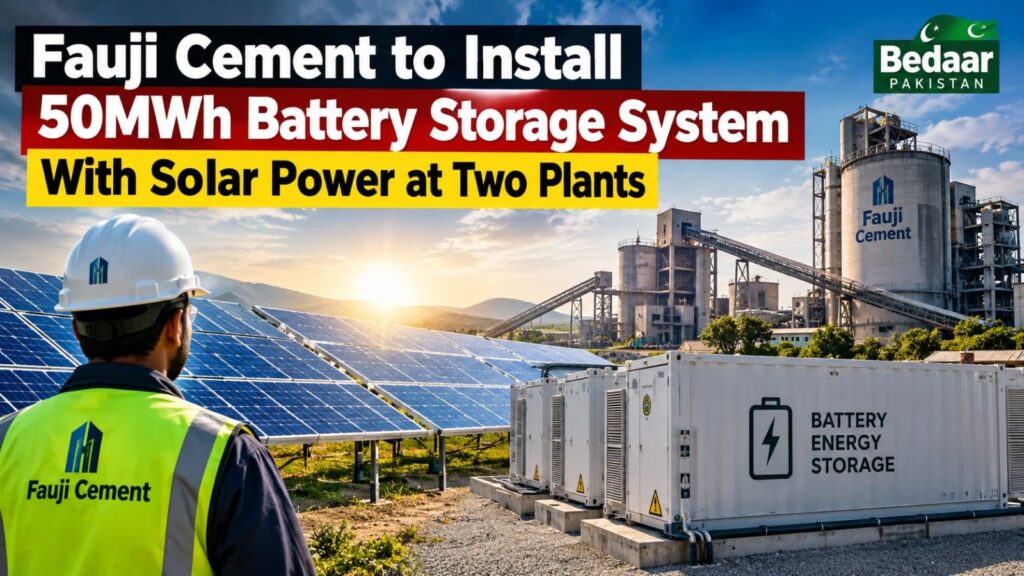
Fauji Cement Company Limited (FCCL) has approved a major renewable energy investment, installing Battery Energy Storage Systems paired with dedicated solar power capacity at two of its production sites. The Board of Directors gave the go-ahead through a Resolution by Circulation, according to a notice filed with the Pakistan Stock Exchange (PSX) on Monday. The move deepens FCCL’s long-running push toward captive green energy as the cement maker looks to cut costs tied to peak grid electricity.
What the Company Told the Stock Exchange
In its filing to the General Manager of the Pakistan Stock Exchange, FCCL described the approval as material information for shareholders and market participants. The company stated that the project is intended to store daytime solar energy in the BESS for discharge during evening peak hours, thereby reducing reliance on peak grid electricity, optimising the company’s energy costs and enhancing its renewable energy capacity.
The dual-site structure — identical 5 MW solar setups paired with BESS units at both Nizampur and Jhang Bahtar — indicates FCCL is standardising its approach to energy storage across its plant network rather than treating it as a one-off pilot. Copies of the notice were sent to the Securities and Exchange Commission of Pakistan (SECP), the Central Depository Company of Pakistan, and the company’s share registrar, Corplink (Pvt) Limited, as part of standard regulatory disclosure requirements for listed companies.
Part of a Broader Green Energy Strategy
The BESS announcement is the latest step in a renewable energy build-out FCCL has pursued for more than a decade. The company, Pakistan’s third-largest cement producer by capacity with plants in Jhang Bahtar, Wah, Nizampur and Dera Ghazi Khan, has steadily expanded its captive power portfolio through solar installations and waste heat recovery plants. FCCL previously commissioned a 26MW Ashar Navaid Solar Park at its Nizampur plant and has operated waste heat recovery units generating power from its cement production process for years, alongside a solar plant at Jhang Bahtar first approved in 2018.
Industry reporting has previously noted that self-generated and green power sources meet a significant share of FCCL’s total electricity requirement, helping the company manage volatile grid tariffs that have squeezed energy-intensive manufacturers across Pakistan. Cement production is highly energy-intensive, and captive power — particularly renewable sources like solar — has become a strategic priority for major producers seeking to control input costs amid Pakistan’s fluctuating electricity prices.
The timing of this latest approval also comes on the back of a strong financial year for the company. FCCL reported a profit after tax of Rs16.18 billion for the financial year ended June 2026, up 21% from Rs13.33 billion a year earlier, on turnover of Rs93.69 billion. The company also completed a landmark acquisition of a 92% controlling stake in Attock Cement Pakistan Limited during the year, in partnership with Kot Addu Power Company Limited, as part of a wider consolidation strategy in Pakistan’s cement sector.
Why Battery Storage Matters for Pakistan’s Industrial Sector
Battery Energy Storage Systems represent a growing trend among Pakistan’s energy-intensive industries, allowing companies to capture cheaper daytime solar generation and deploy it during costlier evening peak-demand hours, when grid electricity tariffs are typically highest. For cement manufacturers, which run continuous, energy-hungry kilns and grinding operations, this time-shifting capability can meaningfully reduce dependence on the national grid during periods of peak pricing and potential load-shedding.
FCCL’s move also reflects a broader shift among Pakistan Stock Exchange-listed industrial firms toward integrating storage technology alongside renewable generation, rather than relying on solar or wind capacity alone. Solar power without storage is only available during daylight hours, whereas pairing it with a battery system allows manufacturers to use stored solar energy well into the evening, when factories often continue operating at full capacity.
Fauji Cement’s approval of a 50MWh Battery Energy Storage System paired with 10MW of dedicated solar capacity at its Nizampur and Jhang Bahtar plants marks a further step in the company’s long-term captive energy strategy. With the project expected to be completed within 10 months, FCCL is positioning itself to reduce peak-hour grid dependence and lower energy costs at a time when the company has just posted a 21% jump in annual profit. As Pakistan’s cement sector continues to grapple with high energy costs and grid reliability concerns, FCCL’s investment adds to a growing pattern of listed industrial firms turning to solar-plus-storage solutions to protect margins and secure more predictable power supplies.