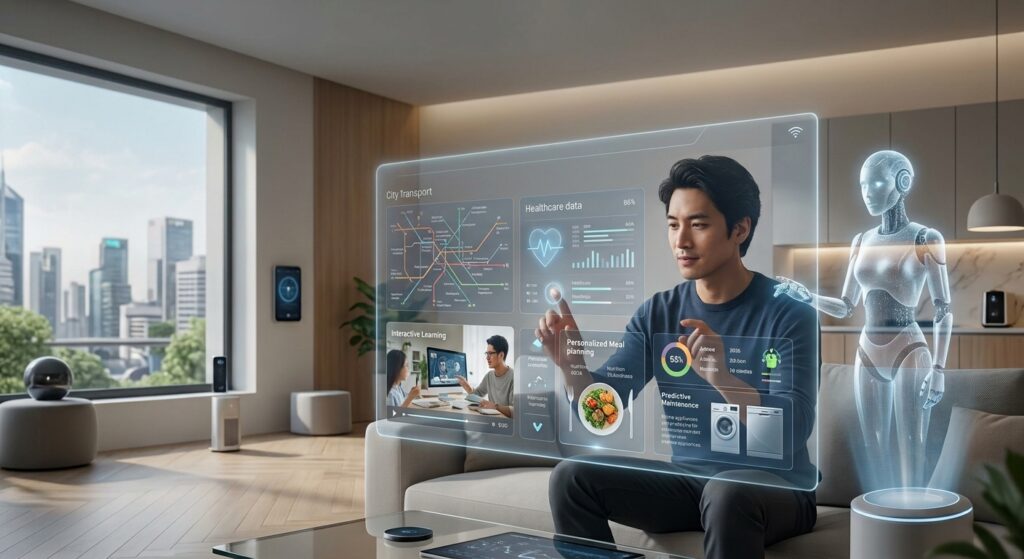
Imagine starting your day with a tool that can answer a question, organize your work, translate a message, explain a difficult topic or help turn an idea into something useful — all within seconds. For many people around the world, this is no longer a glimpse of the future; it is becoming part of everyday life. As artificial intelligence continues to become more capable, its next chapter could bring new possibilities for the way people work, learn, create and solve everyday problems.
- AI is moving beyond simple chatbots toward systems that can reason, use tools and handle multi-step tasks.
- New AI models are making voice interaction and complex tasks more natural and accessible.
- AI tools are expanding into everyday uses such as learning, research, writing and productivity.
- As AI becomes more capable, knowing how to use, guide and check AI tools is becoming an increasingly useful digital skill
Sources
- OpenAI — Introducing the Agents API, September 10, 2026
- Google — Gemini 3.8 Live & Gemini 3.8 Live Extended Thinking, September 15, 2026
- Google — Sharpen Your Study Routine with New Gemini Notebook Tools, September 15, 2026
AI Is Becoming Part of Everyday Life
Not long ago, artificial intelligence seemed like something limited to research labs and advanced technology companies. Today, it is quietly becoming part of ordinary routines. People use AI to find information, translate languages, draft emails, summarize documents, create images, learn new subjects and organize their work. AI is also making every day digital tasks faster and easier.
The change is not always dramatic. Sometimes it appears as a feature inside an app or a tool that saves someone a few minutes during a busy day. A student may use AI to understand a difficult concept, while a small business owner may use it to prepare content or communicate with customers. These simple interactions show how AI is gradually moving from a specialized technology into a practical everyday tool.
As adoption grows, the bigger story is no longer simply about what AI can do. It is about how people are finding new ways to use the technology alongside their existing skills.
From Simple Tools to Smarter Assistants
What if AI could do more than simply answer your question?
That shift is already happening. Recent AI developments are moving from simple chatbots toward systems that can reason, use tools and handle multiple steps to complete a task.
In September 2026, OpenAI introduced its Agents API, allowing developers to build AI agents that can work with files, use tools, run code and manage longer tasks. Google has also introduced Gemini 3.8 Live, designed to handle complex tasks through more natural voice conversations and multi-step reasoning.
For everyday users, this could change the way we interact with technology. Instead of asking, “How do I do this?”, we may increasingly be able to say, “Help me do this.”
AI is gradually moving from simply giving answers to helping people get things done.
Make AI Work for You
Imagine having a digital assistant ready whenever you need one — to explain a difficult topic, organise your ideas, improve your writing or help with research.
The interesting part is that AI is becoming easier to use even for people without advanced technical skills. Recent tools are bringing research, writing, analysis and everyday tasks into simpler, more accessible AI experiences. For example, Google’s latest Gemini Notebook updates allow users to discuss their notes, create quizzes, flashcards and even turn complex material into short video summaries.
So, learning AI does not necessarily mean learning to code. It can begin with simple skills: writing clear prompts, choosing the right tool, checking information and improving AI-generated results.
A student, writer, teacher, designer or business owner can use these skills in completely different ways.
The real opportunity is not just using AI — it is learning how to make it useful for you.
Preparing for an AI-Powered Future
AI is becoming more than a tool we open when we need an answer. With newer AI agents and voice-based systems, technology is moving toward helping people complete tasks and interact with digital tools more naturally.
But as AI becomes smarter, human skills will still matter. Creativity, critical thinking, communication and good judgement will help people decide how to use these tools effectively.
The future may not be about people versus AI. It could simply be about people using better technology to do more.
Every major technology changes the way people live, but its real value lies in the possibilities it opens.
AI is already helping people learn, create, work and explore ideas in new ways. As it continues to evolve, those possibilities are likely to grow.
The question is no longer whether AI will change everyday life, but what we will choose to create with it.