
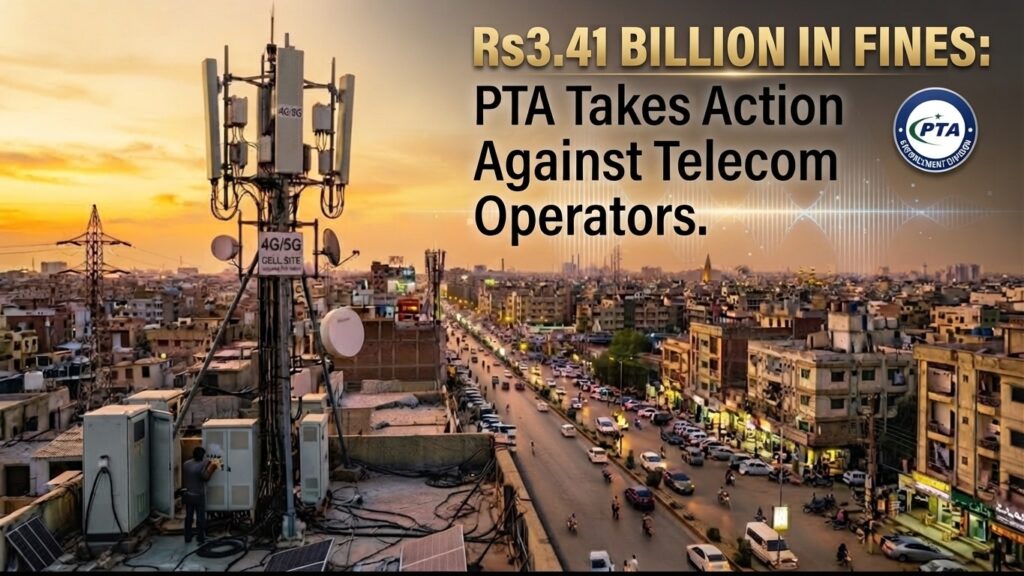
Pakistan’s telecom regulator has imposed financial penalties totaling Rs3.41 billion on telecom operators over the past four years, amid complaints about weak coverage, slow internet and unreliable mobile services. The Pakistan Telecommunication Authority (PTA) also issued 86 show-cause notices and 20 warning letters
PTA Fines Telecom Companies Over Service Quality
Federal Minister for Information Technology and Telecommunication Shaza Fatima Khawaja disclosed the figures in a written reply submitted to the National Assembly. PTA conducted more than 500 Quality of Service (QoS) surveys across cities, rural areas, highways, motorways and railway corridors during the four-year period.
The regulator also carried out more than 200 complaint-based surveys to investigate consumer grievances. Where operators fail to meet prescribed standards, PTA can issue warnings, show-cause notices and financial penalties under the Pakistan Telecommunication (Re-organisation) Act, 1996, applicable licences and Cellular Mobile Network QoS Regulations.
The Rs3.41 billion represents cumulative penalties imposed over four years, rather than a single fine against one company. The move keeps regulatory scrutiny focused on consumer-facing service standards nationwide and network performance.
Why Are Telecom Operators Being Fined?
PTA’s enforcement action covers failures involving quality of service, network coverage and other service-related obligations. For consumers, such problems can mean weak signals, dropped calls, slow mobile data and unreliable connectivity.
The National Assembly Standing Committee on Information Technology and Telecommunication has recently expressed concern over mobile and internet services. On September 10, the committee directed PTA to submit details of show-cause notices and fines imposed during the previous six months, including amounts recovered and outstanding.
PTA told lawmakers that it conducts QoS surveys and gives operators time to correct deficiencies. If problems remain after a re-survey, the regulator can issue a show-cause notice and impose a fine under applicable rules. PTA also informed the committee that a fine of up to Rs350 million may be imposed on telecom operators.
Pakistan’s Telecom Sector Faces Quality Concerns
The Pakistan Economic Survey 2025-26 reported 207.2 million telecom subscriptions and 161 million broadband subscribers by March 2026. Telecom-sector revenue reached Rs837 billion during July-March FY2026.
Despite the size of the sector, Parliament continues to receive complaints about poor connectivity. In July, the National Assembly committee highlighted slow internet speeds and repeated call connection failures in remote areas and major cities, including Karachi.
The government says service standards are being strengthened through revised Next Generation Mobile Services licence conditions following the recent spectrum auction. These include higher QoS benchmarks, additional 4G and 5G rollout obligations and network modernisation requirements.
What Does the Rs3.41 Billion Fine Mean for Consumers?
The penalties demonstrate that PTA is using financial enforcement against operators that fail to meet licence and service-quality requirements. However, fines alone do not guarantee better connectivity.
For consumers, the key question is whether enforcement is followed by improvements in network coverage, call quality, data speeds and reliability. Parliament has asked PTA and telecom operators to explain how persistent service problems will be addressed.
- Penalty total: Rs3.41 billion
- Show-cause notices: 86
- Warning letters: 20
- QoS surveys: More than 500
- Complaint-based surveys: More than 200
- Maximum fine cited by PTA: Up to Rs350 million
The Rs3.41 billion in telecom fines highlights Pakistan’s continuing struggle with mobile and internet service quality. PTA has conducted hundreds of quality and complaint-based surveys, while Parliament is demanding greater transparency over penalties and corrective measures. For Pakistani consumers, the real test will not be the size of the fines, but whether networks become faster, more reliable and more widely available.