
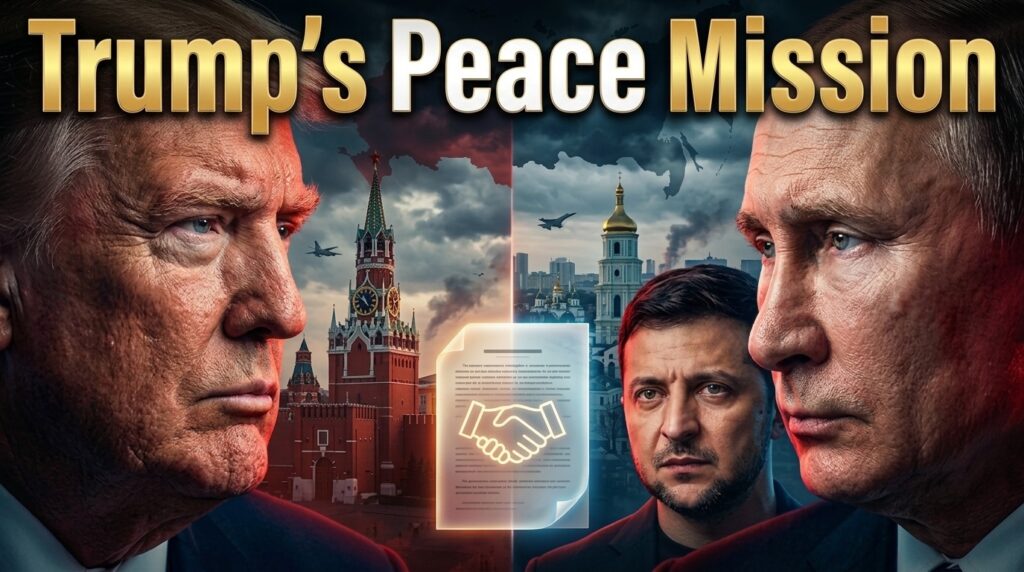
U.S. President Donald Trump has dispatched top envoys Steve Witkoff and Jared Kushner on a high-stakes diplomatic mission to Moscow and Kyiv with a new peace framework aimed at ending the Russia-Ukraine war. Speaking to reporters in the Oval Office, Trump confirmed that the two negotiators are tasked with breaking a monthslong diplomatic deadlock between Russian President Vladimir Putin and Ukrainian President Volodymyr Zelenskyy. The strategic shuttle diplomacy comes amid intense battlefield hostilities, highlighting Washington’s renewed push to broker a settlement in the multi-year conflict.
High-Stakes Diplomacy: Trump Dispatches Top Negotiators
In a bid to reignite paused peace negotiations, President Trump revealed that Special Envoy Steve Witkoff and senior adviser Jared Kushner carry a concrete peace proposal. “We have an idea for peace,” Trump told reporters, praising the pair as “great negotiators” with “a good chance” of making progress.
The mission represents the first direct, high-level diplomatic outreach to Kyiv by Witkoff and Kushner since Trump took office. Prior negotiations held early in Abu Dhabi and Geneva stalled, partly owing to shifting global priorities and ongoing regional tensions. Washington’s new diplomatic momentum seeks to restore direct communication channels and test whether either party is willing to compromise.
Key Human and Geopolitical Statistics
- Monthly Troop Loss Estimates: Trump highlighted human losses averaging nearly 25,000 casualties a month as a core reason why a settlement is urgent.
- Diplomatic Timeline: Prior U.S.-mediated rounds included Abu Dhabi (Jan 23–24, Feb 4–5) and Geneva (Feb 17–18).
- Displaced Population: Over 6 million Ukrainians remain displaced across Europe due to ongoing frontline operations.
- Global Economic Impact: Energy and grain price volatility continues to affect global markets, particularly developing economies in South Asia.
Escalation vs. Mediation: Kremlin and Kyiv Responses
The diplomatic push unfolds against a backdrop of severe military tension. Ukrainian troops were ordered to observe a localized, temporary halt in fighting to ensure the safe passage and travel logistics of the American delegation. President Zelenskyy confirmed on social media that Kyiv prepared extensively for the talks, promising to refrain from aerial strikes during the delegation’s visit while urging Moscow to show equal restraint.
Despite the proposed pause, volatile strikes continue near the Ukrainian capital. A Russian drone strike recently hit the headquarters of Ukraine’s SBU security service in central Kyiv. Intelligence analysts remain divided: Western officials question whether the Kremlin seeks an immediate truce, while Kyiv cautions that battlefield maneuvers could escalate alongside negotiations.
The Personality Barrier: Putin and Zelenskyy’s Rift
Addressing the political friction hindering a resolution, Trump framed the standoff partly around personal animosity. “It’s a personality problem in Russia-Ukraine. You have President Zelenskyy and President Putin; they truly hate each other,” Trump noted during his Oval Office briefing, adding that deep personal animosity actively blocks compromise.
Moscow has consistently demanded recognition of territorial control and guarantees against NATO enlargement, whereas Kyiv insists on full territorial integrity and security guarantees. Overcoming this core divide requires significant flexibility from both sides—an outcome U.S. envoys hope to test during their visits to Moscow and Kyiv.
The high-stakes journey of Steve Witkoff and Jared Kushner represents one of the most visible U.S. diplomatic interventions in the Russia-Ukraine conflict to date. While structural divisions over territory and security remain formidable, Washington’s direct push reflects growing urgency to end the devastating military conflict. The success of this diplomatic race between Moscow and Kyiv will depend on whether both warring parties are ready to transition from battlefield attrition to substantive political negotiation