
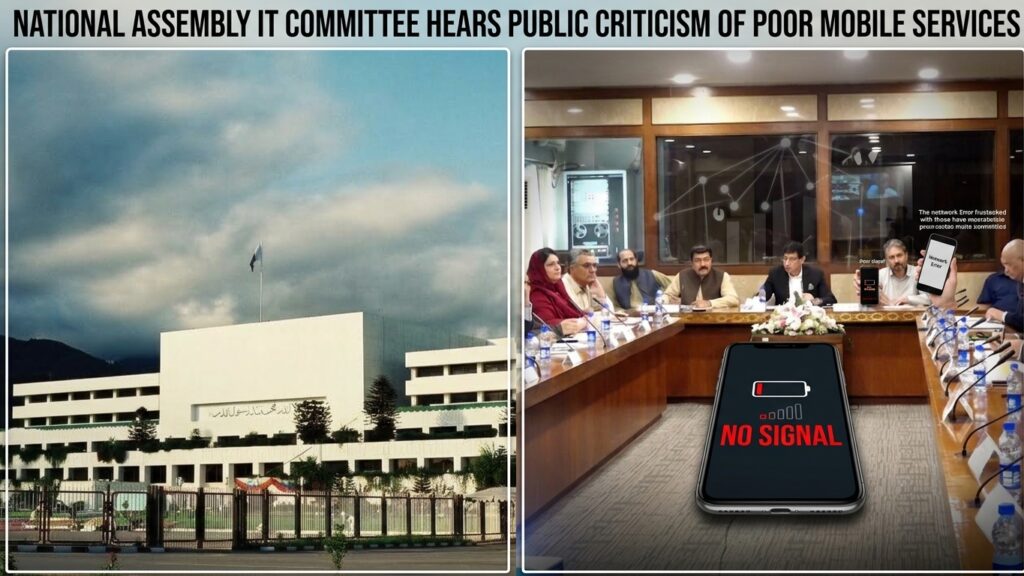
The National Assembly Standing Committee on Information Technology and Telecommunication has censured regulatory authorities and cellular operators over deteriorating mobile connectivity across the country. During a parliamentary session chaired by Syed Amin-ul-Haque, lawmakers voiced strong frustration over frequent dropped calls, sluggish internet speeds, and inadequate network enforcement by the Pakistan Telecommunication Authority (PTA).
NA Panel Lambastes Regulatory Inaction on Poor Mobile Services Pakistan
Lawmakers expressed severe concern over the nationwide decline in cellular connectivity, observing that network disruptions affect both rural regions and major metropolitan centers, including Karachi. Committee members pointed out that subscribers frequently face multiple failed attempts before a call successfully connects.
The parliamentary body questioned the PTA regarding its enforcement mechanisms against non-compliant telecom firms. Official briefings disclosed that while regulatory bodies issued numerous warnings, administrative fines collected amounted to Rs 68.9 million—far below the legal penalty threshold of Rs 350 million. Committee members stressed that poor mobile services Pakistan consumers endure daily stem from inadequate oversight and power management failures at cellular towers during extended load-shedding. Consequently, the panel summoned chief executives of major mobile operators to explain connection failures directly.
Transitioning to 4G/5G and Addressing Consumer Vulnerabilities
The committee instructed stakeholders to align domestic manufacturing with a broader “Smartphone for All” national vision. Chairman Syed Amin-ul-Haque stated that local factories must phase out basic 3G hardware and focus entirely on affordable 4G and 5G smartphones to meet modern data demands.
In addition to technology standards, the committee highlighted consumer challenges, noting that street crime in cities like Karachi leaves citizens vulnerable to frequent phone theft. Access to durable, locally produced smartphones ensures affected citizens can secure affordable replacements without facing exorbitant import taxes.
Alternative Energy Urged to Resolve Telecom Tower Blackouts
Addressing underlying operational hurdles contributing to poor mobile services Pakistan, the committee identified energy shortages as a primary operational bottleneck. Extended power outages force tower sites to rely on batteries or diesel generators, which are frequently targeted by fuel theft.
To build long-term resilience, the committee recommended that telecom operators transition tower infrastructure toward alternative green energy sources, such as wind and solar power. Utilizing regional wind corridors would lower operational expenditure, reduce reliance on diesel, and sustain continuous cellular coverage during power outages.
Regulatory Modernization and Spectrum Expansion
The PTA briefed the panel that total allocated spectrum increased from 274 MHz to 754 MHz following recent spectrum auctions, providing the raw capacity necessary to enhance cellular bandwidth nationwide. Regulatory authorities assured lawmakers that network capacity expansion, alongside strict compliance monitoring, will lead to progressive quality improvements over coming months
The National Assembly IT Committee’s twin focus on service accountability and industrial growth marks a critical juncture for Pakistan’s telecommunications sector. By holding mobile operators accountable for call drops lawmakers aim to elevate infrastructure standards in Pakistan.