
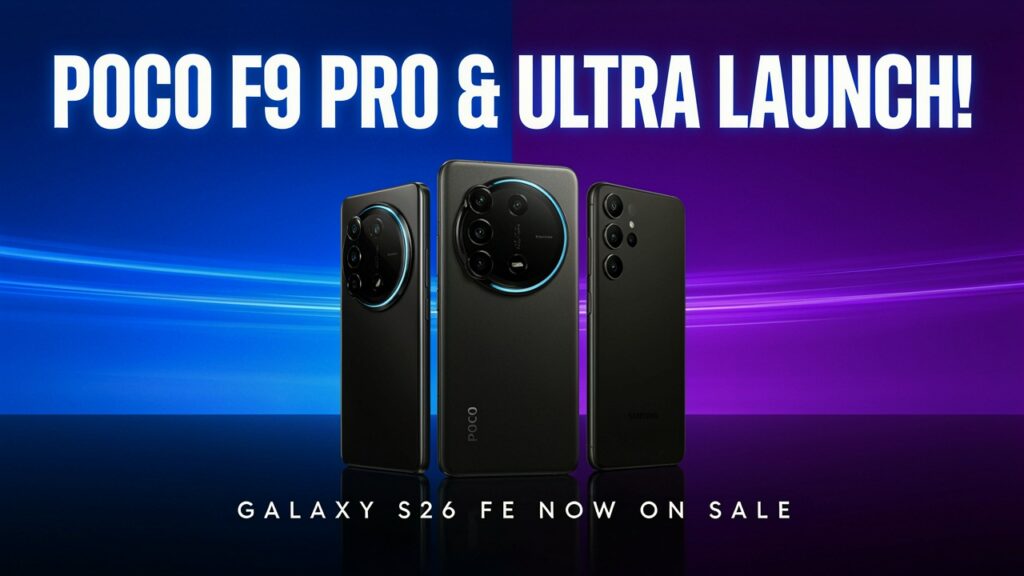
Mobile technology markets saw a major wave of mid-tier and flagship releases as Xiaomi sub-brand POCO officially launched its premium F9 Pro and F9 Ultra smartphones, coinciding with Samsung placing its new Galaxy S26 FE on store shelves worldwide. The simultaneous market rollouts set up a fierce commercial battle across North America, Europe, and key Asian hubs for value-focused flagship buyers.
POCO F9 Pro Delivers High Refresh Rate Display and 200MP Imaging
The POCO F9 Pro enters the sub-flagship segment powered by Qualcomm’s 3nm Snapdragon 8 Elite Gen 5 V processor. Upgrading visual fluidity for mobile gaming and media, the device integrates a 6.59-inch AMOLED display with a 185Hz refresh rate and a peak brightness rating reaching 4,500 nits.
On the rear, the F9 Pro carries an optically stabilized 200MP primary sensor alongside a 50MP telephoto camera and an 8MP ultra-wide lens. Energy is provided by a 6,330mAh battery supporting 100W HyperCharge fast charging and 50W wireless top-ups.
POCO F9 Ultra Sets Battery and Hardware Standards
Positioned at the top of POCO’s line-up, the F9 Ultra introduces an 8,050mAh silicon-carbon (Si/C) battery designed to deliver multi-day operational endurance. The phone features a larger 6.9-inch 1.5K AMOLED display protected by Corning Gorilla Glass 7i while retaining the 185Hz refresh rate found on the Pro variant.
To support sustained processing loads, POCO incorporated its proprietary 3D IceLoop cooling system alongside the Snapdragon 8 Elite Gen 5 processor. Its camera configuration upgrades the telephoto assembly to a 50MP periscope module offering 5x optical zoom alongside a 50MP ultra-wide sensor.
Operating Systems and AI Features Drive Competition
All newly launched models arrive pre-installed with Android 16, utilizing custom user interfaces. POCO relies on Xiaomi’s HyperOS 3 to manage background performance and frame rate stability during gaming, whereas Samsung integrates One UI to deliver productivity tools, photo editing suites, and real-time translation features.
Software optimization across these devices focuses heavily on battery management algorithms and dynamic display adjustments to handle high-brightness media consumption efficiently.
Operating Systems and AI Features Drive Competition
All newly launched models arrive pre-installed with Android 16, utilizing custom user interfaces. POCO relies on Xiaomi’s HyperOS 3 to manage background performance and frame rate stability during gaming, whereas Samsung integrates One UI to deliver productivity tools, photo editing suites, and real-time translation features.
Software optimization across these devices focuses heavily on battery management algorithms and dynamic display adjustments to handle high-brightness media consumption efficiently.
The arrival of the POCO F9 Pro, POCO F9 Ultra, and Samsung Galaxy S26 FE provides consumers with a diverse range of high-performance mobile options. As displays push toward 185Hz refresh rates and battery sizes expand past 8,000mAh, hardware manufacturers continue to redefine expectations for mid-range and sub-flagship devices