
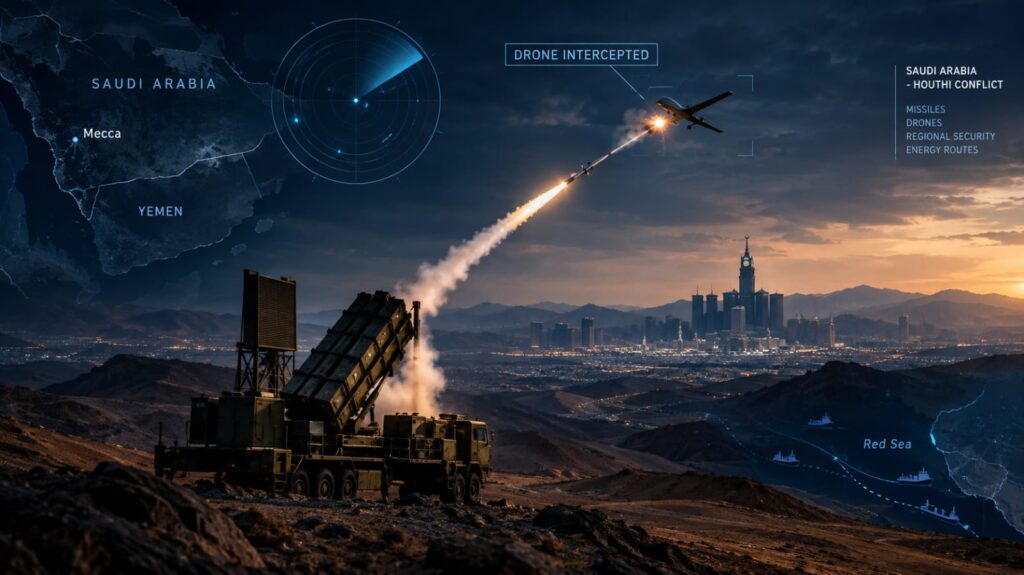
Saudi Arabia said its air defences destroyed a Houthi drone south of Mecca on September 15 before it entered the holy city’s restricted airspace. The incident comes amid a sharp escalation in fighting between Riyadh and Yemen’s Houthi movement, including missile and drone attacks on Saudi cities and military facilities.
According to Reuters, Saudi air defences destroyed the Houthi drone on Tuesday evening before it breached restricted airspace around Mecca. Coalition spokesman Major General Turki al-Maliki said it was the second known Houthi attempt to target the holy city, following a ballistic missile launch in July 2017.
Saudi officials said the incident threatened pilgrims, residents and citizens. No damage to the Grand Mosque or other holy sites was reported. The Houthis denied targeting Mecca, leaving the drone’s intended target disputed.
Fighting spreads across Saudi Arabia and Yemen
The incident follows several days of attacks involving missiles and drones. Reuters reported that Houthi forces attacked the Saudi military facility at Khamis Mushait, while Saudi authorities issued security alerts covering several areas, including Mecca.
Saudi-led coalition officials said attacks on Khamis Mushait, Abha and Taif caused 13 civilian injuries and damaged seven homes and two vehicles. The Houthis said their operations were retaliation for Saudi-led airstrikes in Yemen.
Some battlefield claims remain independently unverified. Al Jazeera reported that the Houthis claimed 54 Saudi air raids over 24 hours, while Saudi authorities had not publicly confirmed that figure.
Why the conflict matters for the region
The renewed Saudi-Houthi fighting is taking place during a broader Middle East crisis. The Houthis have expanded their presence along parts of Yemen’s Red Sea coast, near the Bab el-Mandeb Strait, a major maritime route linking the Red Sea with the Gulf of Aden.
The fighting is being watched by energy and shipping markets. Reuters reported that heightened tensions and attacks on Saudi targets have weighed on Gulf stock markets, while disruption around the Strait of Hormuz has increased concern about energy supplies.
For Pakistan, prolonged disruption to regional energy routes could affect oil prices, freight costs and inflation, although the scale and duration of any economic impact remain uncertain.
Humanitarian impact in Yemen
The escalation is also worsening Yemen’s humanitarian crisis. Reuters reported on September 15 that UNHCR estimates renewed fighting had displaced more than 100,000 people inside Yemen, with thousands more reportedly fleeing by sea toward Djibouti.
The renewed hostilities threaten the relative reduction in large-scale fighting that followed the 2022 UN-brokered truce. Saudi Arabia supports Yemen’s internationally recognised government, while the Houthis control large parts of the country.
What happens next?
The immediate question is whether attacks on Saudi territory continue and how Riyadh responds. Saudi coalition officials have warned of further action, while the Houthis have threatened additional attacks.
The Mecca incident carries particular sensitivity because the city hosts the Grand Mosque and Hajj. However, available evidence does not independently establish that the intercepted drone was intended to strike a specific religious site. The next phase will depend on fighting in Yemen, control of Red Sea areas and diplomatic efforts to prevent wider escalation.
The September 16 escalation shows how quickly the Saudi-Houthi conflict can affect security beyond Yemen. The intercepted drone near Mecca, attacks on Saudi cities and military sites, and renewed fighting along Yemen’s Red Sea coast have created overlapping security, humanitarian and economic risks. Continued monitoring of military activity, shipping routes and diplomatic efforts will be important as regional tensions remain elevated.