
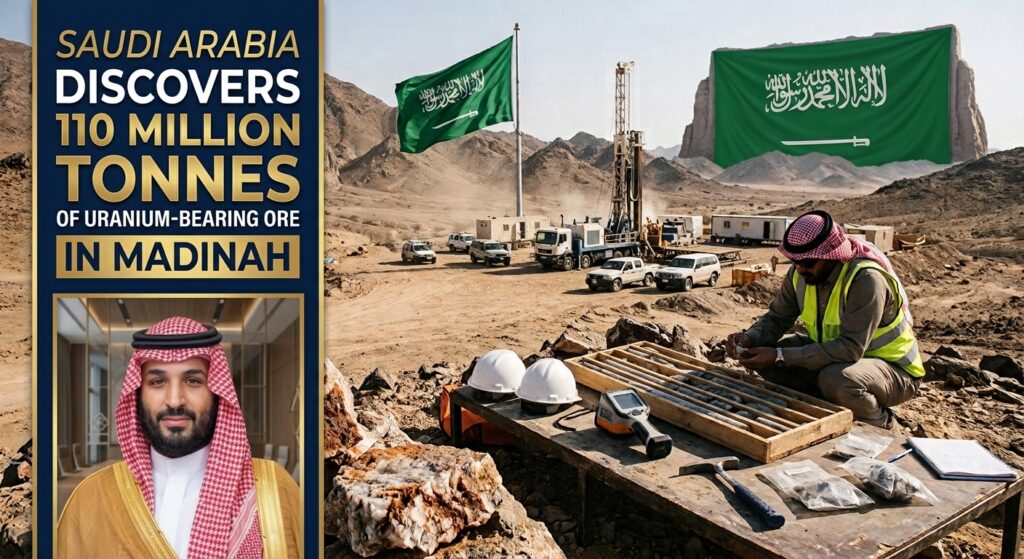
Saudi Arabia has announced a major mineral discovery in the Madinah region, where exploration at the Jabal Sayid project identified an estimated 110 million tonnes of ore containing promising concentrations of uranium and high concentrations of rare-earth elements. Energy Minister Prince Abdulaziz bin Salman announced the finding during the International Atomic Energy Agency’s General Conference in Vienna. The discovery could strengthen Saudi Arabia’s efforts to develop domestic mineral resources alongside its civilian nuclear programme.
What Saudi Arabia Actually Discovered
The headline figure needs careful interpretation. Saudi Arabia has not announced 110 million tonnes of pure uranium. The 110 million-tonne estimate refers to ore containing uranium, alongside significant concentrations of rare-earth minerals.
According to Prince Abdulaziz bin Salman, geological studies and exploration at Jabal Sayid identified about 110 million tonnes of ore with high concentrations of rare earths, particularly heavy elements, as well as promising uranium concentrations. Reuters reported the announcement after it was carried by Saudi state television.
Reuters and Arab News reported the announcement, while IAEA data provides context on Saudi Arabia’s nuclear activities and uranium resources. The figure remains an exploration estimate, not a confirmed recoverable reserve.
This distinction matters because the amount of uranium that could ultimately be recovered cannot be calculated from the total ore figure alone. The uranium grade, recoverable quantity and commercial feasibility have not been publicly detailed in the announcement.
Why the Madinah Discovery Matters
Rare-earth elements such as dysprosium, terbium, neodymium and praseodymium are used in technologies including permanent magnets, electronics and renewable-energy equipment.
Jabal Sayid is located roughly 350 kilometres northeast of Jeddah in the Madinah region.
Saudi Arabia’s Nuclear Ambitions
The Saudi Arabia Uranium Discovery 2026 comes as the kingdom advances plans for civilian nuclear power. Riyadh has been working with international partners on a long-term nuclear programme while stressing that its nuclear activities are intended for peaceful purposes.
In July 2026, Washington and Riyadh formalised civil nuclear cooperation. The US Department of Energy said the agreements created a framework for a decades-long, multibillion-dollar partnership and greater access for US companies to Saudi Arabia’s civilian nuclear programme.
Saudi Arabia has not yet become a uranium producer. An earlier IAEA/OECD uranium report said the kingdom had not produced uranium and was preparing to introduce its first nuclear power plant, with operation expected in the mid-2030s.
What It Means for Global Markets
The discovery could attract greater attention from international mining and technology companies because it combines uranium potential with rare-earth resources. Saudi Arabia is also seeking to position itself as a mining and processing hub as countries diversify critical-mineral supply chains.
However, the latest announcement should not be interpreted as proof that all 110 million tonnes are economically recoverable. Further exploration, testing and feasibility work would be needed.
For Pakistan, the development is worth watching because Saudi Arabia is an important economic partner and a major destination for Pakistani workers. However, no Pakistan-specific investment or employment plan was announced with the discovery.
Saudi Arabia’s latest announcement is more than a headline about uranium. The estimated 110 million tonnes of uranium-bearing ore, combined with heavy rare-earth elements at Jabal Sayid, highlights Riyadh’s wider strategy to build a domestic critical-minerals and civilian nuclear sector. For now, the figure is an ore estimate rather than 110 million tonnes of pure uranium, and its eventual commercial value will depend on grades, recoverability and future development decisions.