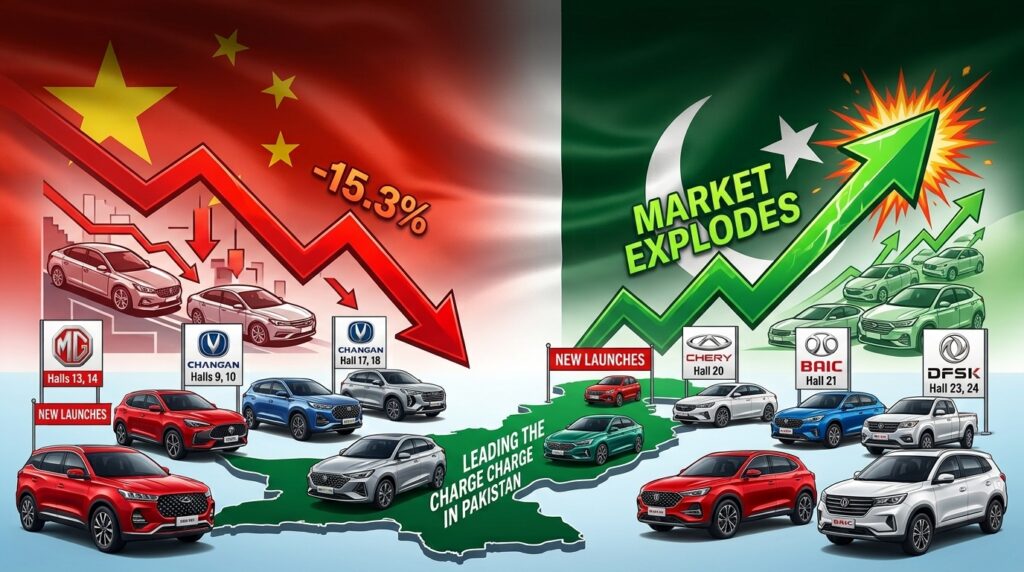
In a striking economic inversion across the Asia auto market, Pakistan’s car market 2026 recorded explosive expansion, emerging as one of the region’s standout growth stories. This remarkable trajectory comes at a time when China’s domestic car market faces a 15.3% retail downturn driven by reduced subsidies and overcapacity. Aggressive central bank interest rate cuts, stabilised currency conditions, and surging localised assembly have driven a massive multi-segment rebound in Pakistan’s automotive sector
The Macroeconomic Turnaround Driving Pakistan Car Sales Growth
The Pakistan auto industry growth observed throughout FY26 represents a sharp departure from two years of stagnant demand. Slashed key interest rates by the State Bank of Pakistan revitalized commercial auto financing, lowering monthly installment barriers for retail buyers. Combined with stabilized foreign exchange reserves, local original equipment manufacturers (OEMs) successfully normalized the import of Completely Knocked Down (CKD) kits.
This macroeconomic stabilization triggered a pent-up release of consumer demand. Total automotive sales across all vehicle categories—including passenger cars, trucks, buses, and two-wheelers—climbed 41% to reach 1.63 million total units in FY26.
Local Assemblers Lead the Pakistan Car Sales Boom
Pak Suzuki Motor Company maintained its dominant market position, generating 94,848 unit sales—a 30% jump year-on-year—led by entry-level vehicles like the Suzuki Alto. Indus Motor Company (Toyota) experienced a 34% increase, moving 44,646 vehicles, driven largely by local production of the Corolla, Yaris, and Corolla Cross. Honda Atlas recorded a 53% surge to reach 28,015 sales, while local player Sazgar Engineering surged by 77% on demand for its Haval SUV line.
The momentum accelerated sharply entering the FY27 fiscal calendar. Data published by the Pakistan Automotive Manufacturers Association (PAMA) showed July 2026 sales surging by 141.28% year-on-year. Suzuki Alto alone climbed to 7,217 units in July 2026, up from 2,327 units in July 2025.
China’s Domestic Retraction: Subsidies, Saturation, and Price Wars
While Pakistan automotive manufacturers expand assembly capacity, China’s domestic auto market is navigating severe headwinds. Forecasts from industry bodies, including the China Passenger Car Association (CPCA), project a domestic sales drop between 14% and 20% in 2026.
Beijing’s decision to roll back purchase tax exemptions on New Energy Vehicles (NEVs)—introducing a 5% levy—curbed domestic EV demand. Combined with domestic vehicle saturation exceeding 370 million registered automobiles and fierce price wars among more than 70 domestic brands, Chinese automakers face shrinking margins. To offset domestic declines, Chinese manufacturers are aggressively expanding export footprints into emerging South Asian and Southeast Asian auto markets.
How Chinese Brands Fuel Pakistan’s Fast Growing Market
The divergence between these two Asian economies has created a natural synergy. Chinese manufacturers facing domestic saturation are channeling inventory and technology transfers directly into Pakistan’s expanding market.
Companies like Great Wall Motors (GWM), Changan, and MG have secured substantial market shares in Pakistan’s SUV and crossover segments. Sazgar Engineering’s local assembly of Haval models yielded 19,179 unit sales in FY26. Furthermore, Chinese entry-level Electric Vehicles (EVs), such as the Dewan Honri VE, are establishing early footholds as localized assembly lowers pricing barriers.
Forecast for Asia Auto Market 2026 and Beyond
Brokerage analyses from AKD Securities project a further 20% volume growth for Pakistan’s auto industry throughout FY2026–27. Long-term stability remains contingent on central bank monetary policy, localized raw material sourcing, and potential duty adjustments under upcoming Auto Industry Development and Export Policy (AIDEP) revisions. Nevertheless, Pakistan stands out in 2026 as one of Asia’s fastest-growing car markets, offering a vibrant contrast to global retrenchment.
Pakistan’s auto industry has successfully pivoted from economic stagnation toward unprecedented growth, driven by key interest rate cuts, stabilized supply chains, and rising localized production. As domestic contraction forces Chinese carmakers to look outward, Pakistan’s auto market 2026 has become a prime recipient of global automotive investment and inventory. Provided inflation and exchange rates remain balanced, the country’s auto market expansion is set to maintain its upward trajectory