
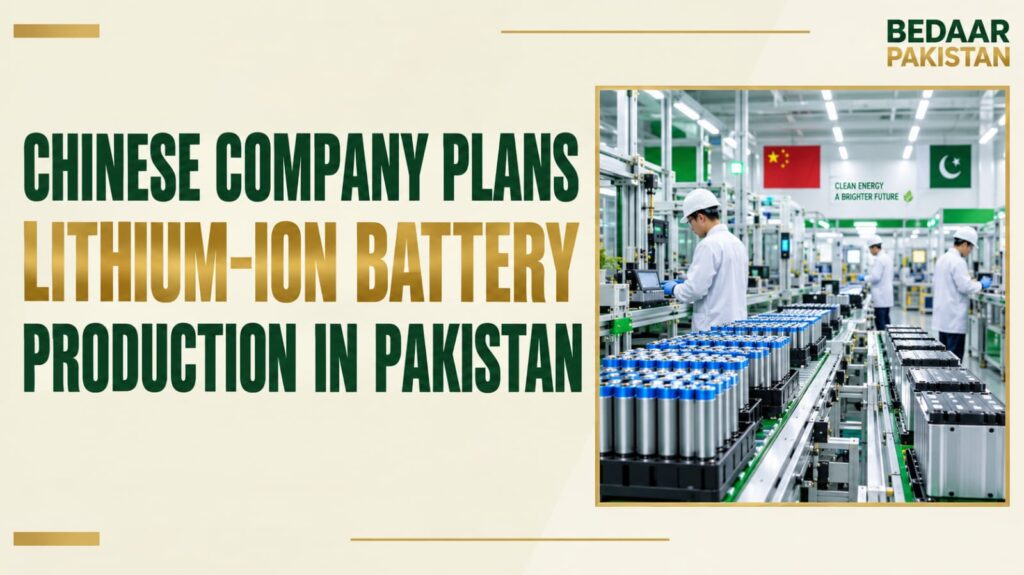
Pakistan’s battery manufacturing industry could receive a boost after Kohinoor Energy Limited signed a memorandum of understanding with China’s Hebei Juhang Energy Technology Group to explore lithium-ion battery production in the country. The proposed joint venture would focus on battery packs, battery energy storage systems and related electrical equipment, with an initial annual capacity of 50 to 100 megawatt-hours (MWh). The development comes as demand for solar energy storage grows in Pakistan, although the project remains at the planning stage and is subject to further evaluation, approvals and definitive agreements.
Chinese Battery Production in Pakistan: What Is Planned?
Kohinoor Energy Limited (PSX: KOHE) and Hebei Juhang Energy Technology Group signed the non-binding memorandum of understanding on 1 October 2026. Kohinoor Energy disclosed the development in a notice to the Pakistan Stock Exchange (PSX). The venture would mark the company’s move into battery assembly and energy storage.
Under the proposed arrangement, the companies intend to explore a joint venture covering the assembly, manufacturing, marketing and sale of lithium-ion battery packs, battery energy storage systems (BESS), related products and associated electrical equipment.
The project is envisaged in several phases. Initial annual production capacity could range from 50 MWh to 100 MWh, with possible expansion to 300-500 MWh and, eventually, 700-1,000 MWh. These figures are proposed targets rather than confirmed production levels, and the expansion is subject to market demand and business performance.
Kohinoor Energy has stated that the MoU is non-binding and that the proposed transaction remains subject to further evaluation, due diligence, applicable approvals and definitive agreements. The company has said it will make further material disclosures to the PSX as the project progresses. The announcement therefore does not mean that a factory has started operating or that commercial production has begun.
Why Is Pakistan Attracting Battery Manufacturing Investment?
Pakistan’s electricity market has been changing as households and businesses seek alternatives to expensive grid electricity. Solar panels have become an important option for consumers looking to manage energy costs, while batteries can help store electricity for use when solar generation is unavailable.
Business reports point to rapidly growing demand. Pakistan’s imports of lithium-ion battery packs are projected to reach 8.75 GWh by 2030, and monthly lithium battery imports hit a record $88 million in July 2026. The surge has been attributed to high electricity costs, cheaper solar equipment and changes to the net billing framework.
Battery energy storage systems can store electricity generated during the day and release it later, depending on system design and capacity. They can support homes, commercial buildings, industrial facilities and renewable energy projects, helping manage peak demand, provide backup power and integrate variable renewable energy into the grid.
What Does the Project Mean for Pakistan’s Battery Industry?
If implemented, the proposed project could create opportunities for local assembly, technical skills development and industrial supply chains. Domestic production may also give buyers access to battery products assembled or manufactured closer to their markets.
However, local assembly does not necessarily mean that every battery component will be produced in Pakistan. The extent of domestic manufacturing would depend on the project’s eventual design, sourcing arrangements and investment commitments.
The proposal comes amid broader Pakistan-China energy cooperation. In June 2026, Pakistan’s Saigols Group and Hebei Juhang Energy Technology Group signed a separate MoU covering advanced lithium-ion batteries, energy storage systems and electric vehicle charging infrastructure. The October announcement involving Kohinoor Energy is a separate proposed partnership with the same Chinese company.
Pakistan has also proposed a National Lithium-Ion Battery Manufacturing Policy 2026-2031, which envisages phased localisation targets, tariff reforms and performance-based incentives for domestic manufacturing. These developments indicate growing interest in battery-related business in Pakistan, but memorandums of understanding should not be treated as proof that planned investments have been completed.
Could Battery Storage Help Pakistan’s Solar Users?
Battery storage could become increasingly important for Pakistani consumers who want to use more of the electricity generated by their solar panels.
Without storage, excess solar electricity may be exported to the grid, depending on the applicable arrangement. With a suitable battery, some of that surplus generation can instead be stored for later use. The practical benefits depend on battery size, household consumption, solar generation, equipment costs and the applicable electricity rules, including net billing.
Businesses and factories may also consider storage to manage power interruptions or shift some electricity consumption away from expensive periods.
Nevertheless, batteries require upfront investment, and their financial value varies by consumer. Local manufacturing alone would not guarantee lower prices. Competition, imported components, taxes, exchange rates, financing costs and manufacturing efficiency would all influence the final price.
Kohinoor Energy and Hebei Juhang partnership
The proposed Kohinoor Energy and Hebei Juhang partnership represents a potential development for Pakistan’s lithium-ion battery manufacturing industry. Its planned capacity, which could eventually reach 1,000 MWh annually, reflects growing interest in battery storage as solar adoption and demand for reliable electricity continue to shape the energy market. However, the project remains at the MoU stage, and its impact will depend on final agreements, investment decisions and implementation. For now, the announcement signals a potential opportunity rather than a completed manufacturing project.