
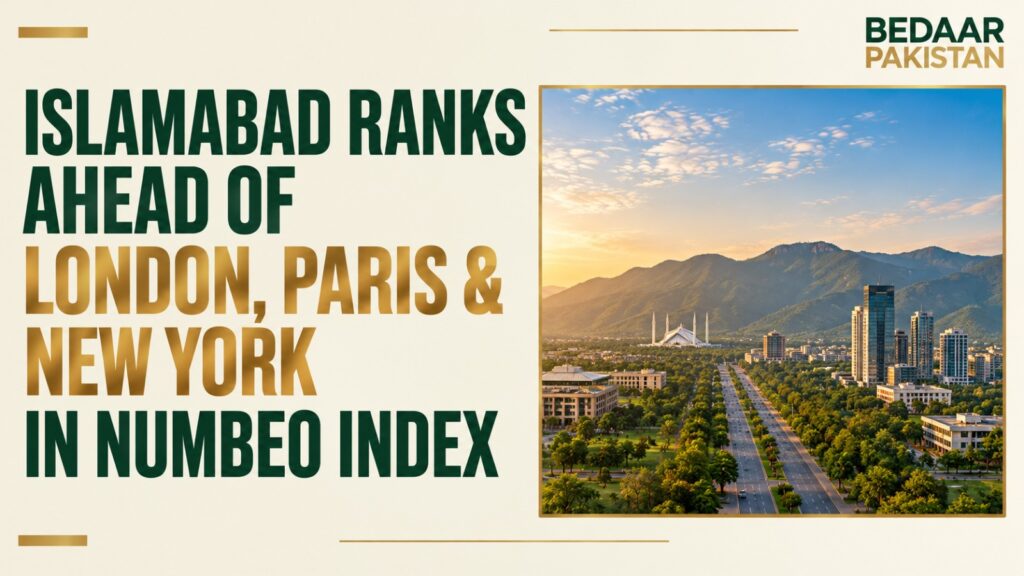
Islamabad has ranked ahead of London, Paris and New York in Numbeo’s 2026 Mid-Year Quality of Life Index, drawing international attention to Pakistan’s capital. The city recorded a score of 140.7, compared with 138.8 for Paris, 137.3 for New York and 135.8 for London. However, the results reflect a survey-based comparison of living conditions rather than a definitive assessment of which city offers the best life in every respect.
- Islamabad: 140.7 quality-of-life points
- Paris: 138.8 points
- New York: 137.3 points
- London (UK): 135.8 points
- Islamabad Safety Index: 69.2
- Islamabad Cost of Living Index: 25.3 (New York = 100)
- Within Pakistan: Lahore scored 98.4 and Karachi 76.1 in the same mid-year dataset
Islamabad Quality of Life Ranking: What the Numbers Show
The Islamabad quality of life ranking places the Pakistani capital slightly above three internationally recognised cities in the mid-year dataset. Its lead over Paris is 1.9 points, while the gaps over New York and London are 3.4 and 4.9 points, respectively. The margins are small: the results indicate a difference in the index, not a sweeping verdict on the living standards of millions of residents.
| City | Quality of Life Index |
| Islamabad | 140.7 |
| Paris | 138.8 |
| New York | 137.3 |
| London | 135.8 |
The figures come from Numbeo’s 2026 Mid-Year Quality of Life Index, a snapshot of its city-level data. The Hague, Netherlands, led the table with 221.5 points, followed by Eindhoven at 210.7. Islamabad therefore outscored the three cities highlighted in the headline but remained well behind the index’s leading performers.
Why Islamabad Scored Higher
The Numbeo Quality of Life Index combines several measures associated with urban living: purchasing power, safety, healthcare, cost of living, property price to income ratio, traffic commute time, pollution and climate. These are weighted differently, so a strong result in one area can offset weaker results elsewhere.
Islamabad recorded a Safety Index of 69.2 and a Cost of Living Index of 25.3. Its healthcare score was 63.7, its climate score 76.9, its pollution index 41.5 and its purchasing power score 43.7. For context, a lower cost-of-living and pollution figure is better, while higher is better for the other measures. Compared with London, Paris and New York, Islamabad scored better on safety, cost of living, pollution and traffic commute time, but its purchasing power remains modest.
The cost-of-living comparison is particularly striking. In the same dataset, New York recorded 100.0, London 88.2 and Paris 78.6. Numbeo uses New York as the reference point for this scale. These are index values, not percentages, and should not be read as the exact amount a household would save by living in Islamabad. Personal expenses vary with income, housing, family size and lifestyle.
Islamabad vs London, Paris and New York
The comparison has attracted attention because it challenges common assumptions about the world’s most prominent cities. However, it is not a complete measure of economic opportunity, wages, public services or individual experience.
London, New York and Paris are major centres of finance, business, culture and employment, and residents may value these opportunities even when housing, transport or everyday expenses are high. Islamabad may appeal more to people who prioritise lower living costs, perceived safety and its climate.
A higher overall score does not mean Islamabad is superior in every category. Both London and Paris, for example, scored higher than Islamabad on purchasing power and healthcare in this dataset.
How Does Islamabad Compare With Other Pakistani Cities?
The mid-year figures also put Islamabad well ahead of Lahore and Karachi. Lahore recorded 98.4 and Karachi 76.1, against Islamabad’s 140.7.
These figures offer a point of comparison for Pakistani readers, but they do not capture every neighbourhood or household. Access to employment, reliable utilities, healthcare, affordable housing, education and transport can vary widely within the same city.
For Islamabad, the result could renew discussion about urban planning, public transport, housing costs, environmental protection and the quality of public services.
What the Ranking Does Not Tell Us
The ranking should be treated as one indicator, not a final judgement on urban living standards. Numbeo’s estimates are based on user-contributed data and surveys rather than official government statistics, so categories such as safety reflect perceptions reported by contributors. Numbeo also publishes a continuously updated live index, whose figures can differ from the mid-year snapshot.
The index does not establish that Islamabad has better wages, healthcare access, infrastructure or employment prospects across the board, nor that every person would prefer living there. It is best understood as a positive headline that also highlights areas for improvement, including public transport, affordable housing, cleaner air and stronger purchasing power.