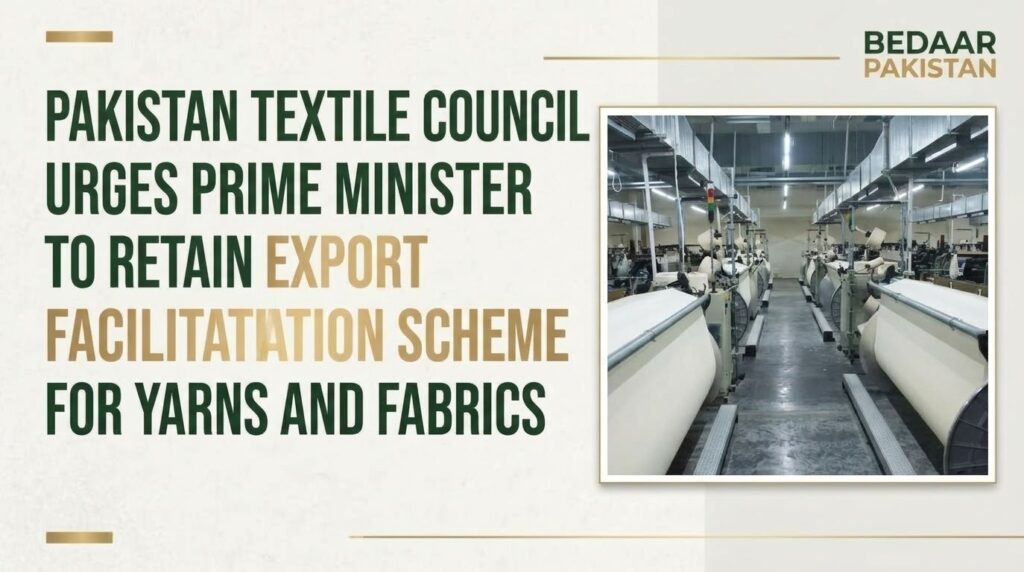
The Pakistan Textile Council (PTC) has formally urged Prime Minister Muhammad Shehbaz Sharif to maintain the Export Facilitation Scheme (EFS) for all textile inputs, warning that excluding yarns and fabrics will severely strain exporters’ working capital and hurt global competitiveness.
The Pakistan Textile Council has strongly opposed recent demands seeking the removal of essential raw materials from state facilitation frameworks. In a formal correspondence, industry leadership emphasized that abrupt regulatory rollbacks could disrupt manufacturing supply chains. The ongoing debate centers on balancing stringent tax enforcement with the operational needs of export-oriented units.
Why is the Pakistan Textile Council opposing EFS exclusions?
In a letter addressed to the Prime Minister, PTC Chairman Fawad Anwar voiced strong opposition to proposals seeking to exclude all yarns and fabrics falling under Chapters 52 and 55 of the Pakistan Customs tariff from the Export Facilitation Scheme.
The council cautioned that restricting yarn and fabric imports under the EFS would trigger multiple operational setbacks:
- Higher Production Costs: Exporters would face inflated overhead expenses to secure mandatory raw materials.
- Working Capital Strain: Tax burdens and upfront payments would restrict liquidity for small and medium-sized manufacturers.
- Weaker Global Competitiveness: Reduced access to cost-competitive inputs would undermine Pakistan’s footing against regional manufacturing rivals.
What are the key concerns surrounding scheme misuse?
The push to amend or restrict the scheme stems from concerns raised over potential revenue leakages and the domestic diversion of duty-free imports. Critics pointing to rising import volumes argue that tighter controls are necessary to curb tax evasion.
However, the PTC has clarified that penalizing the entire export ecosystem is counterproductive. Instead, the council expressed its full cooperation with the government to target bad actors specifically:
- Targeted Enforcement: Strongly supporting strict action against misdeclaration, under-invoicing, and unauthorized domestic diversion.
- Protecting Genuine Exporters: Ensuring that compliant businesses relying on imported man-made fibers (MMF) and specialized inputs are not penalized.
How does the EFS impact Pakistan’s foreign exchange earnings?
As Pakistan’s largest exporting sector, textiles require seamless access to global raw materials to fulfill international orders on time. Value-added segments, which registered notable growth reaching $7.70 billion in the first half of previous fiscal tracking, depend heavily on timely inputs to match international quality specifications.
Industry leaders maintain that preserving the Export Facilitation Scheme is critical to safeguarding foreign exchange inflows and keeping industrial units operational. The government faces the delicate task of closing enforcement loopholes while preserving export-friendly policies.