
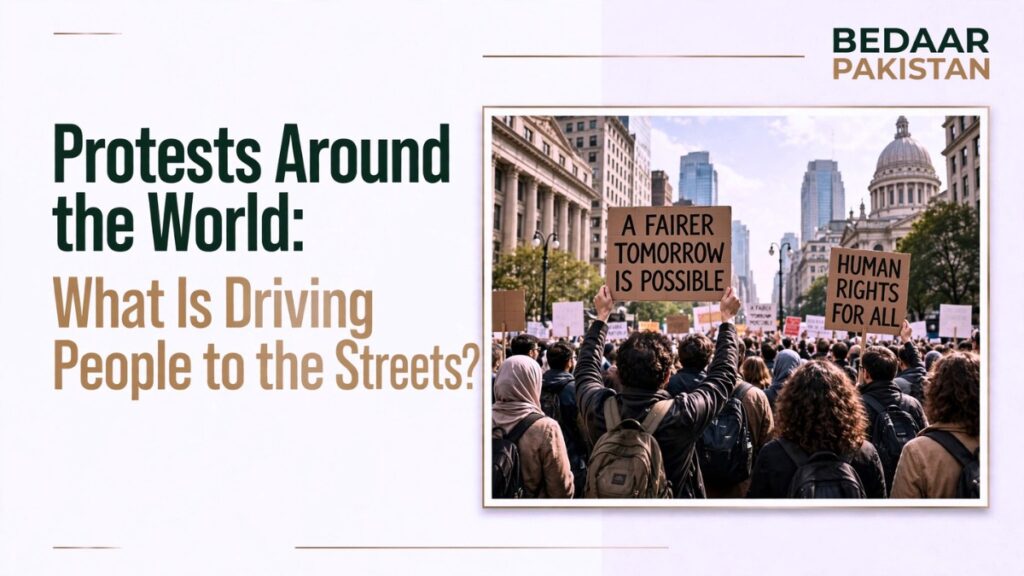
A street fills with voices, placards rise above the crowd, and ordinary people leave their daily routines behind to demand change. Thousands of miles away, another crowd gathers, carrying different messages but the same hope of being heard.
From France and Spain to Pakistan, Brazil, Serbia, Albania, Chile, South Africa, India and Argentina, people take to the streets for different reasons. For some, it is about rising costs; for others, education, public rights or political accountability.
Behind every protest is a story of people who believe something must change. Their struggles differ, but their voices reveal a deeper question: what happens when people feel that their concerns can no longer be ignored?
Different Countries, Different Triggers
In one country, rising prices push families to the edge; in another, a political decision or an unanswered demand brings people into the streets. Every crowd has its own story.
From housing concerns in France and Spain to calls for accountability in Serbia and Albania, the reasons vary. Political grievances fuel protests in Pakistan and India, while debates over public funding and social issues shape demonstrations in Brazil, Argentina and Chile. In South Africa, migration-related tensions have also sparked public concern.
Different struggles, different demands—but each reflects people’s desire to be heard.
When the Future Feels Uncertain
A young graduate searches for a job, a worker counts the money left after paying bills, and parents wonder whether they can give their children better opportunities. Their lives may be different, but each carries a worry about what tomorrow will bring.
For some, these concerns remain private. For others, frustration grows when promises bring little change and their voices seem to go unheard. What begins as a personal struggle can eventually become a public demand, bringing people together in streets and squares.
Behind every placard is a life, a family or a dream that someone is trying to protect. People may disagree about solutions, but many take to the streets because they want a future where hard work offers hope and ordinary families can live with greater security.
What Happens When People Raise Their Voices?
A crowd fills the streets, voices grow louder, and soon the message reaches far beyond the people holding the placards. News spreads, conversations begin, and leaders face a growing call to respond.
Sometimes, a protest opens the door to talks or brings promises of change. Other times, the crowds go home with the same questions they brought to the streets. Days pass, daily routines return, but the problems remain.
Still, every protest leaves a story behind. Its real impact depends on what happens next—whether leaders listen, concerns are taken seriously, and words finally turn into action.
The Human Cost Behind Every Protest
A shopkeeper hears the noise growing outside and begins putting away his things. Across the road, a student turns back after finding the street blocked. Somewhere nearby, a family keeps calling a loved one who has not yet made it home. The protest may be the main story on the news, but for these people, the day has become a struggle of its own.
As crowds grow, ordinary routines can fall apart. Shops close, buses stop, and workers lose hours trying to reach home. When tensions turn into clashes, the situation can become even more serious, leaving people injured and families worried about their safety.
Long after the streets become quiet, the effects may remain. A small business has lost a day’s income, a worker has missed a shift, and a family has spent hours in fear. These are the stories behind the crowds—lives interrupted while people wait for the day to return to normal.
When the Crowds Disappear, the Questions Remain
By the next morning, the streets look different. The banners have disappeared, the crowds have gone home, and traffic moves through the roads again. Shopkeepers open their doors, students return to school, and the city slowly finds its usual rhythm.
But not everyone feels that life has returned to normal. A young person who joined the protest still wonders whether anyone heard their message. A family waits to see whether the promises made will lead to change. Others watch quietly, unsure whether the days ahead will bring answers or more disappointment.
Soon, another story may take over the headlines, and the world may look elsewhere. Yet the people who raised their voices are left with the same question: will anything change now that the streets are quiet?
A World of Voices, A Need to Listen
A better future begins when people are not only allowed to speak, but are also heard. When leaders listen to public concerns, understand people’s needs and take practical steps to address them, even difficult problems can find a way forward.
No country can solve every problem overnight. But honest conversations, fair decisions and a willingness to listen can build trust between people and those who lead them. Small changes, when made with care and responsibility, can improve lives and create stronger communities.
Across the world, people may raise their voices for different reasons, but their concerns deserve serious attention.
When people are heard and their problems are addressed, the path to a better country—and a better world—becomes possible.