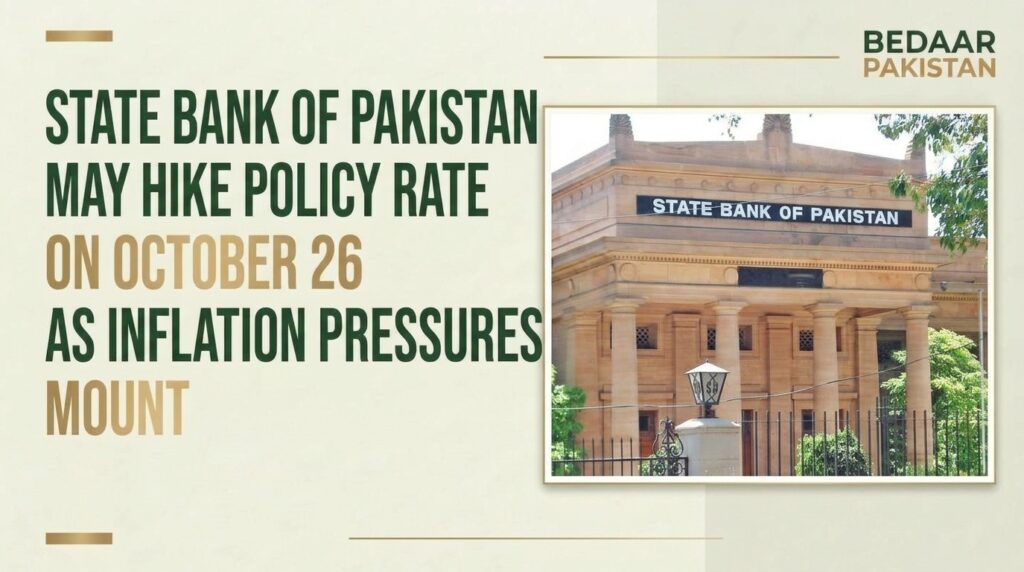
The State Bank of Pakistan (SBP) is expected to review its policy rate on October 26, 2026, with analysts forecasting a potential interest rate hike. Escalating Middle Eastern conflicts, rising international Brent crude prices, soaring domestic transport costs, and T-Bill yields reaching 12.49% have intensified inflationary pressures.
The State Bank of Pakistan (SBP) is preparing for its upcoming Monetary Policy Committee (MPC) meeting scheduled for October 26, 2026. While the SBP held the baseline benchmark interest rate steady at 11.5% during its previous decision, deteriorating global geopolitical conditions and domestic cost pressures have altered market sentiment. Financial institutions and economic analysts increasingly suggest that a monetary policy tightening or interest rate hike may be necessary to anchor inflation expectations.
Why Is SBP Considering an Interest Rate Hike on October 26?
Several global and domestic macroeconomic developments have converged, prompting financial markets to price in a higher likelihood of monetary tightening:
- Surging Global Energy Prices: Heightened Middle Eastern geopolitical tensions and operational risks near regional transport hubs have driven international Brent crude oil prices upward. As an energy-dependent economy, higher import costs feed quickly into Pakistan’s domestic fuel and transport tariffs.
- Upward Revision in Inflation Forecasts: On October 13, 2026, the International Monetary Fund (IMF) officially revised Pakistan’s consumer price inflation projection upward to 9.9% for FY2026–27, compared to its earlier estimate of 8.4%.
- Domestic Transport & Utility Cost Pressures: Although food inflation softened in September 2026, significant upward price shocks emerged in transport costs (up 27.4%) and housing/utility tariffs (up 12.4%), directly affecting consumer price indices.
- Spike in Treasury Bill Cut-Off Yields: Recent government market operations saw cut-off yields on Treasury bills rise up to 12.49%. Commercial banks are demanding higher returns to cushion against anticipated inflation—a dynamic that historically signals a benchmark rate increase by the central bank.
Key Economic Indicators Ahead of the SBP Monetary Policy Review
| Indicator | Stat / Value | Impact on Policy Decision |
| Current Policy Rate | 11.5% | Baseline rate established in prior MPC decision |
| IMF Inflation Outlook (FY27) | 9.9% (up from 8.4%) | Increases pressure on SBP to maintain real positive rates |
| Transport Inflation (Sep 2026) | +27.4% | Driven by domestic petrol price adjustments |
| Housing & Utilities Inflation | +12.4% | Reflects ongoing energy tariff pass-throughs |
| Government T-Bill Cut-Off Yields | Up to 12.49% | High market yields signal tight money market conditions |
What Would a Policy Rate Hike Mean for Businesses and Consumers?
An upward adjustment to the monetary policy rate directly influences commercial banking operations and broader economic activity. If the SBP decides to hike rates on October 26, commercial banks will adjust their KIBOR-linked lending rates upward.
Higher borrowing costs make corporate working capital, consumer financing, and industrial expansion loans more expensive. On the flip side, higher rates help protect real returns for fixed-income depositors, control imported inflation by slowing down non-essential import demand, and stabilize the balance of payments against global volatility.
Final Outlook for October 26
As the October 26 MPC meeting approaches, economic watchers will closely observe international commodity price movements and short-term liquidity conditions. Whether the central bank chooses a cautious policy rate hike or maintains its current stance will hinge on its assessment of imported inflation risks and medium-term price stability.