
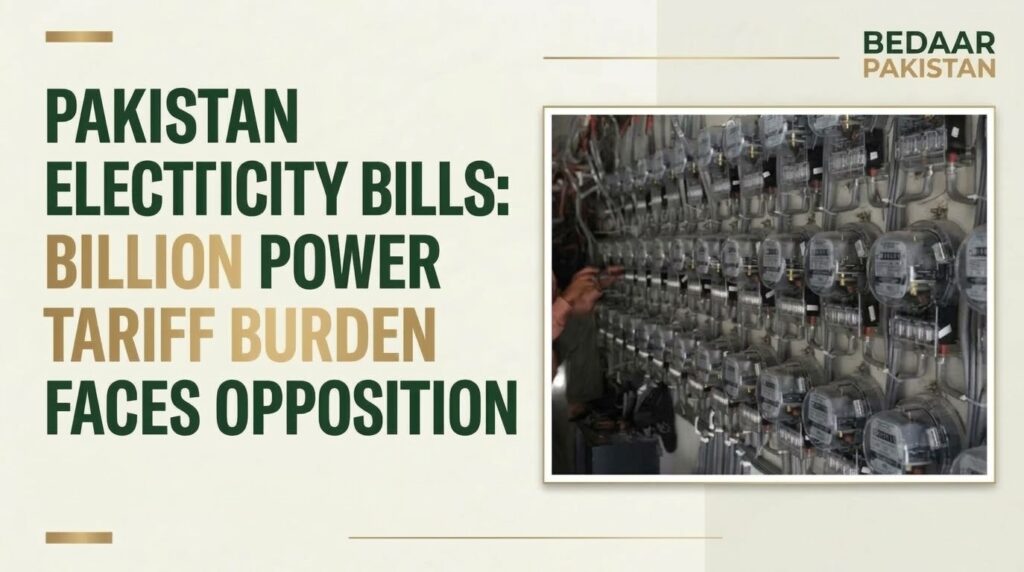
The Federation of Pakistan Chambers of Commerce and Industry (FPCCI) has formally petitioned energy regulators to reject an additional Rs268 billion financial burden sought by state-owned power distribution companies. The controversial demands form part of multi-year tariff indexation petitions submitted by ten former WAPDA distribution companies (DISCOs) for calendar year 2027. As public hearings commence, business leaders warn that passing these unverified historic claims onto consumers will inflict unbearable financial strain on households and industrial enterprises across the nation.
Why Are Pakistan Electricity Bills Facing New Surcharges?
Why are power distribution companies seeking such massive extra recoveries?
Ten state-run DISCOs recently submitted multi-year tariff petitions to NEPRA outlining a cumulative revenue requirement of Rs2.64 trillion for calendar year 2027. However, a detailed audit conducted by the FPCCI’s Energy Advisory Committee revealed that DISCOs included hundreds of billions of rupees in historic adjustments within these baseline projections. A substantial portion of these claims dates back several years.
Many of these retrospective charges were previously rejected by NEPRA or contested by third parties. For example, DISCO filings included Rs33 billion tied to seven-year-old input tax claims that business representatives describe as completely inadmissible under existing tariff rules.
FPCCI Demands NEPRA Reject Disputed Power Tariff Claims
Can industrial sectors absorb another massive rate increase? The commercial sector says no.
The FPCCI has urged NEPRA to scrutinize every itemized claim line by line during scheduled public hearings. The apex business body highlighted severe discrepancies across regional DISCO petitions. In its filing, Faisalabad Electric Supply Company (FESCO) sought Rs535 billion in total revenue requirements, including Rs57 billion in prior-year adjustments. FPCCI requested NEPRA to immediately throw out Rs26 billion of that demand, pointing out that it covers 11-year-old post-retirement benefits and previously disallowed supplementary charges.
“Utility consumers cannot serve as a financial safety net for administrative inefficiency,” stated the FPCCI Energy Advisory Committee in its formal submission. “Passing unverified historical liabilities onto current monthly bills threatens industrial productivity and domestic stability.”
How Regional Distribution Discrepancies Inflate Power Costs
Are all distribution companies making similar demands?
The magnitude of prior-year claims varies dramatically across DISCOs. Islamabad Electric Supply Company (IESCO) leads the group with prior-year claims exceeding 212 per cent of its proposed annual distribution margin. Sukkur Electric (SEPCO) follows closely with claims reaching 113 per cent of its margin, while Faisalabad Electric (FESCO) stands at 91 per cent.
Meanwhile, Peshawar Electric (PESCO) and Gujranwala Electric (GEPCO) filed adjustments representing 40 per cent and 32 per cent of their respective margins. Industrial representatives argue that allowing individual companies to recover unverified historical losses creates unequal tariff distortion across provinces.
What Lies Ahead at the NEPRA Public Hearings?
What must happen before these claims affect everyday consumers?
NEPRA’s three-day public hearing schedule from October 13 to 15 provides a crucial battleground. The regulator will evaluate whether DISCOs provided sufficient documentation to validate their claims. FPCCI has demanded that DISCO management present detailed written responses to all public objections prior to final determinations.
If NEPRA approves these claims, the additional financial load will be phased into consumer electricity bills through future quarterly or base tariff adjustments. If rejected, utility companies must absorb those legacy operational accounting deficits themselves.
The confrontation over the Rs268 billion tariff burden underscores deep structural conflicts in managing Pakistan electricity bills. As regulators weigh DISCO revenue demands against growing public opposition, NEPRA’s upcoming decisions will determine whether Pakistani consumers receive transparent rate protection or face another wave of rising utility expenses.