
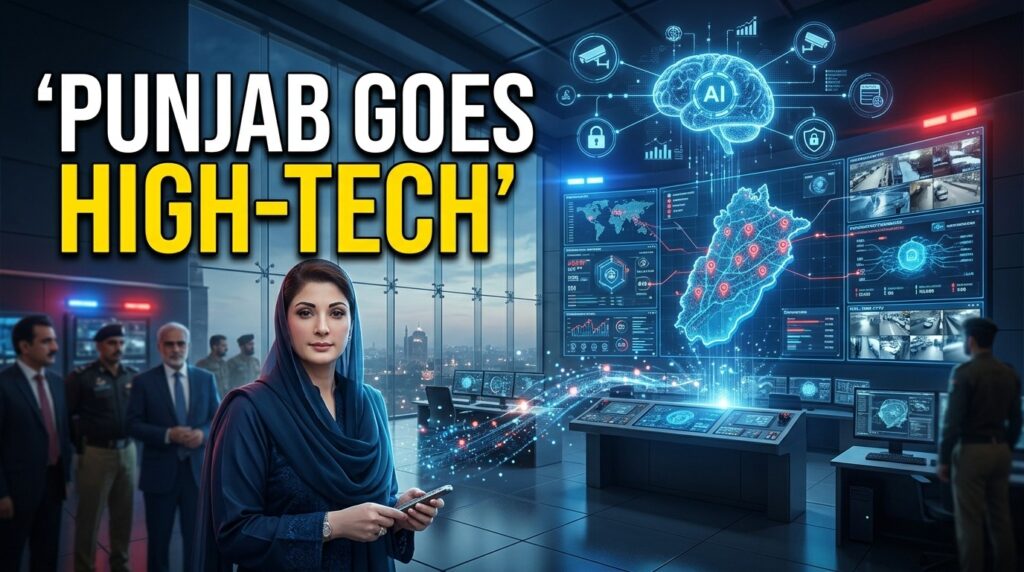
Chief Minister Maryam Nawaz Sharif has officially inaugurated the Provincial Intelligence Fusion and Threat Assessment Center (PIFTAC) alongside the e-launch of Pakistan’s first provincial Artificial Intelligence (AI) Hub. The state-of-the-art facilities in Lahore mark a shift toward proactive threat prevention, equipping provincial law enforcement with real-time early warning capabilities. By integrating cross-agency intelligence stream processing and advanced analytical tools, the initiative aims to dramatically reduce response times against terrorism, organized crime, and cross-border security challenges.
A Structural Shift from Reactive Policing to Threat Anticipation
Addressing the inaugural ceremony in Lahore, Chief Minister Maryam Nawaz emphasized that modern security demands a transition from traditional post-incident investigation to early threat detection. The establishment of PIFTAC consolidates raw intelligence data from multiple provincial and federal security bodies into actionable operational insight.
“Controlling an incident before it occurs would be the real success,” stated Maryam Nawaz during her opening remarks, stressing that economic development projects carry little value if citizens remain exposed to violence or property loss. The AI Hub was developed within a record timeframe of a few months, turning theoretical AI surveillance frameworks into operational reality.
High-Tech Fortification and Tri-Border Monitoring
The new technological framework addresses vulnerabilities along Punjab’s provincial boundaries, particularly the tri-border region. Historical security gaps—where hostile elements possessed superior night-vision equipment compared to local police—have been addressed through targeted infrastructure upgrades.
Joint check posts across vulnerable perimeter zones are now fortified with:
- High-definition thermal and night-vision surveillance systems.
- Bulletproof camera enclosures designed to resist direct tactical fire.
- Aerial surveillance drone fleets integrated directly into local intelligence feeds.
These technological investments have reportedly brought criminal activity in riverine (Kacha) areas under tighter state control, drastically limiting casualty rates among security forces during ambushes.
Inter-Agency Intelligence Sharing: Working as “One Unit”
A cornerstone of PIFTAC is its ability to break down traditional operational silos between civil law enforcement agencies, the Special Branch, and national defense intelligence organs. The Chief Minister specifically commended the Pakistan Army and Lahore Corps Commander Lieutenant General Fayyaz Hussain Shah for their institutional support in establishing the fusion network.
By functioning as a synchronized unit, federal and provincial law enforcement entities can pool data on counter-terrorism, organized smuggling, and narcotics distribution. This unified architecture enables early pattern recognition when hostile networks attempt movement across provincial lines.
Accountability and Governance via AI Integration
Beyond high-level counter-terrorism, the AI Hub’s analytical capabilities extend to internal governance, urban traffic discipline, and administrative anti-corruption measures.
- Police Accountability: Body cameras have been deployed across active field units to record public interactions, monitor conduct, and ensure transparency during duty.
- Zero-Tolerance Anti-Corruption Policy: The provincial government has established dedicated public helplines and deployed digital tracking algorithms to identify systemic graft within public offices.
- Civic Regulation Monitoring: Advanced video analytics monitor public compliance regarding road safety, helmet laws, and zebra crossing enforcement.
Positioned as Pakistan’s Leading Tech-Enabled Province
The launch of the AI Hub forms part of a broader master plan to position Punjab as Pakistan’s most technologically integrated province. Officials highlighted that modernizing security apparatuses builds necessary investor confidence, stabilizes domestic markets, and enhances Pakistan’s international image.
As threat landscapes grow increasingly complex, the provincial administration projects that automated early detection systems will drastically lower long-term security expenditures by replacing resource-heavy post-incident responses with swift, precision-targeted operations.
The inauguration of PIFTAC and the Punjab AI Hub represents a decisive evolution in Pakistan’s internal security matrix. By bridging artificial intelligence with multi-agency intelligence fusion, Punjab is laying down a scalable blueprint for modern, data-driven governance. If successfully maintained, this proactive early-warning system could permanently alter law enforcement paradigms across the nation