
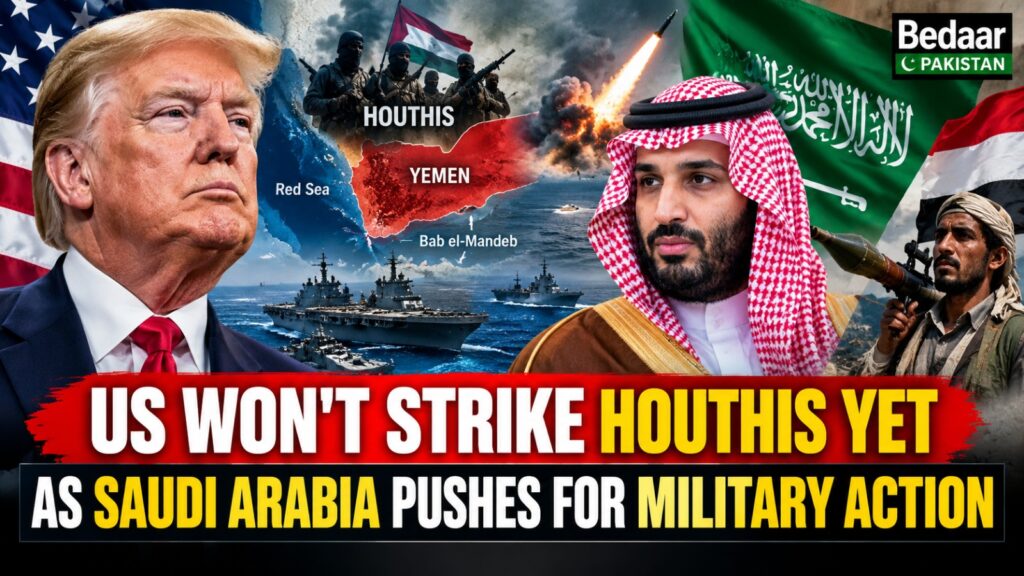
US President Donald Trump has turned down repeated personal requests from Saudi Crown Prince Mohammed bin Salman to launch direct American airstrikes against Houthi forces in Yemen. The rejection follows a rapid surge by the Iran-aligned group, which recently captured strategic points along the Red Sea coast, including the key port city of Mokha. While Washington agreed to provide Riyadh with logistical support, intelligence, and targeting data, American officials reiterated that US military assets will remain focused elsewhere in the Middle East conflict
- Direct Appeal: Saudi Crown Prince Mohammed bin Salman called President Donald Trump twice in one day, urging direct US intervention.
- US Stance: Washington refused direct air attacks, offering targeting data and intelligence sharing instead.
- Battlefield Shift: Houthi fighters seized Mokha port, Mayyun Island, and surrounding coastal areas near the Bab al-Mandeb Strait.
- Coalition Dynamics: Saudi Arabia recently helped launch a 14-nation regional alliance, including Pakistan and Turkey, to protect regional shipping lanes
Escalating Advances Force Diplomatic Urgent Calls
What prompted the sudden flurry of high-level calls between Riyadh and Washington?
Houthi forces launched a massive coastal offensive, routing Saudi-backed Yemeni government units and taking control of the historic port city of Mokha. Following that advance, the group seized Mayyun Island alongside Greater and Lesser Hanish. This offensive placed the strategic Bab al-Mandeb Strait directly under Houthi artillery and drone coverage.
Observing the collapse of defensive lines on the western coast, Saudi Crown Prince Mohammed bin Salman made two direct phone calls to US President Donald Trump. The Saudi leadership pushed Washington to launch immediate, heavy air raids against advancing Houthi columns to stem their progress.
Trump Administration Declines Direct Military Role
President Trump declined the Saudi request, signaling a firm limit on direct US military involvement in Yemen’s long-running civil strife.
US officials told news outlets that Washington has no appetite for opening a fresh direct combat theater against the Houthis. American military leaders, including US Central Command officials, communicated to Riyadh that the primary directive for US forces remains guarding the Strait of Hormuz and deterring broader threats.
A senior administration official noted that while protecting freedom of navigation in global waterways remains a primary US interest, regional allies must lead local ground and air operations. Instead of dropping bombs, Washington committed to sending advanced intelligence, real-time surveillance, and precise targeting assessments to Saudi defense planners.
Houthi Blockade and Economic Aftershocks
The Houthi movement recently declared a selective maritime blockade aimed specifically at Saudi Arabia. The group previously claimed responsibility for strikes against Saudi oil tankers, energy facilities in Yanbu and Jazan, and key inland infrastructure. Over 500 people have died in recent fighting, with roughly 46,000 displaced along Yemen’s western coast according to international monitors.
Can regional energy markets endure a sustained blockage of Red Sea routes?
Global shipping operators already divert significant trade flows around Africa due to persistent Houthi attacks. Daily ship transits through the southern Red Sea remain far below pre-conflict averages of 75 vessels per day, currently hovering around 31 ships. Energy analysts warn that continued disruptions to Saudi tanker movements will spark severe price spikes across global fuel networks.
The US refusal to launch direct strikes against the Houthis underscores a tactical pivot in Washington’s regional strategy. While Saudi Arabia faces an escalating security challenge along its southern border and vital shipping channels, the White House insists on empowering regional partners rather than leading new military interventions. As Houthi forces solidify their hold over the Bab al-Mandeb coastline, the responsibility of securing critical trade routes now falls squarely on Saudi Arabia and its regional allies