
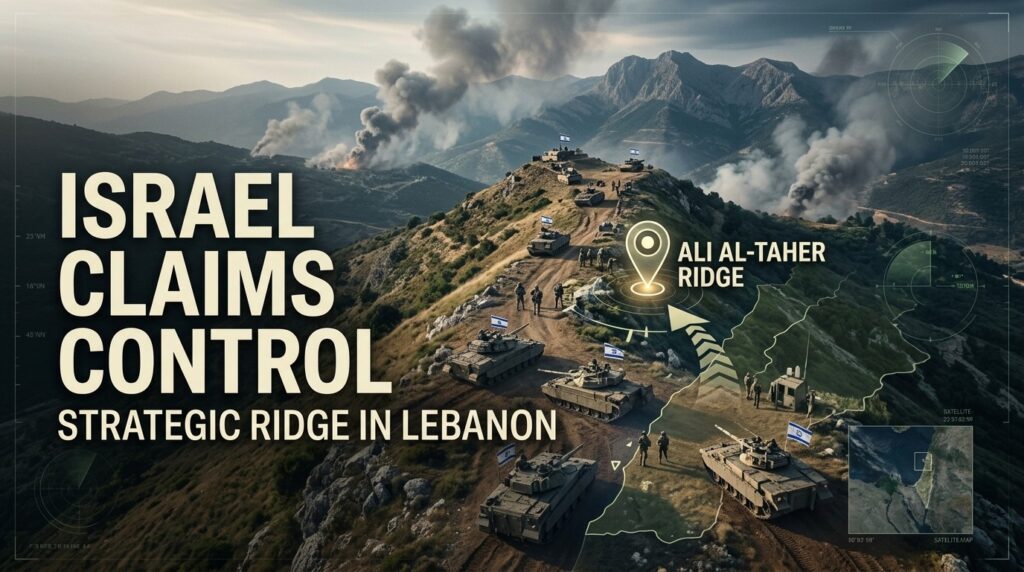
TEL AVIV — The Israel Defense Forces (IDF) declared on September 4, 2026, that military units have established full “operational control” over the strategic Ali al-Taher Ridge in southern Lebanon, following weeks of heavy skirmishes and targeted underground operations. Israeli officials reported clearing complex subterranean facilities, command hubs, and armories constructed over two decades by Hezbollah fighters. However, Hezbollah leadership issued a swift counter-statement denying the Israeli assertions, insisting that its forces remain positioned on the high ground and retain control over the sector.
- Strategic Location: The Ali al-Taher Ridge sits approximately 10 kilometers from the Israeli border, directly overlooking the key city of Nabatieh and the Litani River corridor.
- IDF Operational Assertions: Israeli Defense Minister Israel Katz stated that ground troops cleared subterranean network routes, eliminating embedded fighters and securing large weapons caches.
- Hezbollah Rebuttal: Hezbollah’s Islamic Resistance denied losing the tactical position, asserting that its forces are active on the ridge and ready to engage advancing units.
- Underground Infrastructure: According to Israeli military intelligence, the ridge sits atop an extensive underground network that served as a central command hub for Hezbollah’s regional Badr division.
- Diplomatic High Stakes: The development follows reported diplomatic warnings from Iran to Washington against an offensive on the ridge.
Tactical Significance of the Ali al-Taher Ridge
The Ali al-Taher Ridge represents one of the most critical geographical high points in southeastern Lebanon. Situated on the outer boundary of Israel’s self-declared security buffer zone, the ridge dominates the visual and artillery angles over surrounding villages and crucial logistical arteries leading into Nabatieh.
Controlling this elevated topography provides a definitive surveillance advantage across regional supply lines. For years, military analysts identified the ridge as a primary fortified redoubt built to resist direct ground incursions.
IDF Operational Findings Above and Below Ground
According to statements released by the IDF, the clearing operation involved combined infantry, engineering corps, and specialized subterranean warfare teams. Israeli military spokespersons stated that operations targeted two main underground networks built into the rock.
- Discovered Infrastructure: Troops reportedly uncovered operational planning rooms, living quarters, electrical generators, and subterranean communications networks.
- Weapons Facilities: The military reported seizing tactical gear, mortar systems, and explosive stockpiles.
- Neutralization Operations: The IDF confirmed that engineering teams remain on site to permanently dismantle and seal the tunnel entries.
Hezbollah’s Response and Contested Claims
In a formal broadcast statement, Hezbollah’s media wing rejected the claims of total Israeli occupation. The group stated that its fighters continue to hold perimeter positions along the highland and have launched explosive drones targeting Israeli assembly points near the base of the ridge.
Independent international media outlets and UN observers have noted that verifying ground dominance remains difficult due to restricted access within the military operations zone. However, localized drone imagery and artillery smoke over Nabatieh confirm ongoing heavy engagements around the ridge’s perimeter.
Regional Comparative Overview: Key Tactical Points in South Lebanon
| Location | Tactical Value | Distance from Border | Current Reported Status |
| Ali al-Taher Ridge | Overlooks Nabatieh & Litani River | ~10 km | Contested (IDF Claims Control / Hezbollah Denies) |
| Beaufort Castle Heights | Historic high-altitude vantage point | ~7 km | IDF Presence (Secured in earlier operations) |
| Maroun al-Ras | Border-adjacent hilltop overlook | ~2 km | Active Security Zone |
| Khiam Sector | Key entry point into eastern valley | ~6 km | Heavy Patrol & Surveillance Zo |
Broader Geopolitical Implications for the Region
The fight over the Ali al-Taher Ridge comes amid intense diplomatic maneuvering. Intelligence disclosures indicate that regional actors had previously raised concerns that a major confrontation over the ridge could disrupt fragile negotiations and trigger broader escalation across Middle Eastern transit corridors.
For observers in Pakistan and Asia, continued instability in southern Lebanon maintains upward volatility in global energy markets and maritime trade routes running through the Red Sea and Gulf channels. Further military consolidation at the ridge could reshape the ground baseline ahead of upcoming international security talks.
The assertion of control over the Ali al-Taher Ridge marks a significant tactical escalation in southern Lebanon. While the Israeli military moves to neutralize subterranean positions, Hezbollah’s firm pushback highlights that full stability on the ground remains uncertain, keeping regional security dynamics on high alert.