
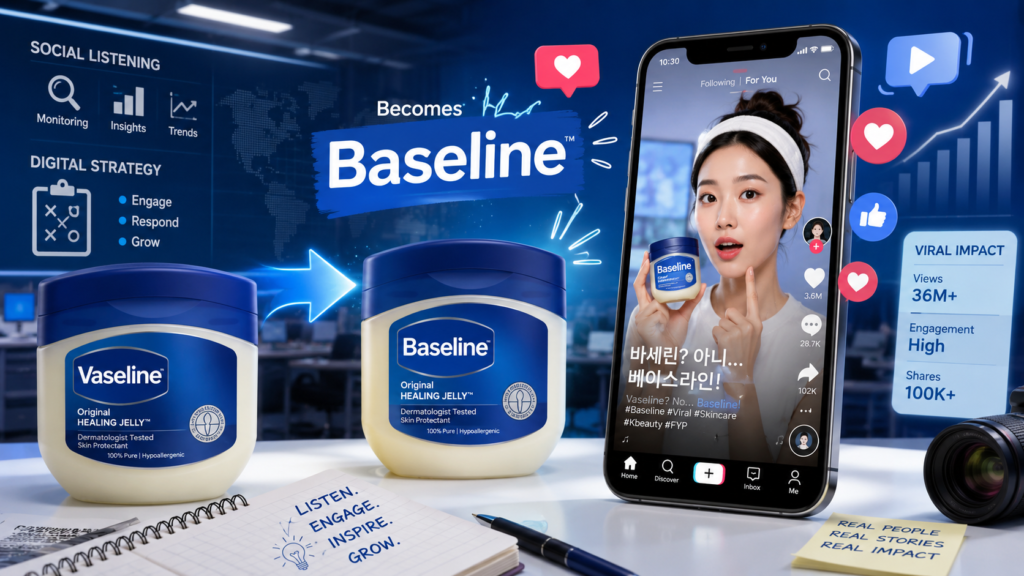
Vaseline has turned an unexpected pronunciation joke into one of the internet’s latest brand-marketing moments. South Korean skincare creator Min Day Lee went viral after repeatedly pronouncing “Vaseline” as “Baseline” in an Instagram video featuring her collection of the brand’s products. Instead of correcting the pronunciation, Vaseline embraced the joke, temporarily adopting “Baseline” branding on social media and turning an organic meme into a marketing opportunity.
- The viral video came from South Korean creator Min Day Lee.
- Her pronunciation of “Vaseline” as “Baseline” became a social-media meme.
- Reports put the original video at more than 36 million views, with later reports citing more than 38 million.
- Vaseline responded with a playful, temporary “Baseline” rebrand rather than a permanent corporate name change.
- The brand jokingly credited Lee as the “CEO of Baseline”.
What Is the Vaseline Baseline Marketing Strategy?
The Vaseline Baseline marketing strategy is an example of real-time social listening: instead of creating a trend from scratch, the brand identified an existing internet joke and participated in it.
The trend began when Lee showcased her Vaseline products while using the word “Baseline”. The pronunciation attracted attention because Korean does not have a native equivalent of the English “v” sound, meaning foreign words containing the sound can be adapted in pronunciation.
The important marketing decision came afterward. Vaseline did not treat the viral pronunciation as a mistake requiring correction. It adopted the joke, changing elements of its social-media identity to “Baseline” and presenting the move as a humorous temporary rebrand. This allowed the company to become part of a conversation that consumers had already started.
Why the Baseline Campaign Worked
The strategy worked because it combined speed, cultural relevance and authenticity.
Traditional advertising usually begins with a brand message that is distributed to consumers. In this case, the process was reversed. A consumer-created moment gained traction first, and the brand then entered the conversation.
That approach can make branded content feel less like an advertisement and more like participation in internet culture. The campaign also gave audiences a simple idea to repeat: “Vaseline” becoming “Baseline”.
This approach fits Vaseline’s broader shift toward social-first marketing. In 2025, Unilever highlighted its Vaseline Verified campaign, which tested viral skincare hacks with scientists and turned online conversations into brand content. Unilever said the campaign launched in March 2025.
Vaseline’s wider digital strategy has also produced measurable results. A TikTok case study for Vaseline Lip Care reported more than 600 million impressions, a 472% higher click-through rate than the market median, and three times more units sold during campaign periods.
The Vaseline-to-Baseline episode shows how modern marketing increasingly happens in real time. A simple pronunciation from a Korean creator became a global internet conversation, and Vaseline strengthened the moment by joining rather than resisting it. For marketers in Pakistan and elsewhere, the strategy is a reminder that authenticity, cultural awareness and speed can turn an unexpected social-media moment into valuable brand attention