
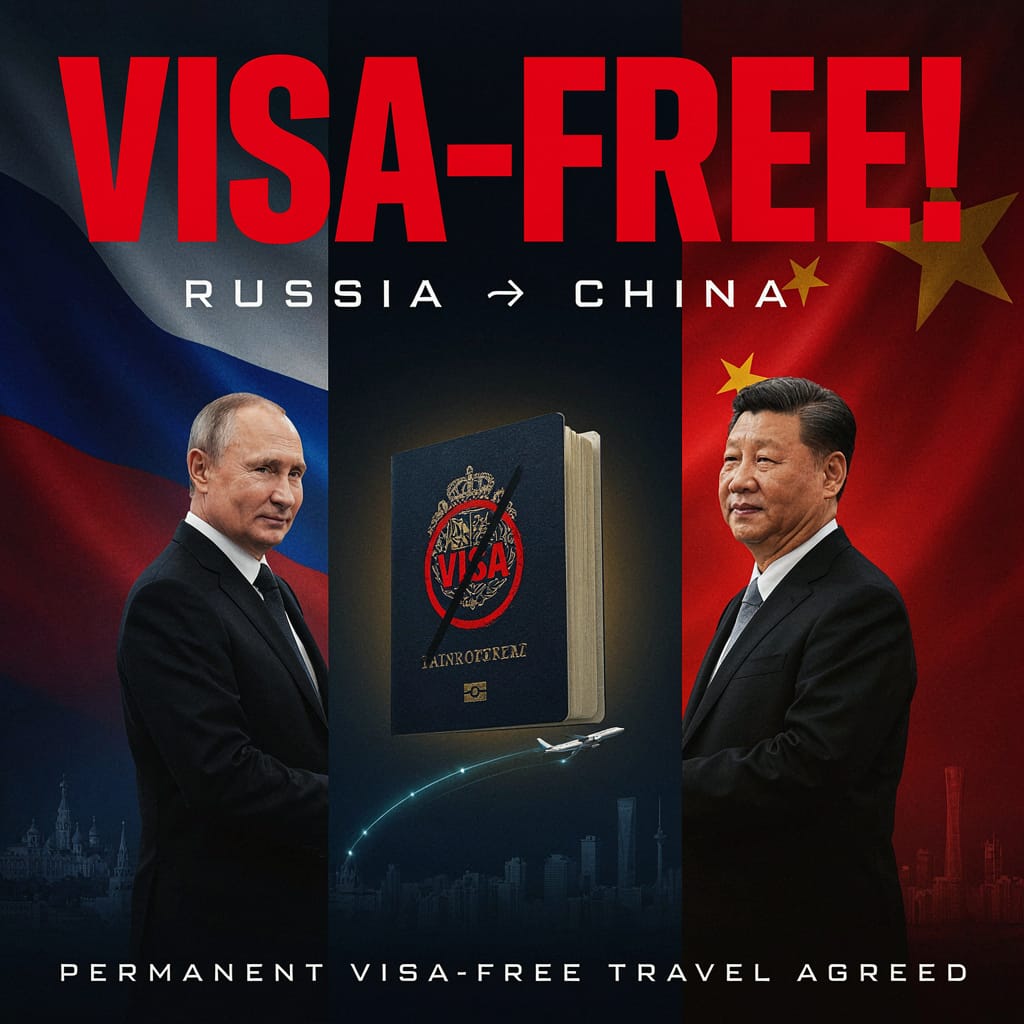
Russian President Vladimir Putin has proposed making the reciprocal visa-free travel regime between Russia and China permanent, signaling a deeper integration of economic and people-to-people ties between Moscow and Beijing. Speaking during a bilateral meeting with Chinese President Xi Jinping on the sidelines of the Shanghai Cooperation Organisation (SCO) summit in Bishkek, Putin stated that Moscow is fully prepared to institutionalize the temporary travel agreement if Beijing views the transition as beneficial. The move follows a dramatic 43 percent increase in cross-border tourist traffic during the first half of 2026, highlighting the rapid expansion of Eurasia’s most significant strategic partnership.
- Proposal Context: Made during the 2026 SCO Summit in Bishkek, Kyrgyzstan, by President Vladimir Putin to President Xi Jinping.
- Current Policy Frame: China introduced visa-free entry for Russian passport holders in September 2025; Russia enacted a reciprocal 30-day visa-free decree in December 2025. Both sides subsequently extended the temporary regime through December 31, 2027.
- Economic Impact: Bilateral tourism grew by 43% year-on-year in the first half of 2026. Chinese visitor arrivals in Russia surged nearly 50% in Q1 2026 alone.
- Regional Implications: Drives broader Eurasian economic realignment, offering potential lessons for regional connectivity initiatives like the China-Pakistan Economic Corridor (CPEC).
Strengthening the ‘No Limits’ Strategic Partnership
The proposal to institutionalize permanent visa-free movement represents a significant leap forward in diplomatic and logistical ties between Moscow and Beijing. Since the escalation of Western sanctions against Moscow in 2022, Russia has aggressively reoriented its economic, trade, and diplomatic focus toward the East. China has emerged as Russia’s dominant trade partner, with bilateral trade volumes surpassing $240 billion.
During their dialogue in Bishkek, President Putin noted: “We are ready to work together to make the visa-free regime permanent, if the Chinese side considers this possible and useful.”
President Xi Jinping echoed the commitment to long-term alliance-building, observing that under joint strategic guidance, the foundation of China-Russia relations will continue to grow stronger despite mounting international turbulence. Making border crossings seamless for up to 30 days per visit shifts bilateral relations from purely high-level government-to-government agreements to direct societal and business integration.
Boom in Bilateral Tourism and Commercial Mobility
The push to eliminate visa barriers permanently is rooted in immediate economic returns. China initially opened visa-free entry for Russian citizens holding ordinary passports in September 2025, allowing short visits for tourism, business, and exchange programs. President Putin responded in December 2025 with a reciprocal executive decree granting Chinese nationals 30-day visa-free access to the Russian Federation.
According to official figures cited by Russian state media, tourist flows jumped 43 percent in the first six months of 2026 alone. Chinese Ambassador to Russia Zhang Hanhui noted that Chinese tourism to key Russian destinations—including Moscow, St. Petersburg, and the Far East—increased nearly 1.5-fold during the first quarter of 2026.
Cross-border trade hubs, such as the Blagoveshchensk-Heihe zone along the Amur River, have reported record border crossings by small-business owners, logistics experts, and academic researchers, illustrating how mobility fuels regional commercial growth.
Western Sanctions and the Accelerated Pivot to Eurasia
The structural shift toward permanent visa-free travel is part of a broader macroeconomic strategy aimed at building alternative infrastructure independent of Western institutions. As traditional European travel corridors remain severely restricted for Russian travelers due to airspace closures and visa bans, Eurasia has become the primary destination for Russian outbound travel and capital allocation.
By consolidating travel access with China, Moscow is securing a steady influx of commercial investment and tourism revenue. For Beijing, easing travel for its citizens provides direct access to Russian markets, agricultural supplies, and energy-sector opportunities. The movement also aligns with efforts by SCO and BRICS member states to conduct bilateral transactions in local currencies, reducing dependence on the US dollar.
What Lies Ahead for the Russia-China Travel Regime
While both nations have already extended their temporary visa-free arrangements through December 31, 2027, converting this framework into a permanent bilateral treaty will require technical alignment. Officials from both foreign ministries are expected to negotiate detailed immigration protocols, biometric sharing standards, and border infrastructure upgrades to support permanently open corridors. If finalized, the agreement will serve as a cornerstone of the Russia-China alliance, embedding bilateral cooperation deep into the civil and economic structures of both nations for decades to come.
President Vladimir Putin’s proposal to make Russia-China visa-free travel permanent underscores how deeply the two powers are intertwining their socio-economic futures. Driven by soaring tourism metrics, expanding cross-border commerce, and mutual geopolitical alignment, the initiative marks another milestone in the creation of a multipolar Eurasian bloc. For regional partners like Pakistan, watching these two neighboring giants dismantle traditional border barriers offers a clear blueprint for the future of regional connectivity and diplomatic integration.