
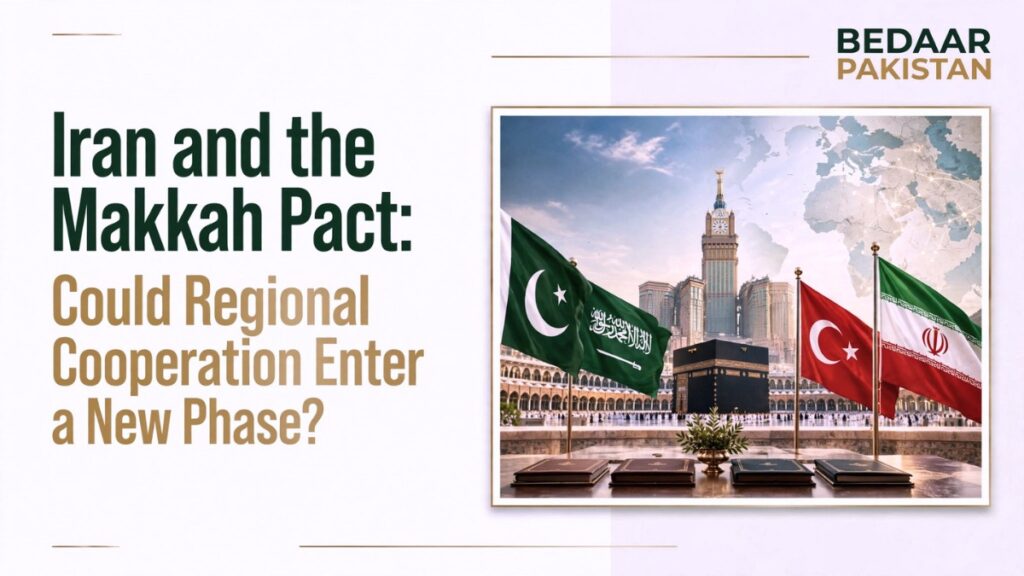
The Makkah Joint Defence Agreement, signed by Pakistan, Saudi Arabia and Türkiye on 7 August 2026, has opened a new conversation about regional security. Now, Iran’s possible participation has added another dimension to that discussion. What began as cooperation among three countries raises a wider question: could the pact create opportunities for broader regional understanding, stronger security and a more stable future?
The Vision Behind the Makkah Pact
Imagine a situation in which a security threat crosses borders and one country’s response affects its neighbours. In such moments, cooperation matters as much as preparation. This is the thinking behind the Makkah Pact, which aims to help Pakistan, Saudi Arabia and Türkiye coordinate their responses to shared security threats.
Yet, bringing countries together on paper is only the first step. The real test begins when they must make difficult decisions, honour their commitments and work towards a common goal. How successfully the three countries turn their agreement into action will shape its future—and influence whether the framework can eventually welcome wider participation.
Iran’s Diplomatic Initiative: A New Opening for Regional Dialogue
Iran’s possible connection with the Makkah Pact began with a statement that left room for a new possibility. An Iranian envoy said Tehran would accept an invitation to join the agreement, although Iran had not formally applied for membership. That distinction matters: the door may be open, but no one has yet confirmed that Iran will walk through it.
If the idea moves forward, the next chapter will depend on discussions between Iran and the pact’s founding members—Pakistan, Saudi Arabia and Türkiye. Each country has its own regional priorities, so finding common ground would take careful diplomacy.
For now, Iran’s role remains uncertain. The coming decisions will determine whether this possibility stays a diplomatic discussion or becomes a meaningful step towards wider regional engagement.
Pakistan’s Diplomatic Role
In a region where political interests often take different directions, Pakistan has an important balancing act ahead. Its defence partnership with Saudi Arabia and Türkiye brings shared commitments, while its neighbouring relationship with Iran calls for continued dialogue. Managing both sides requires careful diplomacy rather than quick decisions.
For Pakistan, every diplomatic meeting offers a chance to keep communication moving. A discussion today may not resolve a disagreement immediately, but it can help countries understand each other’s concerns and leave room for future cooperation. This is particularly important when regional security involves several countries whose decisions can affect one another.
Pakistan’s real opportunity lies in turning its relationships into constructive engagement. How successfully it maintains these connections could influence whether the Makkah Pact remains focused on defence or also creates space for wider regional understanding.
The Challenges of Wider Cooperation
Bringing countries to the same table is one thing; getting them to agree is another. Each nation has its own security concerns and political priorities, and these differences can complicate even the best intentions.
For the Makkah Pact, wider participation would require more than an invitation. The founding members would need to agree on the terms, build trust and decide how countries with different interests could work together. Iran’s willingness to accept an invitation is only one part of that process.
Ultimately, the pact’s strength will depend not on how many countries join, but on how reliably they cooperate when difficult decisions arise.
Beyond Defence: What Regional Cooperation Means for Ordinary People
When tensions rise between countries, the effects can travel far beyond political meetings. A trader may struggle to move goods across a border, a business owner may delay an investment, and a family may feel the pressure of rising costs. Ordinary people often experience regional uncertainty without ever being part of the decisions behind it.
Now imagine neighbouring countries building stronger trade links, improving transport connections and making it easier for businesses to work across borders. Such progress could open new markets, create jobs and encourage investment. These changes would not happen overnight, but steady cooperation could help make them possible.
For the public, the real measure of regional partnership is simple: does it create better opportunities and make everyday life more secure?
The Road Ahead
Every regional partnership eventually reaches a moment when words must give way to action. The meetings end, the statements fade, and countries return to the decisions that shape their relationships. That is where the real story begins.
For the region, the coming months will show whether today’s diplomatic efforts can open doors that once seemed difficult to reach. Progress may be slow, and differences will not disappear overnight, but every meaningful step can create room for a different future.
In the end, the greatest achievement would be a region where cooperation becomes more than a political ambition—a place where future generations inherit stronger relationships, greater opportunities and fewer conflicts.