
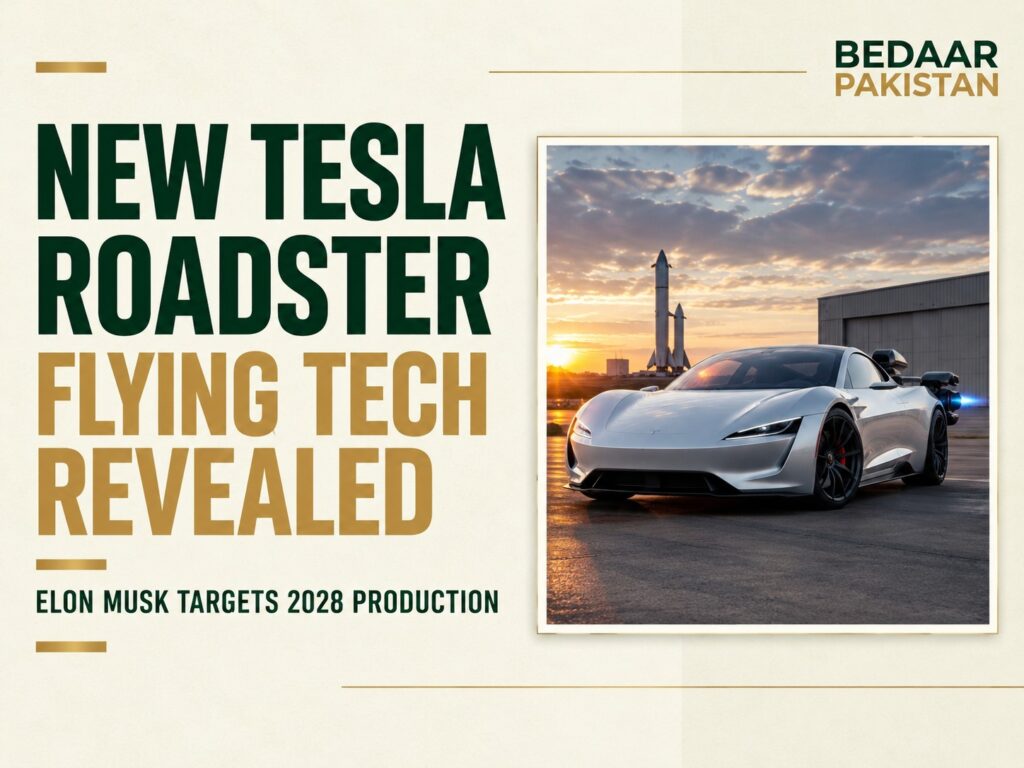
Tesla has unveiled its redesigned Roadster electric sports car in the United States, showcasing technology that allows a demonstration vehicle to lift briefly into the air and perform mid-air manoeuvres. The company says the high-performance vehicle can accelerate from zero to 60 miles per hour in less than one second, while production is planned to begin in 2028. For Pakistani readers following Elon Musk’s latest automotive developments, the launch is significant—but the so-called flying car remains a specialised concept, not a vehicle ready for ordinary road use.
About the New Tesla Roadster
- Unveiled: 15 October 2026, at an event in McGregor, Texas, United States.
- Manufacturer: Tesla, led by Elon Musk.
- Technology: Electric powertrain, with optional SpaceX-developed cold-gas thrusters on specialised versions.
- Claimed acceleration: Zero to 60 mph (approximately 97 km/h) in under one second.
- Claimed top speed: More than 230 mph (approximately 370 km/h).
- Claimed range: More than 300 miles (approximately 480 km) per charge.
- Production target: 2028.
- Confirmed customer delivery date and final retail price: Not announced.
These figures are based on company claims and launch reporting; they should not be treated as independently verified production-car test results.
What Makes Elon Musk’s New Roadster Different?
The new Tesla Roadster is designed as a high-performance electric sports car, but its headline feature is the optional thruster technology developed with SpaceX, Musk’s aerospace company.
During the Texas demonstration, the vehicle performed dramatic manoeuvres, including lifting into the air and turning while airborne. Tesla also showed a suction-based system that helped the car travel upside down along a ramp.
The demonstration is unusual for an electric car, but it does not mean the Roadster can fly like an aircraft. The displayed capabilities involve specialised hardware and short bursts of thrust. The company has not established that the vehicle can safely or legally fly over public roads.
Tesla Roadster Speed, Range and Performance
Tesla’s engineering team has claimed acceleration from zero to 60 mph in less than one second and a top speed above 230 mph. If achieved in a production vehicle under appropriate testing conditions, these figures would place the Roadster among the most extreme performance cars.
Tesla also claims a range exceeding 300 miles, or around 480 kilometres, on a single charge. Actual driving range can vary with speed, temperature, road conditions and driving style.
The figures remain claims rather than independently confirmed results from a customer-ready model. Buyers should wait for production specifications, testing and regulatory information before making comparisons with other electric vehicles.
When Will the New Tesla Roadster Launch?
Tesla has set a 2028 production target for the second-generation Roadster. However, the model has a long history of delays: Tesla first revealed its next-generation Roadster in 2017 and initially expected deliveries to begin in 2020.
The latest unveiling therefore marks a major development, but it does not guarantee that customer deliveries will begin on schedule. Tesla has not provided a confirmed delivery timetable for individual buyers.
The company has described different versions, including a conventional performance model and variants with additional thrust technology. Its Rocket version has been described as invitation-only and not approved for public-road use.
Is the Tesla Roadster Really a Flying Car?
The Roadster’s demonstration has prompted comparisons with flying cars, but that description needs context. Tesla showed a vehicle using cold-gas thrusters to perform brief airborne movements, rather than a conventional aircraft capable of sustained flight.
Regulatory approval is a major hurdle. A vehicle that leaves the ground raises questions about aviation rules, road safety and where such manoeuvres could legally take place. Tesla’s Rocket version has specifically been described as not approved for public-road use.
For now, the Roadster is best understood as an ambitious electric supercar with experimental aerospace-inspired features—not a practical flying vehicle for everyday travel.
What the Tesla Roadster Means for the Future of Electric Cars
The Roadster highlights how electric vehicles are expanding beyond efficiency and everyday transport into extreme acceleration and performance engineering. Its SpaceX-inspired systems also demonstrate how technologies associated with aerospace can influence automotive design. However, the car’s commercial impact will depend on more than a dramatic unveiling. Production readiness, safety testing, final pricing, real-world range and regulatory approval will determine whether the Roadster becomes a viable product for customers
The new Tesla Roadster puts Elon Musk’s vision of extreme electric performance back in the spotlight, combining ambitious speed claims with SpaceX-inspired thruster technology. Yet the distinction between a dramatic demonstration and a production-ready vehicle remains important: manufacturing is targeted for 2028, the final price is unconfirmed, and the flying-capable version faces regulatory barriers.