
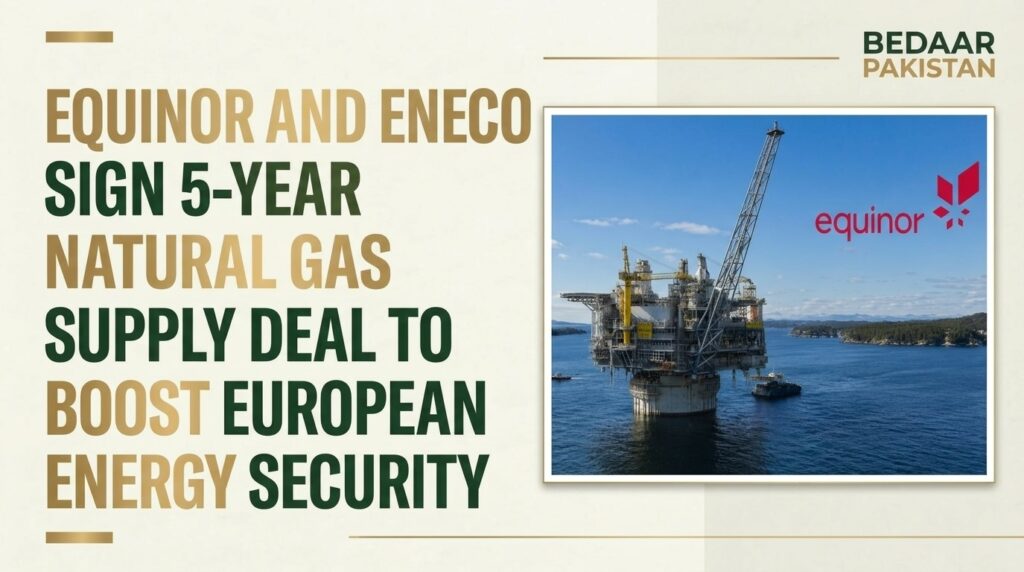
Norwegian state energy giant Equinor and Dutch supplier Eneco have finalized a major five-year agreement for natural gas deliveries across Europe. Deliveries began on October 1, 2026, routing Norwegian gas directly into the Dutch gas grid to power homes and businesses. This long-term contract reinforces Europe’s shift toward pipeline gas imports while offering key market lessons for import-dependent nations like Pakistan.
Expanding European Partnership for Long-Term Energy Supply
Why does this agreement matter? It marks the third major supply contract signed between Equinor and Eneco in 2026 alone. European buyers are moving decisively to lock in structural pipeline supply from reliable neighbors rather than relying entirely on spot-market transactions.
Under the contract, Equinor will deliver around 0.9 bcm of pipeline natural gas each year. Deliveries flow straight from offshore platforms on the Norwegian Continental Shelf through Europe’s interconnected pipeline network. While commercial financial details remain confidential, Eneco confirmed the contract guarantees stable gas supplies for millions of Dutch households and small businesses.
“Across all three agreements, the gas supplied by Equinor includes verified attributes through the Attributes platform, providing documented data on the origin of the gas and its upstream greenhouse gas footprint,” stated Helle Østergaard Kristiansen, Equinor’s Senior Vice President for Gas & Power.
Decarbonization Meets Supply Security in the European Gas Market
Can energy supply be both reliable and low-emission? Europe is trying to prove it can.
A central highlight of the deal is the integration of digital environmental tracking. Equinor uses a dedicated tracking platform to supply independently verified data on the origin and carbon footprint of its gas. Because Norwegian production relies heavily on modern offshore efficiency, the gas carries an upstream emissions intensity roughly 11.8% below the average footprint of the Dutch gas grid.
This focus on verified emissions shows how European utilities balance energy security with strict climate goals. Eneco gets guaranteed physical volumes without compromising its broader corporate decarbonization targets.
Impact on Global Fuel Dynamics and LNG Competition
How does a European pipeline deal affect global fuel availability? Every cubic meter of gas flowing through European pipelines reduces Western demand for spot-market Liquefied Natural Gas (LNG).
When European utilities secure long-term pipeline gas, fewer LNG cargoes are diverted away from Asian markets. Over the past three years, intense European spot-market buying priced out developing Asian nations. Stable European pipeline contracts help stabilize international LNG spot prices, offering indirect price relief to developing importers.
The five-year deal between Equinor and Eneco underscores Europe’s pragmatic path forward: locking down reliable, lower-emission pipeline gas while managing the clean energy transition. By securing 45 TWh over five years, Eneco insulates its retail customers from extreme market swings.
For global energy markets and Pakistani observers, the lesson is clear. Long-term supply planning, rigorous carbon accounting, and strategic trade partnerships remain the bedrocks of modern energy resilience.