
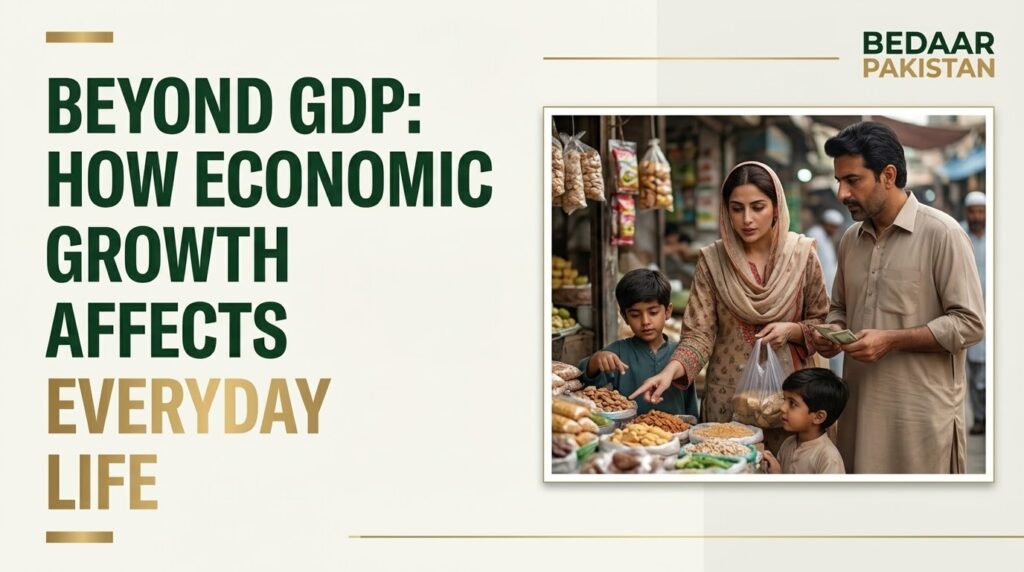
Every morning, a shopkeeper opens his shop, hoping for a good day of sales. Across town, a parent heads to work, planning how to manage the family’s monthly expenses. Like millions of people around the world, both are working towards a better future. Economic growth can expand business activity and create new possibilities, but its effects are best understood through the changes people experience in their daily lives. From the cost of everyday essentials to access to education and healthcare, these experiences help explain what economic progress means beyond national statistics.
What Does Economic Growth Really Mean?
Think of a small bakery that starts with two employees. As more customers arrive, the owner buys new equipment, hires additional staff, and opens a second branch. The bakery is producing more and creating new jobs. When similar progress happens across many businesses, it can contribute to a country’s economic growth.
Economists measure this growth using Gross Domestic Product (GDP), which represents the total value of goods and services produced within a country over a specific period. A rise in GDP generally indicates that economic activity is expanding.
GDP measures the value of economic production, but it does not describe every aspect of life within a country. To understand living standards more fully, economists also consider how income is distributed and whether people can access essential services. These additional measures help explain the difference between economic output and people’s everyday experiences.
Why GDP Alone Cannot Measure Living Standards
Suppose two countries record similar economic growth. Their economic figures may look alike, but the daily experiences of their residents can still be very different. In one country, people may have better access to healthcare and education, while in the other, these services may be less accessible or affordable.
GDP per capita offers another way to understand economic performance. It is calculated by dividing a country’s GDP by its population, giving an average value of economic output per person. However, this figure does not show how income is distributed among people or how much an individual household can actually afford.
For example, a country may have a rising GDP per capita, yet some families may still struggle to manage their expenses. This is why economic performance is often considered alongside indicators such as employment, income levels, housing, healthcare, education and environmental quality.
The Organisation for Economic Co-operation and Development (OECD) recognises the importance of looking beyond economic figures through its well-being framework, which examines different aspects of people’s lives. These measures help provide a broader understanding of how economic and social conditions affect every day experiences.
GDP remains an important measure of economic activity, but combining it with wider well-being indicators offers a more complete picture of a country’s progress.
Reference: OECD — Well-being and Beyond GDP
How Economic Growth Reaches Households
When the bakery opens its second branch, the owner hires another worker to meet growing demand. For the new employee, the job brings a regular salary and a new responsibility: deciding how to use that income to meet every day needs.
As businesses expand, they may create employment and generate income for workers and suppliers. Yet a salary’s value depends partly on what it can buy. If food, rent and transport become more expensive than wages, a worker may find that the same income covers fewer expenses.
The International Labour Organization (ILO) highlights the importance of wages that help workers and their families meet essential needs. This is why employment, wage levels and purchasing power are important when considering how economic growth affects households.
References:
The Role of Education and Skills in Economic Progress
A student learning computer skills today may use that knowledge to design websites, solve problems or develop ideas that were once beyond reach. With the right education and opportunities to practice, a simple classroom lesson can become the starting point for new possibilities.
Education helps people build knowledge, while practical training allows them to apply what they learn in real situations. As technology and industries evolve, opportunities to develop new skills become increasingly valuable for individuals and businesses alike.
The United Nations Development Programme (UNDP) describes human development as expanding people’s abilities, choices and opportunities. From this perspective, progress is not only about producing more goods and services; it is also about helping people develop their potential and use their abilities meaningfully.
Reference: UNDP — Human Development
Economic growth is an important measure of a country’s progress, but GDP alone cannot describe how people experience that progress. Household purchasing power reveals what incomes can afford, while access to education, healthcare and other essential services helps show the wider conditions in which people live. Considered together, these factors provide a fuller understanding of economic development and its significance for everyday life.