
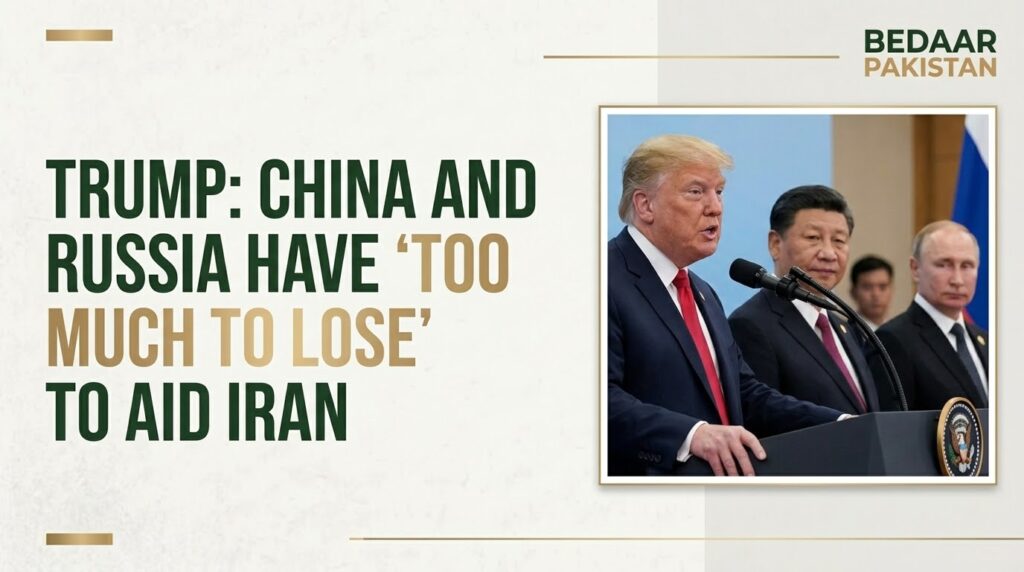
US President Donald Trump has dismissed claims that China and Russia are assisting Iran, stating that both nations have too much to lose and that US intelligence would detect any involvement immediately.
US President Donald Trump has publicly rejected speculation regarding foreign state backing for Tehran. Writing on social media, Trump asserted that Beijing and Moscow are not providing material support to Iran, emphasizing that US intelligence networks would quickly catch any such involvement. The remarks address growing geopolitical discussions regarding international alignments amid regional tensions.
Why does Trump believe Beijing and Russia have too much to lose?
Addressing critics on Truth Social, President Trump dismissed assertions that China and Russia were extending assistance to Iran. He noted that any potential support would likely be minimal, stating that neither nation would risk its broader economic and strategic interests.
- Risk Exposure: Trump stated that both Moscow and Beijing face too much exposure and potential fallout to risk enabling Tehran.
- Intelligence Capabilities: Assuring close monitoring, Trump emphasized that US intelligence would identify any foreign state assistance “very fast”.
- Prior Context: The comments follow previous instances where the administration brushed aside reports concerning foreign entities supplying technological support to regional actors.
What is the broader diplomatic context behind the statement?
The US administration’s assessment comes amid delicate diplomatic maneuvers and fluctuating military tensions involving Iran and Western allies. While international watchdogs and regional analysts routinely scrutinize economic or strategic ties between Tehran and other global capitals, major powers navigate complex balancing acts.
However, Washington’s official stance maintains that neither China nor Russia is actively underwriting operations for Iran.
Conclusion and Outlook
As international diplomatic efforts persist to navigate the regional crisis, Washington’s stance signals a reluctance to broaden the blame circle to other superpowers. While trade ties and diplomatic channels between Tehran, Beijing, and Moscow remain intact, the US executive branch remains confident that deterrence and economic self-preservation will prevent any direct, large-scale material support.