
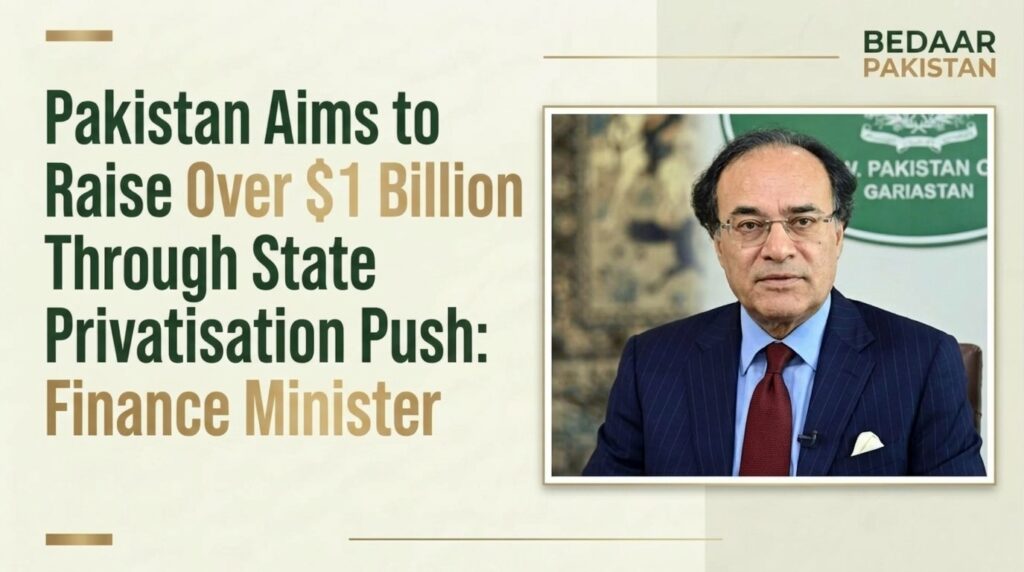
Pakistan’s government plans to raise over $1 billion by successfully privatising five to six state-owned entities during the current fiscal year, according to Finance Minister Muhammad Aurangzeb. Speaking in Bangkok, he emphasized that private sector leadership remains central to the country’s ongoing economic reform agenda.
Pakistan is actively pursuing a renewed economic reform agenda focused on offloading loss-making state assets to bolster public finances. During an interview on the sidelines of the annual meetings of the International Monetary Fund (IMF) and World Bank in Bangkok, Finance Minister Muhammad Aurangzeb outlined the government’s upcoming privatization targets. Despite global macroeconomic headwinds and elevated commodity prices, the administration remains confident in achieving robust economic growth and fiscal stability.
Which State Entities Are Targeted for Privatisation?
Following the successful privatization of the national flag carrier, Pakistan International Airlines (PIA), the government has lined up approximately a dozen additional state-owned entities.
- Pipeline Scope: The government is reviewing about twelve state enterprises in total, with active steps underway for immediate transaction.
- Fiscal Year Targets: Finance Minister Aurangzeb stated that the administration expects five to six of these entities to successfully complete privatization transactions within the current fiscal year.
- Project Types: The pipeline includes state-owned power distribution companies as well as the commercial outsourcing of major airport operations.
Privatization serves as a vital benchmark for evaluating Pakistan’s reform credibility under its ongoing $7 billion, 37-month Extended Fund Facility (EFF) loan program with the IMF. Officials have repeatedly stressed that failing to offload inefficient state assets risks placing renewed strain on national public finances.
Key Economic Highlights and Projections
| Economic Metric / Parameter | Official Detail / Outlook |
| Privatisation Target Value | More than $1 billion |
| Entities Slated for Sale (FY) | 5 to 6 state-owned enterprises (out of ~12 in the pipeline) |
| GDP Growth Forecast | Expected to clock north of 4% for the fiscal year |
| IMF Support Framework | 37-month Extended Fund Facility ($7bn program signed in 2024) |
| External Financing Talks | Ongoing discussions for a proposed $10bn exchange stabilisation facility with the United States |
What Is the Broader Economic Outlook Amid Global Pressures?
While Pakistan remains vulnerable to external shocks—particularly concerning Gulf energy imports and regional trade routes affected by ongoing geopolitical tensions—domestic sectors like agriculture have demonstrated resilience. The country has successfully procured adequate fuel supplies, avoiding domestic shortages.
On the financial front, Aurangzeb confirmed that Pakistan reached a staff-level agreement with the IMF, unlocking roughly $1.21 billion under the EFF and a climate-focused program. Simultaneously, discussions continue with the United States regarding a proposed $10 billion exchange stabilisation facility, alongside ongoing coordination with the Export-Import Bank of the United States and the US International Development Finance Corporation.
The government’s push to raise upwards of $1 billion through targeted privatisations underlines its firm commitment to structural economic reforms and private sector leadership. As transactional milestones unfold over the fiscal year, successful execution will be critical in reducing public sector liabilities and reinforcing long-term investor confidence.